Vermont Quitclaim Deed
County Specific Legal Forms Validated as recently as October 16, 2026 by our Forms Development Team
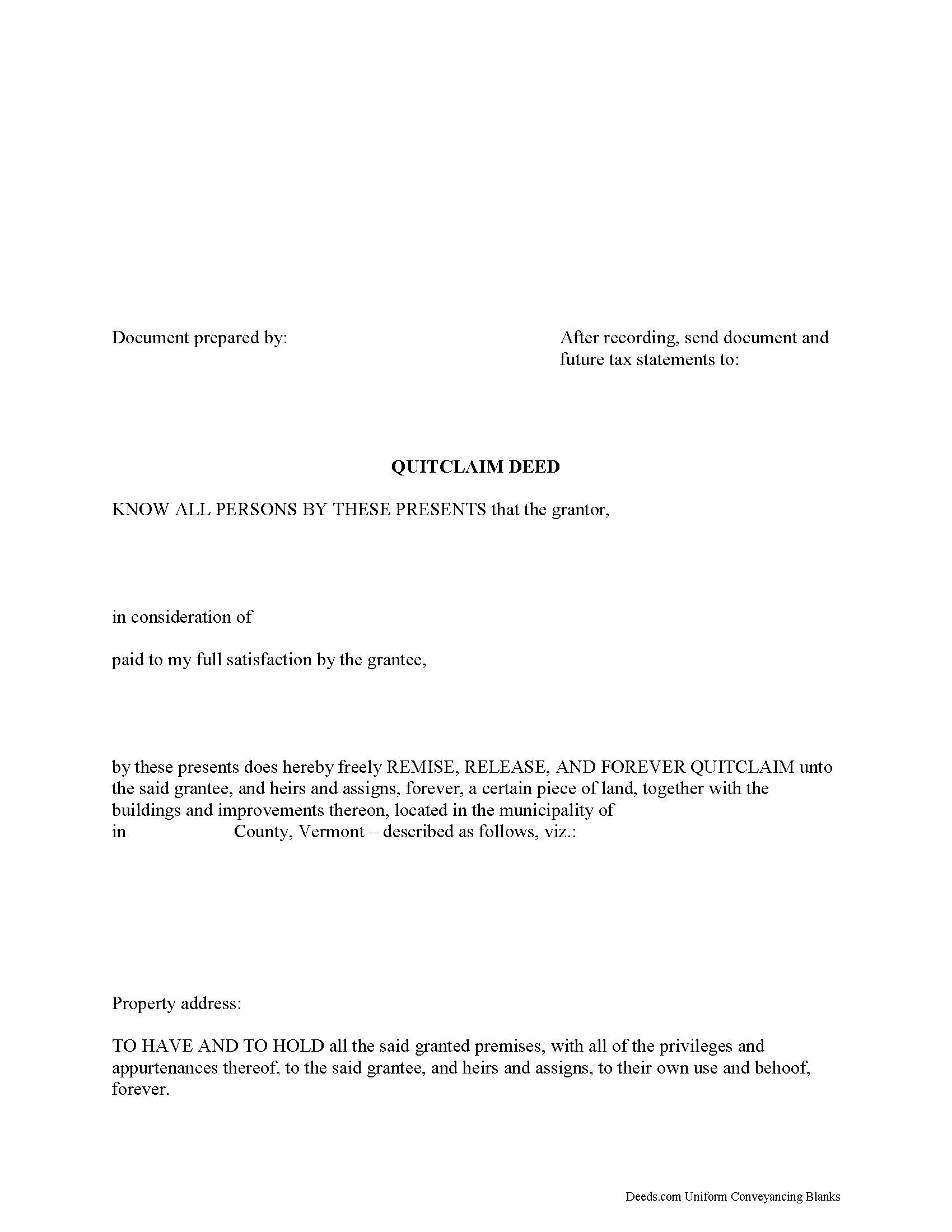
About the Vermont Quitclaim Deed
How to Use This Form
- Select your county from the list
- Download the county-specific form
- Fill in the required information
- Have the document notarized if required
- Record with your county recorder's office
What Others Like You Are Saying
"Easy to use. Good information. Would use again."
"Very fast, efficient, and convenient - thanks Deeds.com! I would recommend this service to everyone …"
"Being a real estate agent I know just enough about legal documents to get in trouble. Thankfully the…"
"Excellent service, great feedback and recommendations by the deed preparer, and I really appreciate …"
"excellent and timely service."
4.8/5 from 4,828 reviews. Read all
Almost nothing on this deed is settled before the parties fill it in. The grantor entry takes one name or two, the grantee entry takes one name or two, and the words fixing how the grantees hold what they receive get typed into a blank rather than printed on the page. This is the Vermont quitclaim deed in its base configuration, natural persons on both sides signing for their own interests, an instrument searchers also spell quit claim deed or quick claim deed.
A deed Vermont never wrote a form for
Vermont authorizes the instrument, then leaves its wording alone. 27 V.S.A. section 301 lets an owner convey by deed; section 341 adds the signature and the notarial acknowledgment. What chapter 5 does not contain is a quitclaim form, or any statute reading covenants of title into an ordinary deed; the one statutory deed form in Vermont law belongs to the enhanced life estate deed at 27 V.S.A. section 660. Express words carry everything, so the operative section states that the grantors remise, release, and forever quitclaim whatever right, title, and interest they hold at delivery, without covenant or warranty of title.
One or two names on each side
The form preprints no party count, no marital status, and no vesting language. A four-line grantor entry accepts one or two individuals with any status recital they write, a matching grantee entry accepts one or two names with any designation Vermont recognizes, and nine numbered sections carry the consideration, the property, the source of title, and matters of record into the operative conveyance. Four count patterns fit one printed page: one grantor to one grantee, one to two, two to one, and two to two. Execution keeps that open shape, a block headed GRANTOR, a second headed SECOND GRANTOR (if applicable), and a certificate under each, so two owners can sign a week apart in different counties while a sole owner leaves the second pair blank. The form is not set up for a signer in a representative capacity, for an agent under a power of attorney, for three or more owners on a side, or for a second block belonging to a spouse joining only to release homestead rights.
The words that decide survivorship
Under 27 V.S.A. section 2, a conveyance to two or more people creates an estate in common unless the instrument says the grantees take jointly, as joint tenants, in joint tenancy, or to them and the survivors of them; conveyances to spouses and to trusts sit outside that default. The section carries a line worth reading twice: Vermont joint tenants may hold equal or unequal interests, and at a joint tenant's death the interest passes to the survivors in proportion to their respective interests rather than in equal parts.
A certificate that can go stampless
27 V.S.A. section 341(a) ends with a line that surprises signers from other states: a Vermont deed acknowledgment is valid without an official stamp affixed to the notary's signature. Certificate content fills the space a stamp would occupy, since 26 V.S.A. section 5367 makes the notary's printed name and commission number part of a tangible certificate, and the short form at section 5368 supplies the operative sentence, that this record was acknowledged before the officer on a stated date by the named individual. Both certificates carry those lines.
What the clerk needs besides the deed
Vermont keeps land records town by town, so the finished instrument goes to the clerk of the municipality where the parcel lies, at fifteen dollars a page under 32 V.S.A. section 1671. It does not travel alone: section 9608 of Title 32 stops a clerk from recording a deed evidencing a transfer until a completed Property Transfer Tax Return, Form PTT-172, and the required Act 250 certificate are in hand, and the return is filed even where a section 9603 exemption leaves nothing to pay. The general rate reaches 1.25 percent of value plus the 0.22 percent clean water surcharge, and the transferee owes it.
What the download contains
The package holds the quitclaim deed as a fillable PDF opening on a non-recorded instructions page, a completed example for a South Hero, Grand Isle County conveyance in which two owners release a surveyed lot to two grantees taking with survivorship, and a plain language guide covering each numbered section, the ways a Vermont grantee may hold title, the homestead statutes, notarization, and recording. The materials describe Vermont law in general terms and are not legal advice.
Important: County-Specific Forms
Our quitclaim deed forms are specifically formatted for each of the 14 counties in Vermont.
After selecting your county, you'll receive forms that meet all local recording requirements, ensuring your documents will be accepted without delays or rejection fees.