West Virginia Warranty Deed (Two Grantors)
County Specific Legal Forms Validated as recently as September 4, 2026 by our Forms Development Team
About the West Virginia Warranty Deed (Two Grantors)
How to Use This Form
- Select your county from the list
- Download the county-specific form
- Fill in the required information
- Have the document notarized if required
- Record with your county recorder's office
What Others Like You Are Saying
"It was so easy to find, download, and use the form I needed. Literally took about 5 minutes and I wa…"
"I found just what I needed at a very good price."
"I believe you need more instruction on the use of the web site. I would type and nothing would appea…"
"Five stars rating for sure. All so easy to download and print from your home computer. I live in rur…"
"I was impressed by the completeness of the package of forms PLUS instructions. Particularly helpful …"
4.8/5 from 4,827 reviews. Read all
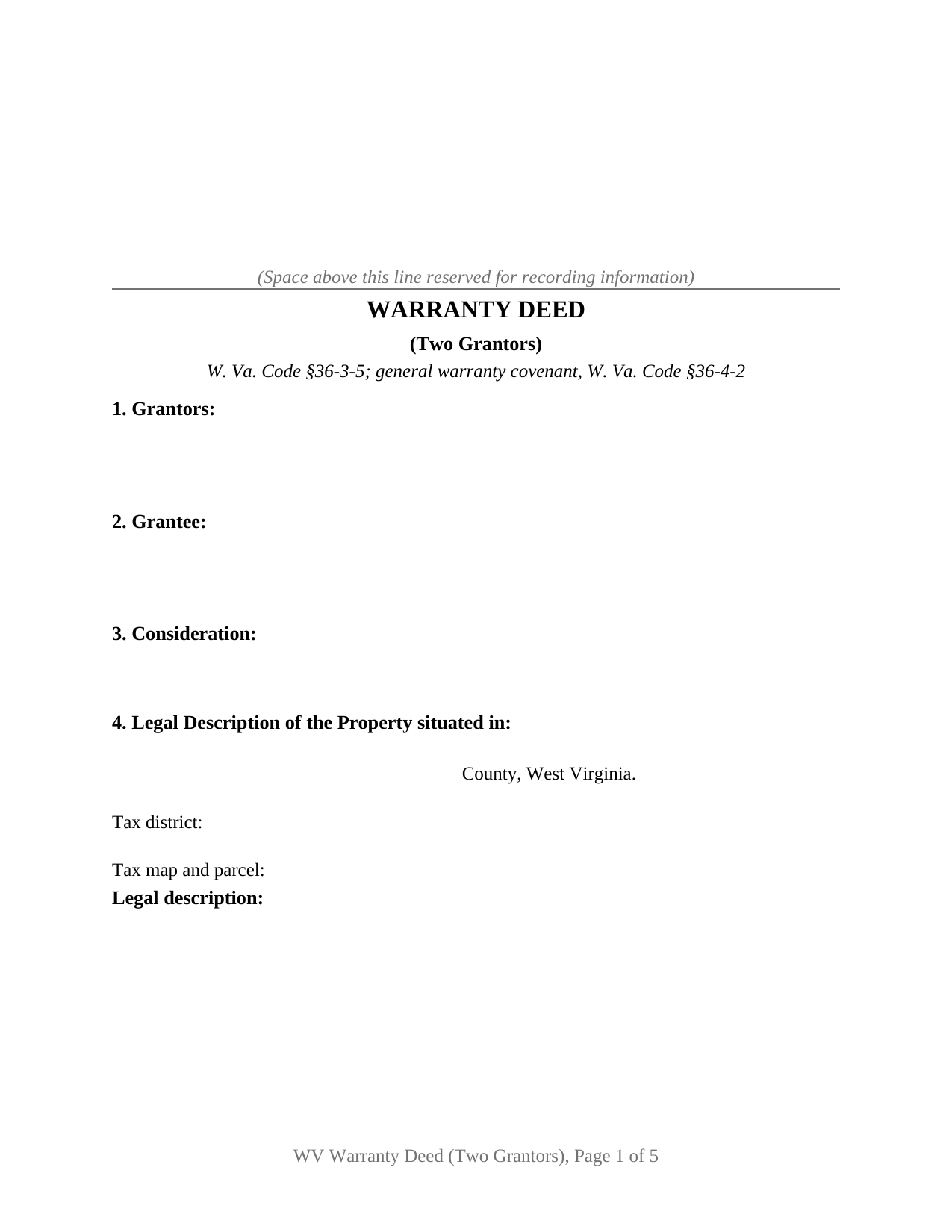
Two record owners sign this West Virginia warranty deed together: the form recites exactly two grantors, prints a signature block for each, and closes with a separate acknowledgment certificate for each signer. It moves the whole title in one instrument, with general warranty, in the co-owner sale a one-owner deed cannot recite.
One deed for two owners
The grantor section names two natural persons, in the style the record carries them, and the operative section states that each grantor conveys that grantor's entire right, title, and interest. Spouses selling a jointly titled house, two siblings passing an inherited tract to a buyer, and co-investors closing out a shared parcel present the two-owner pattern this deed recites. Title held by one person, by an entity, by a fiduciary, or by three or more co-owners presents recital and signature patterns outside this configuration.
Two certificates, one closing or two
No West Virginia statute requires a separate certificate for each signer; the short form certificates of W. Va. Code 39-4-16 hold one or more names. The form carries one certificate per grantor anyway, as a layout choice, so the two owners can acknowledge on different days, before different notaries, even in different states, and the deed still reads cleanly at intake. Each certificate uses the statutory sentence, This record was acknowledged before me on, with the acknowledging grantor's name in its own blank.
Why the second signature is the whole point
West Virginia treats co-owner title in a way that makes both signatures indispensable. Under W. Va. Code 36-1-19, a deceased co-owner's share ordinarily passes like a tenancy in common interest, and survivorship exists only where the instrument satisfies the manifest intent rule of 36-1-20; either way, while both owners live, neither can convey the other's share. A married grantor gets a further point from the same pen stroke: W. Va. Code 43-1-2 directs a married person conveying real estate to notify the spouse, and it names the spouse's signature on the instrument as proof that notice was given, so two spouses signing one deed leave that trail in the record itself.
The covenant both grantors stand behind
West Virginia writes its broadest warranty in shorthand. The granting clause here carries the statutory phrase with general warranty, and under W. Va. Code 36-4-2 that phrase binds the grantors, and after them their heirs and personal representatives, to defend the grantee's title against all claims, reaching back through the entire chain rather than stopping at the grantors' own years of ownership. The deed spells that effect out on its face, so the instrument reads the way the statute operates.
Built to record
A West Virginia deed for consideration records only with its tax paperwork in order, and the form folds the recorded half of that paperwork in: the DECLARATION OF CONSIDERATION OR VALUE of W. Va. Code 11-22-6 appears at the end of the deed with its own signature, interest, address, and date lines. The State Tax Commissioner's sales listing form, Form STC 12:39, is the second half, a separate intake filing handed across the counter with the deed and prepared separately; the county clerk computes the excise stamps, a state rate plus a county rate that differs from county to county, from the declared consideration. The layout keeps the top of page one open for the recording stamp and stays inside the format lines of W. Va. Code 39-1-11.
What arrives in the download
The package holds the two-grantor warranty deed as a fillable PDF, a completed example showing a Monongalia County sale by a married couple filled in from the first blank to the declaration, and a plain language guide walking through each numbered section, both acknowledgments, and the recording steps. The materials are informational and are not legal advice; questions about how a covenant or a co-owner title question plays out on particular land belong with a West Virginia attorney.
Important: County-Specific Forms
Our warranty deed (two grantors) forms are specifically formatted for each of the 55 counties in West Virginia.
After selecting your county, you'll receive forms that meet all local recording requirements, ensuring your documents will be accepted without delays or rejection fees.