West Virginia Warranty Deed
County Specific Legal Forms Validated as recently as September 23, 2026 by our Forms Development Team
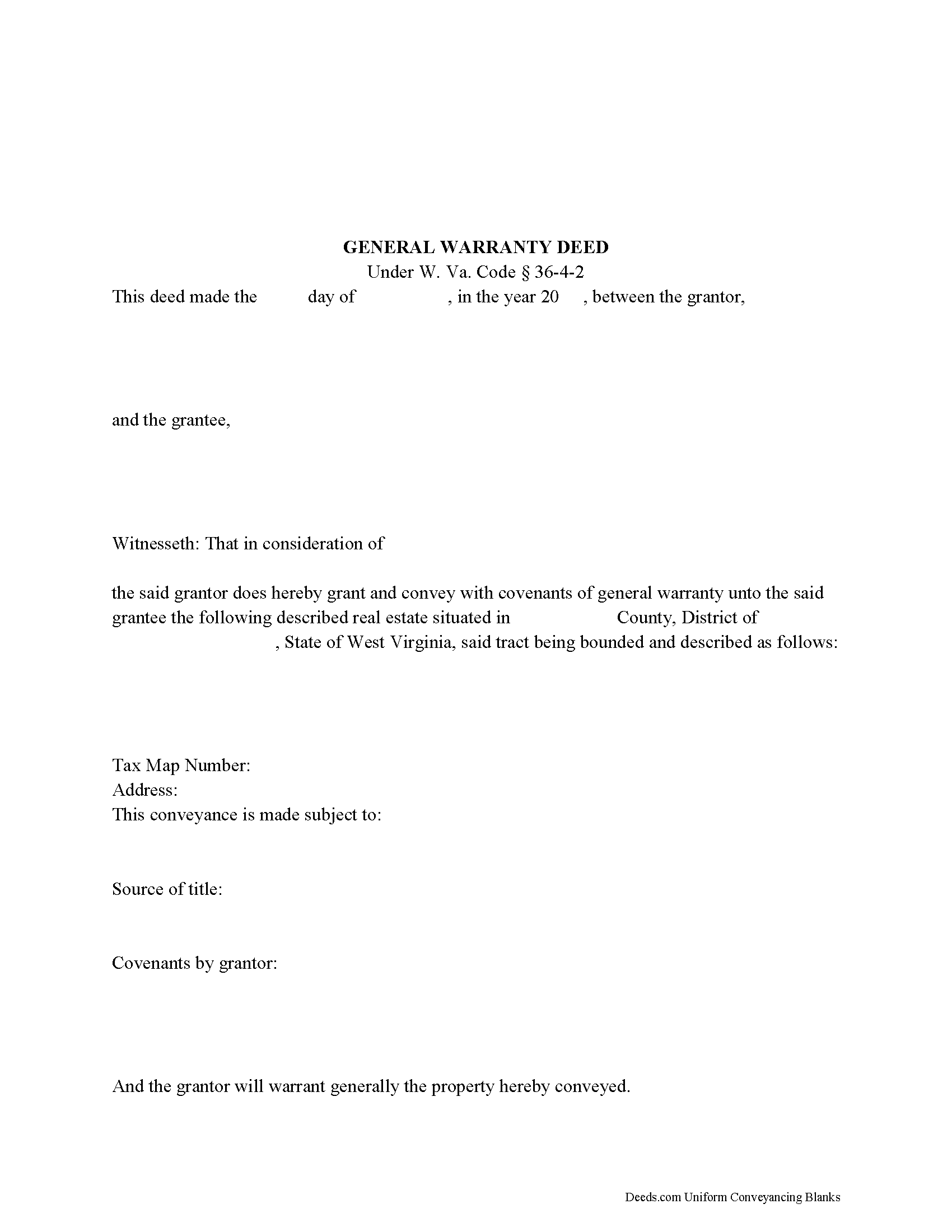
About the West Virginia Warranty Deed
How to Use This Form
- Select your county from the list
- Download the county-specific form
- Fill in the required information
- Have the document notarized if required
- Record with your county recorder's office
What Others Like You Are Saying
"Not sure whether the two forms I printed will be helpful or not. Will find out when I go to a place …"
"The Web site is very intuitive, organized well and forms are easily found. The instructions provided…"
"I was able to easily navigate the interface and purchase the forms that I needed. I was then able to…"
"Very easy. I copied each doc separately. Is there a way to copy the all docs at once into a folder? …"
"Thank you for the comprehensive forms - very much appreciated!"
4.8/5 from 4,815 reviews. Read all
West Virginia decides what a deed does by the words inside it, not by the label on top. This warranty deed is built that way: open name blocks, an open line after the grantee names for the words fixing how the new owners hold, and the general warranty covenant written into the granting sentence under W. Va. Code 36-4-2. It is the base configuration of the state's general warranty deed, one or two natural persons on either side, nothing about status, capacity, or vesting preprinted.
The survivorship words the deed has to say out loud
The grantee line stays open for a reason that surprises drafters from neighboring states. Under W. Va. Code 36-1-19, when a joint tenant or a tenant by the entireties dies, that share passes as though the owner had been a tenant in common, so the familiar labels carry no survivorship of their own. It arrives only where W. Va. Code 36-1-20 is satisfied, where the deed makes it manifestly appear that the share of the one dying belongs to the others. The same section reads co-owners linked by the disjunctive or as holding with survivorship, and W. Va. Code 36-1-20A allows a direct conveyance to the owner and another, no straw party in the middle. Those words belong in the deed rather than on a checkbox, so they are typed after the grantee names.
A conveyance assembled out of covenant words
No official deed form is published in West Virginia. W. Va. Code 36-3-4 retired the distinctions among the old deed types, giving effect to a properly executed and delivered instrument according to its manifest intent. What is left is a menu: Chapter 36, Article 4 fixes the meaning of particular covenant phrases, and the general warranty is the widest, running to the claims and demands of all persons whomsoever, where the special warranty of W. Va. Code 36-4-3 stops at claims arising by, through, or under the grantor.
One form, four party counts
The grantor block takes one name or two, as the record carries them, with any status the signers recite; the grantee block takes one name or two, followed by the vesting words above. Section 9 prints a signature block headed GRANTOR and a second headed SECOND GRANTOR (if applicable), each with its own printed name and date line, and each grantor has an acknowledgment certificate in the short form wording of W. Va. Code 39-4-16; a single owner fills the first of each and leaves the second pair empty. Those four combinations, one or two grantors to one or two grantees, are the counts this configuration recites. A deed executed by a corporation or limited liability company, by a trustee, or by an attorney-in-fact recites the entity, office, or authority behind the signature, and three or more owners run past two signature blocks; those are capacity patterns this configuration omits.
What the counter looks for
Two tax items accompany a taxable West Virginia deed; one is printed inside it. Section 10 carries the declaration of consideration or value in the first alternative wording of W. Va. Code 11-22-6, with blanks for the amount, signer, date, and address. The other is the State Tax Commissioner's sales listing form, Form STC 12:39, which the same statute makes a condition of recording; it is prepared separately and does not come with this package. Stamps run at $1.10 for each $500 of value to the state, plus the additional county excise tax and, where the transfer is for consideration, a $20 Affordable Housing Fund fee.
Where the recording date does the work
A delivered deed already binds grantor and grantee. W. Va. Code 40-1-9 is what makes it hold against a later purchaser for value without notice, and only from the time it is duly recorded with the clerk of the county commission. Section 6 collects the and being recital tying this deed to the one the grantors took under, book and page included, and the layout keeps page one's head clear for the recording stamp.
The download holds the deed as a fillable PDF, a completed example filled from the first blank through the declaration for a Cabell County sale, and a plain language guide covering every numbered section, both certificates, the spousal notice rule of W. Va. Code 43-1-2, and recording. The materials are informational and are not legal advice; a West Virginia attorney can address how the covenant, the vesting words, and the tax filings land on a particular parcel.
Important: County-Specific Forms
Our warranty deed forms are specifically formatted for each of the 55 counties in West Virginia.
After selecting your county, you'll receive forms that meet all local recording requirements, ensuring your documents will be accepted without delays or rejection fees.