Wisconsin Warranty Deed
County Specific Legal Forms Validated as recently as October 6, 2026 by our Forms Development Team
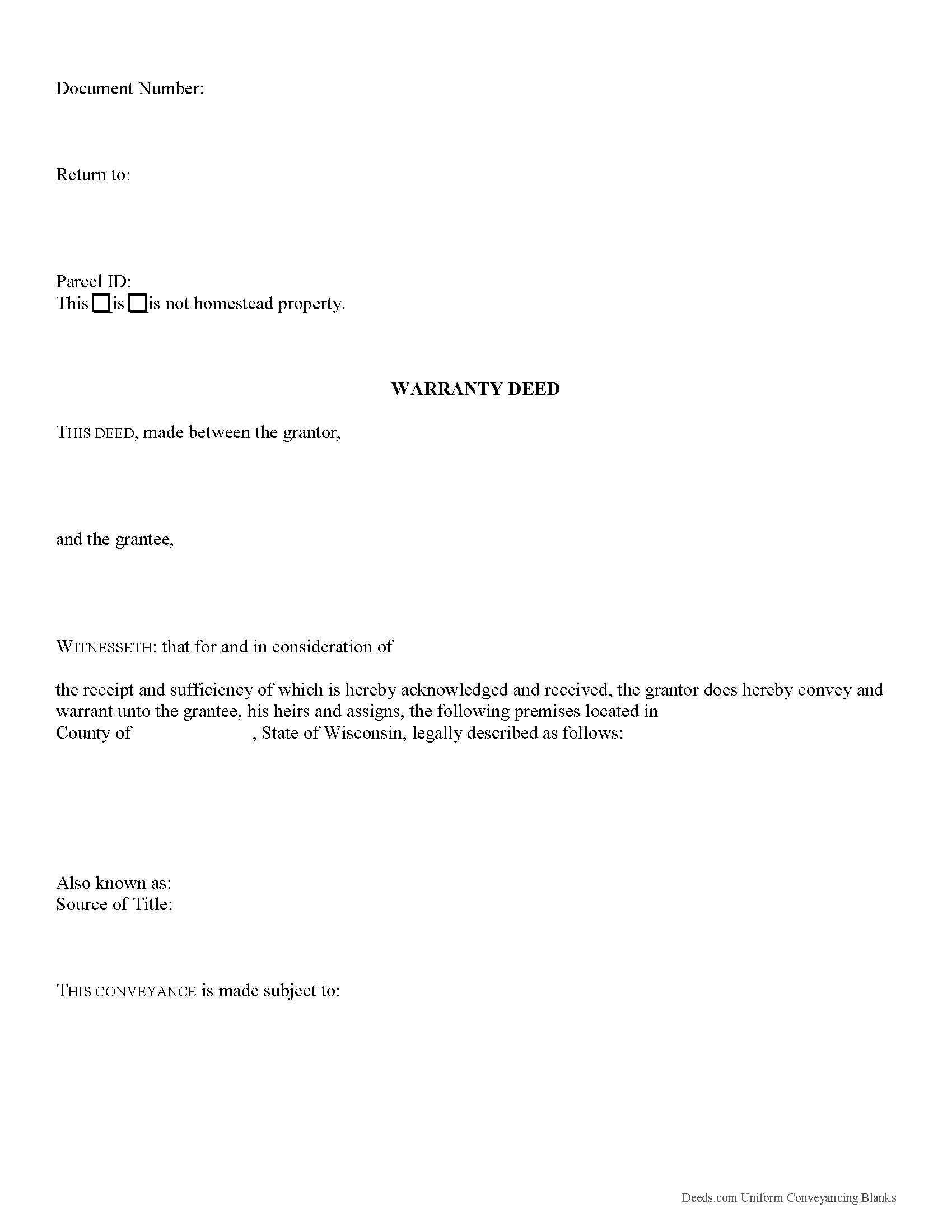
About the Wisconsin Warranty Deed
How to Use This Form
- Select your county from the list
- Download the county-specific form
- Fill in the required information
- Have the document notarized if required
- Record with your county recorder's office
What Others Like You Are Saying
"Easy peazy to find the right forms and they come with instructions and a sample."
"Easy to purchase. Everything you need to get the job done!"
"They were unable to complete the task and my money was immediately refunded."
"I couldn't be happier with this service. They're helpful, quick and thorough. They make filing gover…"
"quick and easy to use"
4.8/5 from 4,828 reviews. Read all
Wisconsin does not legislate a deed form. Wis. Stat. section 706.10(1) keeps the conveyancing forms already in common use and leaves room for shorter ones, so what makes an instrument a warranty deed here is the operative word warrants. The Wisconsin Warranty Deed carries that language in a document formatted for the register of deeds, with free form party blocks for one or two people on each side.
Two words, and the promise behind them
The deed conveys and warrants. That second verb is what section 706.10(5) reads as a covenant package running to the grantee and the grantee's heirs, successors and assigns: the grantor was lawfully seized when the deed was delivered, had good right to convey, passed the land free of encumbrance, and will forever guarantee and defend the title and quiet possession against every lawful claim originating before the conveyance. Buyers search for it as a general warranty deed or full covenant deed, and the reach is what those names suggest: back through the entire chain, not the grantor's own years alone. Section 706.10(6) draws the opposite line: nothing is implied in a Wisconsin conveyance. The promise is as wide as the deed's text, which is what gives the exceptions section its weight.
One form, one or two names on each side
This is the general configuration of the deed. The Grantor and Grantee blocks are free form and preprint no status, capacity, or vesting language, so each holds one or two natural persons signing in their own capacity. Four count patterns record on the same document: one grantor to one grantee, one to two, two to one, two to two. Execution follows that shape, with signature blocks headed GRANTOR and SECOND GRANTOR (if applicable) and an acknowledgment certificate for each; where a single grantor conveys, the second block and its certificate are left blank. Because each certificate stands alone, signers may acknowledge on different dates, before different officers, or in different states. The form recites natural persons only; a conveyance by a company, a trustee, an agent under a power of attorney, or three or more owners follows a different pattern.
Marital property, and the signature that decides validity
Chapter 766 makes Wisconsin a marital property state, a form of community property in which each spouse holds a present undivided one half interest. Apart from classification sits a rule reaching validity itself: under section 706.02(1)(f) a conveyance is invalid unless signed, or joined in by separate conveyance, by each spouse where it alienates any interest of a married person in a homestead, excepting a conveyance directly between spouses. The homestead status section carries the grantors' own statement of that fact, and the second signature block is where a nonowner spouse signs.
How the grantee block reads
Two grantees take title in whatever form the words after their names indicate, and the Wisconsin menu is its own. Chapter 700 supplies tenancy in common, the classification a conveyance lands in when nothing indicates an intent to create a joint tenancy, and joint tenancy, made by phrases the statute lists such as as joint tenants or with right of survivorship. Chapter 766 supplies the spousal forms, where the trap is fine: section 766.60(5)(a) provides that a marital property title form lacking the words survivorship marital property does not establish survivorship. Tenancy by the entirety is not on the Wisconsin list at all.
At the register of deeds
Recording happens in the county where the land lies, for the statewide fee section 59.43(2)(ag)1 sets at thirty dollars per document. The form is built to the format statute: the document name near the top of page one, a blank three inch by three inch recording area in the upper right corner, first page return information, the drafter's name section 59.43(5)(a) makes a condition of recording, and a parcel number line. Format failures here bring refusal rather than a surcharge. A conveyance also travels with the Department of Revenue's electronic real estate transfer return, and the fee of 30 cents per $100 of value falls on the grantor; an exempt conveyance states its exemption on the deed's face by subsection of section 77.25.
The download holds three files: the blank fillable deed formatted for Wisconsin recording, a completed example filled through the second notary certificate for a Brown County transaction, and a plain language guide taking every section with its statutory source. The materials are informational and are not legal advice; questions about a specific Wisconsin title belong with a Wisconsin attorney.
Important: County-Specific Forms
Our warranty deed forms are specifically formatted for each of the 72 counties in Wisconsin.
After selecting your county, you'll receive forms that meet all local recording requirements, ensuring your documents will be accepted without delays or rejection fees.