Wyoming Grant Deed (Individual Grantor)
County Specific Legal Forms Validated as recently as November 10, 2026 by our Forms Development Team
About the Wyoming Grant Deed (Individual Grantor)
How to Use This Form
- Select your county from the list
- Download the county-specific form
- Fill in the required information
- Have the document notarized if required
- Record with your county recorder's office
What Others Like You Are Saying
"Very easy to use. Was able to fill out the forms on my phone."
"this is the only site that helped me out"
"Easy way to get forms that I needed. Would buy again from you if needed."
"this is great because it saves money and gets the job done"
"very user friendly. includes an example you can reference, and explanation of terms, which helps gre…"
4.8/5 from 4,847 reviews. Read all
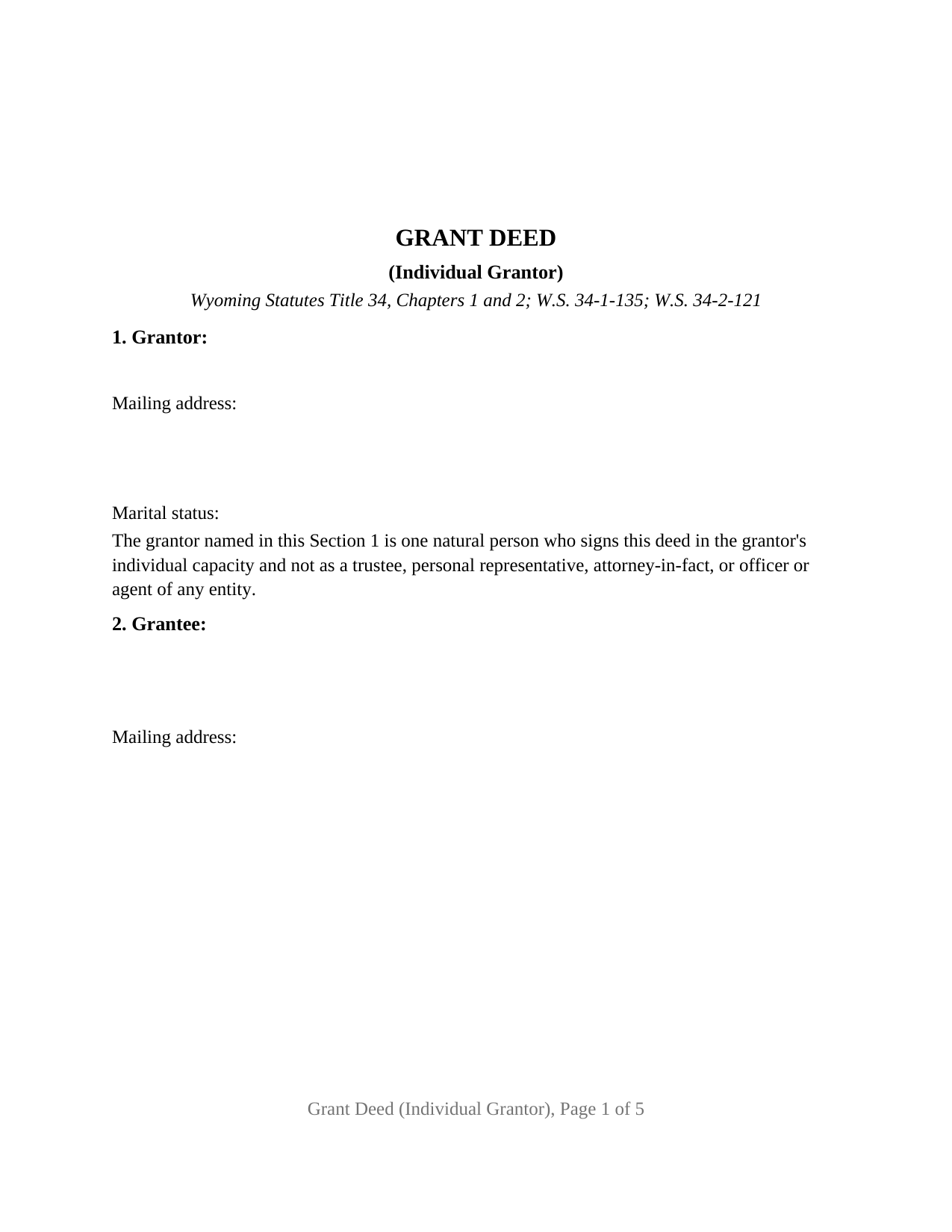
This Wyoming grant deed is drawn for one grantor: a single natural person who signs in the grantor's own right and conveys Wyoming real property with two express promises written into the deed. Section 1 of the instrument names one grantor, asks for that grantor's marital status in a blank, and closes with a printed statement that the grantor is one natural person signing individually and not as a trustee, personal representative, attorney-in-fact, or officer or agent of an entity. Everything else on the form follows from that single-grantor design, including a joinder section reserved for the spouse of a married grantor.
Why the covenants are written out
A grant deed ordinarily carries two covenants: that the grantor has not conveyed the same estate to anyone else, and that the property is free of encumbrances the grantor made, other than those the deed lists. Wyoming Statutes Section 34-1-135 provides that no covenant is implied in a conveyance of real estate other than a conveyance of oil, gas, or other minerals, and Title 34, Chapter 2 prints warranty, special warranty, and quitclaim forms without printing a grant deed. So Section 7 of this deed states both covenants in full, adds a sentence that no covenant is implied and that the grantor's covenants are the ones stated, and cites Section 34-1-135. Section 6 is the place for the matters excepted from the covenant against encumbrances, such as a mortgage that remains on the land, recorded easements, or subdivision covenants. The covenants reach the grantor's own conduct, which is what separates a grant deed from the statutory warranty deed of Section 34-2-102 with its five covenants against the world.
A single grantor and the homestead question
Wyoming has no dower, no curtesy, and no community property, so a sole record owner ordinarily conveys alone. The exception is the homestead. Section 34-2-121 provides that an instrument conveying a homestead shall contain, in substance, the words hereby releasing and waiving all rights under and by virtue of the homestead exemption laws of this state, and shall be freely and voluntarily signed and acknowledged by the owner and the spouse of the owner; a homestead conveyance that fails the rule is void under the statute, with an exception for a conveyance directly from husband to wife. A one-grantor deed therefore has to answer the homestead question without adding a second grantor. This form answers it with Section 8, a joinder in which the undersigned spouse of the grantor joins for the purposes of Section 34-2-121, consents to the conveyance, and releases and waives homestead rights, followed by a signature block headed SPOUSE OF GRANTOR (if applicable) and the spouse's own acknowledgment certificate. The grantor's own release is printed in Section 7, so an unmarried grantor, or a married grantor conveying property that is not the homestead, leaves Section 8 and its block blank and the deed is complete as printed.
The marital status blank in Section 1 has its own statutory reason. Section 34-5-113 provides that a recorded conveyance which contains no release or waiver of homestead, or which does not set forth the marital status of the grantor, is conclusively presumed after ten years of record not to have been a homestead at the time of the conveyance. A deed that states the grantor's marital status and carries the release gives a later title examiner both facts on the face of the record.
What this configuration recites
The form fixes exactly one grantor and prints one GRANTOR signature block, one grantor acknowledgment certificate on the Section 32-3-115 short form, and the Section 1 capacity statement. The spouse joinder is the second signature block and second certificate, used only where Section 34-2-121 reaches the conveyance; the deed carries a separate certificate for each signer so the grantor and a joining spouse may acknowledge on different dates or before different officers, a feature of the form's layout rather than a Wyoming requirement. The grantee side is open: Section 2 receives one or more grantees and any designation of how they hold, and the guide covers each ownership form Wyoming recognizes, from sole ownership and tenancy in common through joint tenancy with survivorship to the tenancy by the entirety that spouse wording creates under Section 34-1-140(b). A sole owner who acquired a home before marriage and now sells it with the spouse's joinder, a widow conveying the family place to a child, and an unmarried owner selling a rental all present the single-grantor pattern this deed recites. The form is not set up as a conveyance by two or more record owners, a trustee's deed, a personal representative's deed, a deed signed under a power of attorney, or an entity conveyance; the Section 1 statement excludes each of those capacities in terms.
At the county clerk
The deed is acknowledged before a notarial officer under Sections 34-1-113 and 34-1-118 and recorded with the county clerk where the land lies, which under Section 34-1-121 makes it notice to later purchasers from the moment of delivery for record. Two statewide prerequisites travel with it: the grantee's mailing address, which Section 34-1-119(a) requires before the clerk records, and the sworn Statement of Consideration of Section 34-1-142, a Wyoming State Board of Equalization form that the grantee or an agent of the grantee swears to; it is prepared separately and is not included in this package, and the clerk may not accept a transfer deed until it is received. The statewide fee under Section 18-3-402 is twelve dollars for the first page and three dollars for each page after it, and Wyoming has no transfer tax. The form's two-inch first-page reserve, one-inch margins, and twelve-point type meet the margin and font rules the larger county clerks publish.
The package includes the fillable Wyoming grant deed for an individual grantor, a completed example prepared for a Natrona County fact pattern in which a married sole owner conveys the family home to a couple as tenants by the entirety with her husband's joinder, and the guide that walks through every numbered section, the homestead joinder, and the recording sequence at the county clerk. This description and the guide explain the form and the Wyoming statutes it rests on in general terms, and neither is legal advice.
Important: County-Specific Forms
Our grant deed (individual grantor) forms are specifically formatted for each of the 23 counties in Wyoming.
After selecting your county, you'll receive forms that meet all local recording requirements, ensuring your documents will be accepted without delays or rejection fees.