Wyoming Grant Deed
County Specific Legal Forms Validated as recently as November 5, 2026 by our Forms Development Team
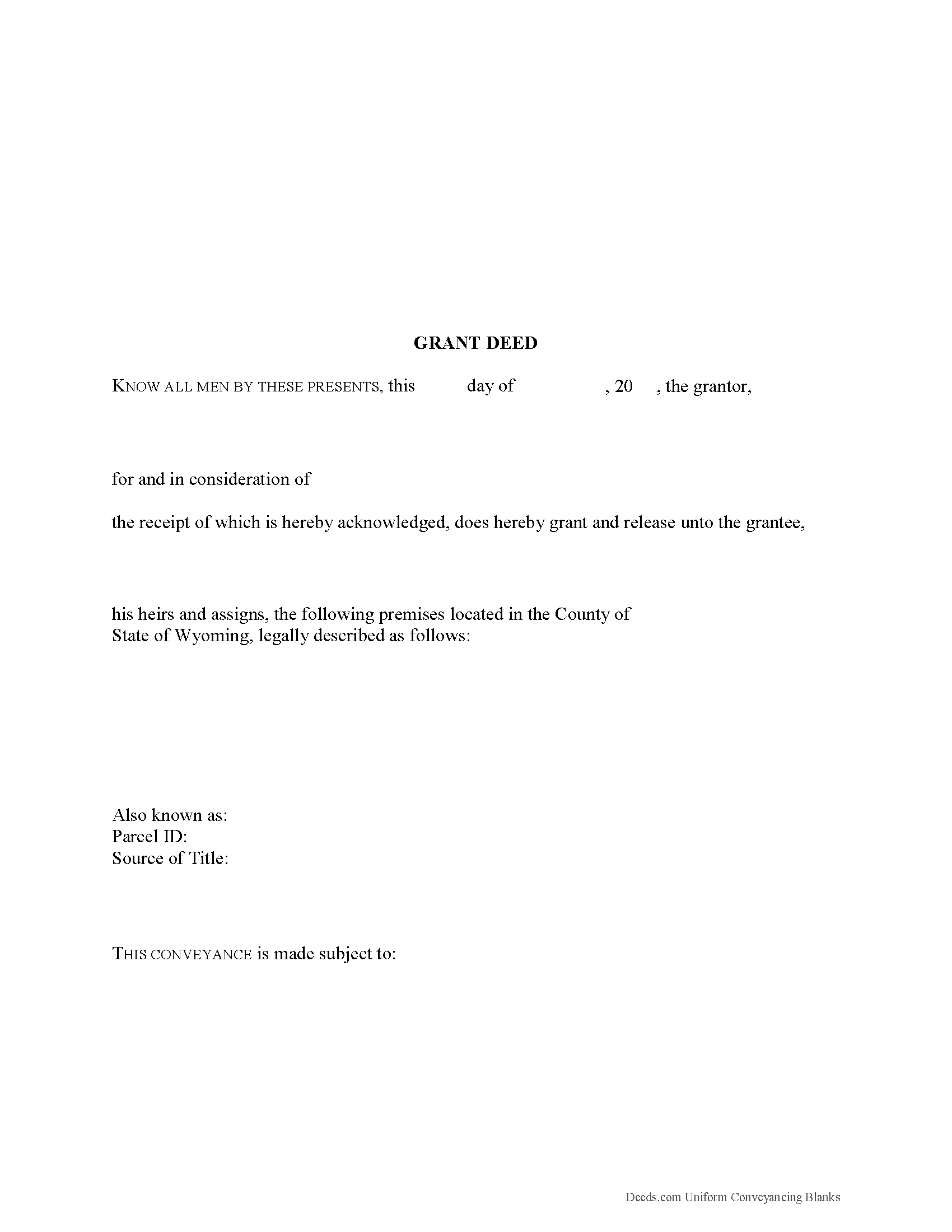
About the Wyoming Grant Deed
How to Use This Form
- Select your county from the list
- Download the county-specific form
- Fill in the required information
- Have the document notarized if required
- Record with your county recorder's office
What Others Like You Are Saying
"The service was fast and professional. So much easier than going to the courthouse. I recommend this…"
"Afficavit worked kind of pricey"
"Easy, fast, and a they even check your work before submitting it. Very convenient service."
"Easy to fill with explanations to accompany"
"Awesome and so easy to use!"
4.8/5 from 4,847 reviews. Read all
A Wyoming grant deed conveys real property with two promises from the grantor: that the grantor has not already conveyed the same estate to someone else, and that the property is free of encumbrances the grantor made, apart from those the deed lists. Where the grant deed is the everyday conveyance, those promises are implied whenever the word grant appears. Wyoming works the other way. Wyoming Statutes Section 34-1-135 provides that no covenant shall be implied in any conveyance of real estate other than a conveyance of oil, gas, or other minerals, so a Wyoming deed carries exactly the covenants written on it. This form writes both grant covenants into Section 7 and cites the statute that explains why.
Two promises, stated rather than implied
Title 34, Chapter 2 prints a warranty deed whose words conveys and warrants carry the five covenants of Section 34-2-103, a special warranty deed limited to claims by, through, or under the grantor, and a quitclaim deed. No printed grant deed form exists, and no section attaches covenants to the word grant, so this form supplies the language: the grantor grants and conveys the property to the grantee and the grantee's heirs, successors, and assigns, then covenants that the grantor has not conveyed the same estate to anyone else and that the property is free from any encumbrance the grantor made or suffered, except the matters listed in Section 6. The covenants reach the grantor's own conduct and not a defect that arose before the grantor took title, which is the line between a grant deed and a full warranty deed. Section 6 is therefore where a mortgage that stays on the land, a recorded easement, or a subdivision declaration is written down: what is listed sits outside the covenant, and what is left off stays inside it.
The homestead release and a married grantor
Section 34-2-121 provides that an instrument conveying a Wyoming homestead contains, in substance, the words hereby releasing and waiving all rights under and by virtue of the homestead exemption laws of this state, signed and acknowledged by the owner and the owner's spouse, with an exception for a conveyance directly from husband to wife. The deed carries that wording in Section 7, and a spouse who holds no record title joins a homestead conveyance by being named in Section 1 and signing the second block. Section 34-5-113 adds a quieter reason the marital-status recital appears in Wyoming deeds: after ten years of record, a conveyance with no homestead release and no marital status is conclusively presumed not to have conveyed a homestead.
One or two people on each side
This is the base configuration of the Wyoming grant deed line, drawn for natural persons signing in their own capacity. The Grantor(s) and Grantee(s) blocks are free-form, each holding one or two names, so one instrument carries four count patterns, from one owner to one buyer through two to two. Nothing about marital status, existing vesting, or capacity is preprinted; the grantee entry carries whatever designation the parties choose, and the guide walks through sole ownership, tenancy in common, joint tenancy with right of survivorship, and the tenancy by the entirety that Section 34-1-140(b) deems created by the words husband and wife or spouses. The deed carries two grantor signature blocks and a separate acknowledgment certificate for each signer on the Section 32-3-115 short form, so two grantors may acknowledge on different dates or before different officers. The form is not set up as an entity conveyance, a trustee's deed, a deed signed under a power of attorney, or a conveyance by three or more owners.
What the clerk receives
The signed and acknowledged deed goes to the county clerk of the county where the land lies, with the statewide recording fee of Section 18-3-402 and the grantee's mailing address that Section 34-1-119 requires. Section 34-1-142 adds the sworn Statement of Consideration, a separate state form completed by the grantee or the grantee's agent and prepared apart from this package, without which the clerk may not accept a transfer deed. Wyoming imposes no transfer tax.
The package includes the fillable grant deed, a completed example prepared for a Laramie County fact pattern, and the guide that walks through every numbered section, the covenants, and the recording sequence. This description and the guide describe the form and the governing Wyoming statutes in general terms; they are not legal advice.
Important: County-Specific Forms
Our grant deed forms are specifically formatted for each of the 23 counties in Wyoming.
After selecting your county, you'll receive forms that meet all local recording requirements, ensuring your documents will be accepted without delays or rejection fees.