Wyoming Grant Deed (Married Couple as Grantors)
County Specific Legal Forms Validated as recently as November 10, 2026 by our Forms Development Team
About the Wyoming Grant Deed (Married Couple as Grantors)
How to Use This Form
- Select your county from the list
- Download the county-specific form
- Fill in the required information
- Have the document notarized if required
- Record with your county recorder's office
What Others Like You Are Saying
"The sample completed form was a big help. While not exactly on point with my situation, it was enoug…"
"I was looking for a certain form I needed. Deeds.com had the necessary form and I was able to purcha…"
"The form was easy to fill out. The only problem I had was on the Notary page I live in a different s…"
"So fare easy and straight forward"
"How easy was this. I was pleasantly surprised by the speed and price. Saved me several days of snail…"
4.8/5 from 4,847 reviews. Read all
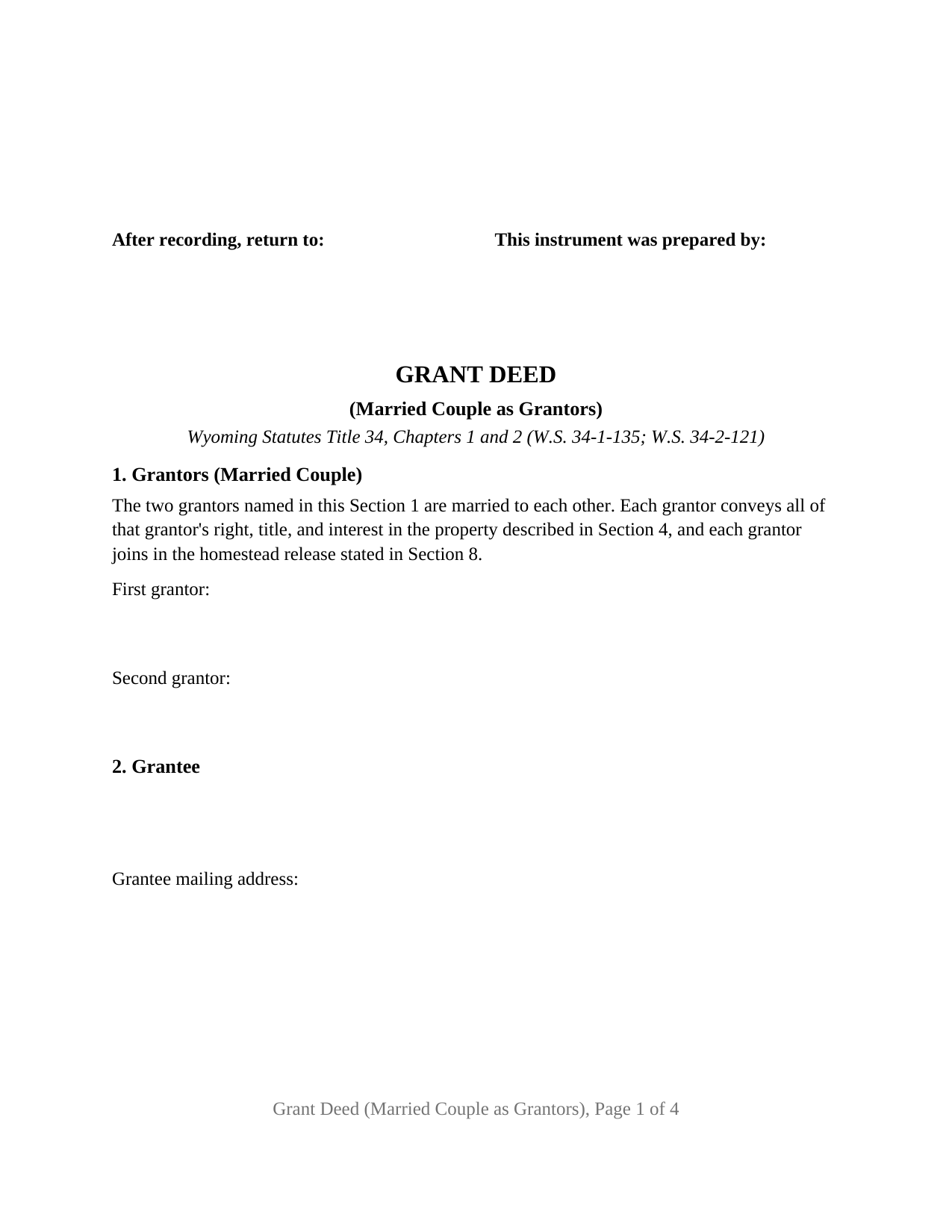
When two spouses sign the same Wyoming grant deed, the question that Wyoming Statutes Section 34-2-121 puts to every conveyance of a homestead is answered on the face of the instrument. That section makes a deed conveying a homestead void unless it carries, in substance, a release of the homestead exemption and is freely and voluntarily signed and acknowledged by the owner and the owner's spouse. This form is the grant deed for that execution pattern: it recites in Section 1 that the two grantors are married to each other, it carries a FIRST GRANTOR and a SECOND GRANTOR signature block, it prints the statutory release as fixed text in Section 8, and it closes with an acknowledgment certificate for each spouse. A married couple conveying Wyoming real property to a buyer, a relative, or a trust signs one deed and leaves nothing about the homestead to inference.
Both spouses sign, so the homestead question is settled on the page
Wyoming has abolished dower and curtesy (Section 2-4-101(b)), and Section 34-1-108 provides that a married woman may convey her real estate as if she were unmarried, so marriage alone adds no signature to a Wyoming deed. The homestead rule is the exception, and it turns on occupancy rather than on whose name appears in the record: the owner and the spouse of the owner both sign and acknowledge, whether the spouse holds record title or not. Because this deed names both spouses as grantors and conveys all of the right, title, and interest of each, the second signature reaches whatever interest the second spouse holds, including the homestead interest, without the deed having to recite who is on title. Where the property is not a homestead, the release and the second signature take nothing away. Where it is, they are exactly what the statute asks for, and the fixed wording in Section 8 tracks the statute: the grantors hereby release and waive all rights under and by virtue of the homestead exemption laws of this state.
What two grantors promise
A grant deed carries two covenants, and in Wyoming they have to be written down, because Section 34-1-135 implies no covenant in a conveyance of real estate outside the oil, gas, and mineral context. Section 8 of this deed states them for both spouses: that the grantors have not conveyed the same estate, or any interest in it, to anyone other than the grantee, and that the property is free from encumbrances the grantors made or suffered, or that anyone claiming under them made, apart from the matters listed in Section 7. The same section then says that no covenant other than those stated is made or implied, so the deed's own text closes the question the statute leaves open. The covenants are narrower than the five that Section 34-2-103 attaches to the words conveys and warrants in a Wyoming warranty deed, and broader than a quitclaim, which carries none. Spouses who took title together and are now conveying together can make these promises about their own period of ownership without warranting the chain of title before them.
A recital of marriage, and what it does and does not do
Section 1 of the deed fixes the grantors' status as married to each other. That recital serves two recording purposes Wyoming law identifies. The first is Section 34-2-121 itself, which speaks of the owner and the spouse of the owner, so a deed that names both and states their relationship shows on its face why two people signed. The second is Section 34-5-113: a conveyance of record for ten years in which there is no homestead release, or in which the grantor's marital status is not set forth, is conclusively presumed not to have conveyed a homestead, a presumption that a deed carrying both the release and the status does not depend on. What the recital does not do is prove the marriage. Section 34-2-127 provides that recitals in a written instrument have no greater effect than they have had in writings not under seal; the recital is the grantors' statement of their status, and the guide describes it that way.
The configuration this deed recites
The deed recites exactly two grantors, each a natural person signing in that person's own right, married to each other. Spouses who hold Wyoming property as tenants by the entirety, the form that Section 34-1-140(b) deems created when a deed names grantees as husband and wife or spouses, present this pattern whenever they sell, because neither spouse can convey an entirety estate alone, a rule the Wyoming Supreme Court restated in Lewis v. Wolfe, 2026 WY 63. Spouses who hold as joint tenants or as tenants in common present it because each holds an interest to convey. A couple where one spouse holds record title and the other joins for a homestead presents it as well, since the deed conveys each grantor's interest without stating what that interest is. The grantee block is free-form and holds one or two grantees with whatever designation the parties write; the completed example conveys to a second married couple as tenants by the entirety. The form is not drawn as a single-grantor deed, a deed by unmarried co-owners, a conveyance from one spouse to the other, an entity or trustee conveyance, a deed signed under a power of attorney, or a conveyance by three or more owners.
Two certificates, one deed
Each spouse acknowledges before a notarial officer, as Section 34-1-113 provides for every deed, and the form carries two acknowledgment certificates on the Section 32-3-115 short form, one captioned for each grantor. The two certificates are the form's design, not a Wyoming requirement; the statutory short form names the person or persons acknowledging, so one certificate may serve both spouses when they appear together. Two certificates let the spouses acknowledge on different days, before different officers, or in different states, which is the situation of a couple who no longer live under one roof or who sign while traveling. Section 32-3-106 gives an acknowledgment taken before a notary of another state the same effect as one taken in Wyoming.
At the county clerk's counter
The deed is recorded with the county clerk of the county where the land lies, with the statewide fee of Section 18-3-402, which is twelve dollars for the first page and three dollars for each page after it, and with the grantee's mailing address, which Section 34-1-119(a) directs the clerk to receive before recording and which the deed carries in its own blank. Section 34-1-142 adds the sworn Statement of Consideration, a confidential state form completed by the grantee or the grantee's agent and prepared separately from this package; the clerk does not accept a transfer deed without it. The guide walks through each of these steps, the exemption classes that let the consideration figure be omitted from the statement, and the first-page margin that Natrona and Sweetwater Counties publish, which the form's two-inch first-page reserve meets.
The package includes the fillable grant deed for a married couple as grantors, a completed example prepared for a Natrona County fact pattern in which two spouses convey a Casper lot to a second couple, and the guide that walks through every numbered section, the covenants, the homestead and marital analysis, and the steps at the clerk's counter. The description on this page and the guide explain the form and the Wyoming statutes that govern it in general terms only; neither is legal advice.
Important: County-Specific Forms
Our grant deed (married couple as grantors) forms are specifically formatted for each of the 23 counties in Wyoming.
After selecting your county, you'll receive forms that meet all local recording requirements, ensuring your documents will be accepted without delays or rejection fees.