Wyoming Personal Representative Deed (Administrator)
County Specific Legal Forms Validated as recently as November 11, 2026 by our Forms Development Team
About the Wyoming Personal Representative Deed (Administrator)
How to Use This Form
- Select your county from the list
- Download the county-specific form
- Fill in the required information
- Have the document notarized if required
- Record with your county recorder's office
What Others Like You Are Saying
"Great service continues! Thanks again!"
"Great job, Deeds.com! I'm a retired lawyer, and I'm liking what I see. Well done."
"Your documents were very helpful. I went ahead and filled in all the info for the Release of Lien do…"
"Very happy"
"The process was easy and reasonable. My only problem was that, when I filled out my form on the comp…"
4.8/5 from 4,849 reviews. Read all
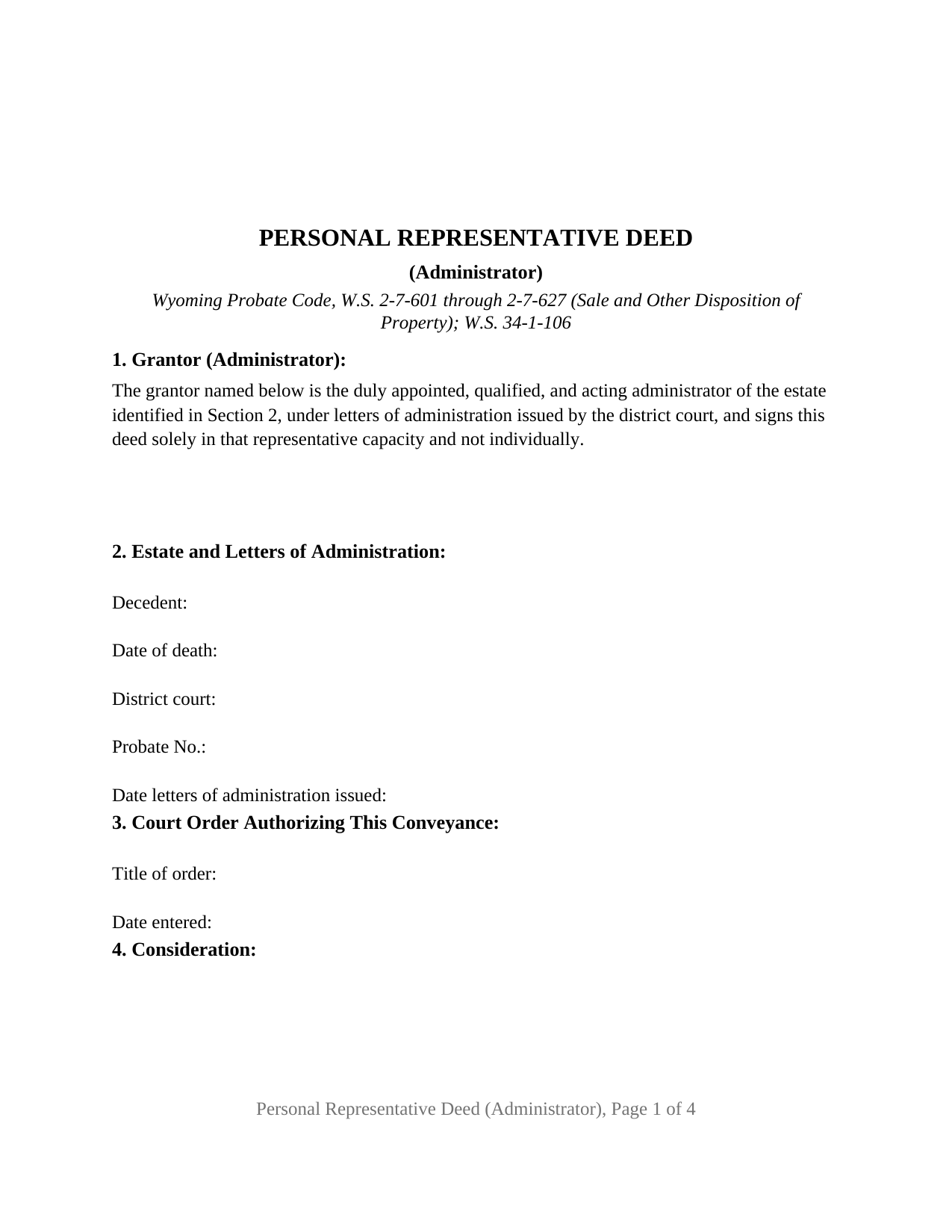
When a Wyoming resident dies without a will, the district court appoints an administrator, and the administrator sells real property of the estate only with the court's authority. This Wyoming Personal Representative Deed (Administrator) is the deed that completes such a sale: the administrator, holding letters of administration, conveys the estate's interest in the property to the buyer under the court's order confirming the sale.
A deed that rests on a court order, not a will
An executor acting under a will may hold a power of sale that Wyoming Statutes section 2-7-609 says removes the statutory sale requirements. An administrator of an intestate estate has no will and no such power, so the sale follows Title 2, Chapter 7, Article 6 of the Wyoming Statutes from petition to confirmation. The administrator petitions the court, describing the property and the reasons for the sale (W.S. 2-7-614); the court sets a hearing with notice to the heirs and other interested persons and may order the sale at the price and on the terms it authorizes (W.S. 2-7-615); the order describes the property and may direct a private sale or a public auction (W.S. 2-7-621). After the sale the administrator files a verified report, and the court, if satisfied that the price and terms were advantageous to the estate and the sale conformed to law, confirms it and orders the administrator to deliver a deed (W.S. 2-7-624). That order is the authority the deed recites.
The deed on this form identifies that order by its title and the date it was entered, and it identifies the estate by the decedent's name, the district court, the probate number, and the date the letters of administration issued. When the deed is recorded, a certified copy of the order is filed with it (W.S. 2-7-626); the certified copy is obtained from the clerk of the district court separately and is not included in this package. Once recorded, the conveyance is protected from collateral attack on account of an irregularity in the proceedings that did not deprive the court of jurisdiction (W.S. 2-7-620).
What the administrator conveys
The operative paragraph grants, sells, and conveys to the grantee all of the right, title, and interest in the property that the decedent held at the time of death and that the estate holds, together with the improvements and appurtenances, subject to the exceptions and matters of record the deed lists. The administrator signs in a representative capacity only and not individually, and the deed states that it carries no covenant of warranty; under W.S. 34-1-135 no covenant is implied in a Wyoming conveyance of real estate, so the grantee takes the estate's interest as it stands, with liens, easements, and restrictions of record riding with the land. The guide explains why a fiduciary's deed is written this way and what the court order, rather than a warranty, supplies to the buyer.
The administrator configuration
This deed recites exactly one grantor: an individual appointed administrator of an intestate estate under letters of administration issued by a Wyoming district court, conveying under an order of that court. A fixed recital at the top of the first section identifies the signer as the duly appointed, qualified, and acting administrator of the estate, signing solely in that representative capacity; the administrator's name and mailing address are the only entries beside it. The form carries one signature block, headed GRANTOR (ADMINISTRATOR), and one acknowledgment certificate in the representative-capacity short form Wyoming's notarial statute prints (W.S. 32-3-115(a)(ii)). The grantee section takes one or more grantees with any designation of how they will hold title, and the guide's section on co-ownership describes the tenancy in common default, joint tenancy with right of survivorship, and the tenancy by the entirety that spouse wording creates under W.S. 34-1-140(b). The form is not set up as a deed by co-administrators, by an executor acting under a will, by an administrator with the will annexed, or by a special administrator, and it is not a deed of distribution under a final decree; each of those recites a different authority or a different signature pattern.
Recording in Wyoming
The deed is recorded with the county clerk of the county where the land lies, and Wyoming's statewide recording fee under W.S. 18-3-402(a)(xvi) is twelve dollars for the first page and three dollars for each additional page; the state imposes no deed transfer tax. Two companions travel with the deed to the counter. The first is the certified copy of the confirmation order described above. The second is Wyoming's sworn Statement of Consideration under W.S. 34-1-142, signed by the grantee or the grantee's agent and reporting the price and terms of the sale to the county assessor, without which the clerk may not accept a transfer instrument for recording; it is a separate State Board of Equalization form prepared separately and not included in this package. The clerk also records no document until the grantee's address is furnished (W.S. 34-1-119(a)), and the deed's grantee section carries a mailing address entry for that reason. The form is built with a two inch recording reserve at the top of the first page, one inch margins elsewhere, and 12 point type, which meets the formatting conventions the larger Wyoming county clerks publish for their scanners.
Searching for the right name
Buyers, title companies, and families searching for this document use several names for it: a Wyoming administrator's deed, a probate deed, an estate deed, or a personal representative's deed. Wyoming's probate code uses the last of these; W.S. 2-1-301 defines a personal representative to include both an executor and an administrator, and this form is the administrator's version of the personal representative deed.
The package includes the fillable personal representative deed, a completed example filled in for a Natrona County estate sale, and the guide that walks through every numbered section, the court procedure behind the deed, the notarial certificate, and the recording steps. This description and the guide describe the form and the governing Wyoming statutes in general terms; they are not legal advice.
Important: County-Specific Forms
Our personal representative deed (administrator) forms are specifically formatted for each of the 23 counties in Wyoming.
After selecting your county, you'll receive forms that meet all local recording requirements, ensuring your documents will be accepted without delays or rejection fees.