Wyoming Personal Representative Deed (Executor)
County Specific Legal Forms Validated as recently as November 11, 2026 by our Forms Development Team
About the Wyoming Personal Representative Deed (Executor)
How to Use This Form
- Select your county from the list
- Download the county-specific form
- Fill in the required information
- Have the document notarized if required
- Record with your county recorder's office
What Others Like You Are Saying
"Very Convenient and easy to use"
"Quick and easy!"
"Very fast and professionally handled."
"Always helpful!"
"Easy to create an account! Awesome!"
4.8/5 from 4,849 reviews. Read all
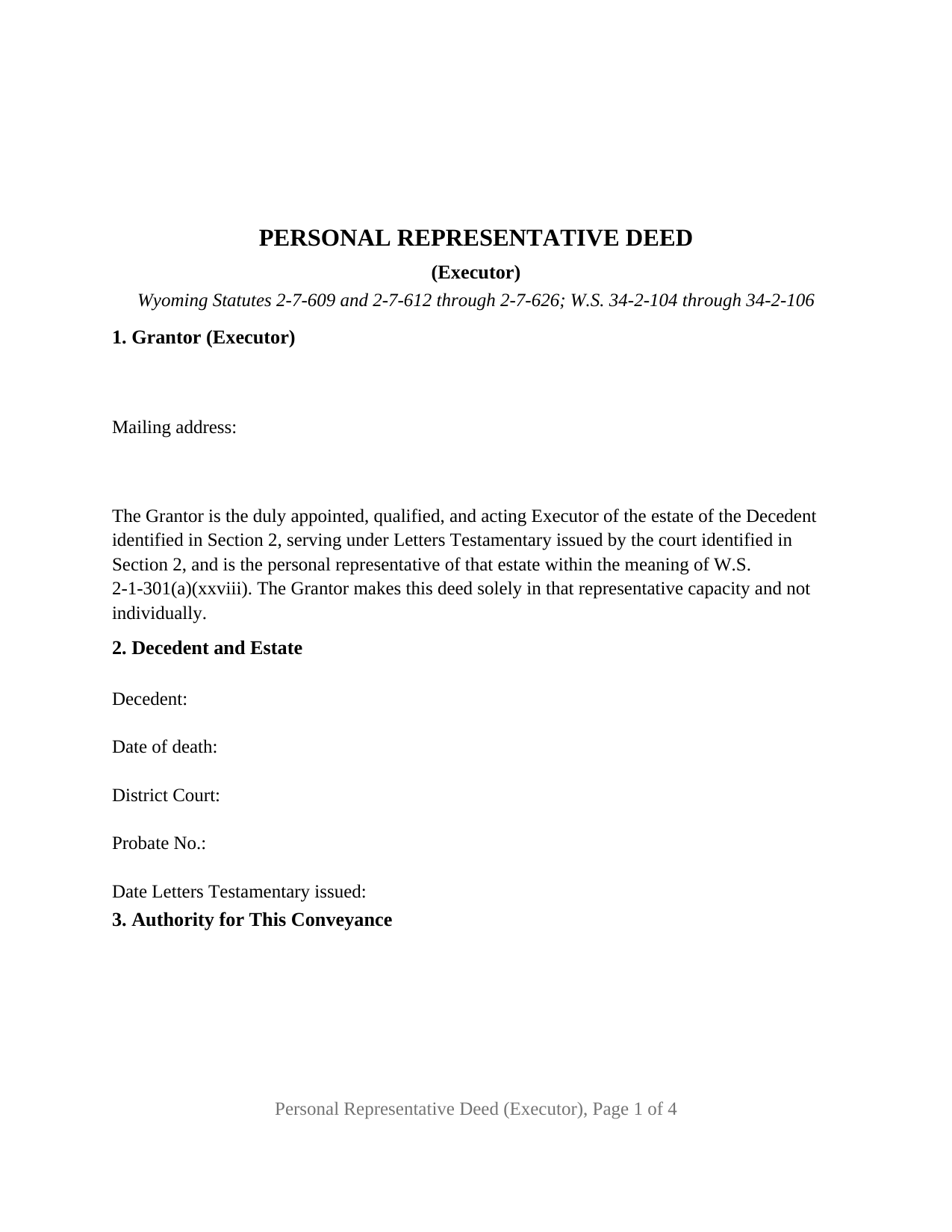
When a Wyoming estate sells real property, the deed is signed by the personal representative, not by the heirs, and the authority behind that signature comes from one of two places: the power of sale the decedent wrote into the will, or an order of the district court confirming the sale. This Wyoming Personal Representative Deed is configured for an executor, the personal representative named in the will and serving under Letters Testamentary, and it carries both the executor's representative-capacity recital and a section identifying which of those two authorities the conveyance rests on. One executor signs, one acknowledgment certificate follows, and the deed conveys the interest of the decedent and of the estate to the purchaser without any warranty from the executor.
Two sources of authority, one deed
Wyoming's Probate Code treats a testamentary power of sale and a court-supervised sale differently, and the deed has to say which one it is operating under. Where the will gives the executor power to sell, W.S. 2-7-609 provides that the statutory sale requirements do not apply; the executor sells on the strength of the will admitted to probate and the letters the court issued. Where the will is silent, the executor petitions the court under W.S. 2-7-614, notice goes out and a hearing is held under W.S. 2-7-615, the court enters an order of sale under W.S. 2-7-621, and after the sale the executor files a verified report that the court examines and, if the price and terms were advantageous to the estate, confirms, ordering the executor to deliver a deed to the purchaser under W.S. 2-7-624. Section 3 of this form is a factual entry describing the authority actually relied on, with the will and its probate order in the first case or the confirmation order in the second, and the operative paragraph states that the executor conveys under the authority stated there.
That structure matters at the recording counter. W.S. 2-7-626 directs the personal representative, when real property is conveyed, to file a certified copy of the confirmation order together with the deed in the office of the county clerk where the land lies. A deed made under a will power has no confirmation order to attach; the probated will and the letters are the record of the executor's authority. The guide walks through both paths and what accompanies the deed under each.
A conveyance of the estate's interest, without warranty
An executor stands in the decedent's shoes for the limited purpose of administering the estate, and a probate deed in Wyoming reflects that. This form uses the operative words of the state's statutory quitclaim form, conveys and quitclaims, together with all interest, which W.S. 34-2-104 through 34-2-106 make a sufficient conveyance of every then-existing legal and equitable right of the grantor and of all the estate the grantor could lawfully convey by a deed of bargain and sale. The deed conveys all interest of the decedent at the time of death and all interest of the estate, subject to the encumbrances and exceptions listed on its face, and it states in terms that the executor makes no covenant or warranty of title, in an individual capacity or otherwise. Under W.S. 34-1-135 no covenant is implied in a Wyoming conveyance of real estate other than minerals, so the deed's silence on warranty is the statute's silence too.
The deed also recites the executor's standing. The fixed paragraph under the grantor section states that the grantor is the duly appointed, qualified, and acting executor of the estate, serving under Letters Testamentary issued by the court named in the deed, is the personal representative of the estate within the meaning of W.S. 2-1-301(a)(xxviii), and makes the deed solely in that representative capacity and not individually. The decedent, the date of death, the district court, the probate number, and the date the letters issued each have their own line, so the chain from the probate file to the recorded deed is complete on the instrument itself.
What this configuration recites
The form recites exactly one grantor, an executor acting under Letters Testamentary, with one signature block headed EXECUTOR (PERSONAL REPRESENTATIVE) and one acknowledgment certificate. It recites no marital status for anyone and carries no spouse signature: the estate's property is conveyed by its representative under the will or the court's order, and the executor's own marital status has nothing to do with the estate's title. The grantee section is free-form, so a single purchaser, two purchasers as tenants in common, joint tenants with right of survivorship, or spouses as tenants by the entirety can each be written in, as the guide's section on how grantees may hold title explains under W.S. 34-1-140 and the Wyoming decisions. The configuration appears in the record whenever a will names an executor and the estate sells real property during administration, whether to pay debts and charges, to make distribution, or for any other purpose in the best interests of the estate under W.S. 2-7-612(a). A deed by co-executors, by an administrator serving under letters of administration, or under an order to carry out the decedent's own contract of sale follows a different pattern from the one this deed recites.
The executor's acknowledgment
Wyoming deeds are acknowledged before a notarial officer, and the certificate is what entitles the deed to record under W.S. 34-1-113 and 34-1-118. Because the executor signs on behalf of the estate, this form carries the representative-capacity short form of W.S. 32-3-115(a)(ii) rather than the individual form: the record was acknowledged before the officer on a date, by the named person, as executor and personal representative, of the named estate. The certificate's venue is wherever the officer takes the acknowledgment, which may be a different county from the one where the land sits, and an acknowledgment taken in another state before that state's notary has the same effect in Wyoming under W.S. 32-3-106.
Recording in the county where the land lies
The deed is recorded with the county clerk of the county where the property is located. Two things accompany it there: the sworn Statement of Consideration that W.S. 34-1-142 makes a condition of acceptance for any transfer of real property, and, where the sale was confirmed by the court, the certified copy of the confirmation order that W.S. 2-7-626 directs the personal representative to file with the deed.
The package includes the fillable personal representative deed, a completed example filled in for a Laramie County estate in which the executor sells under a power of sale in the will, and the guide that describes every section of the form, the two statutory paths to the executor's authority, the acknowledgment, and the recording process, including the certified order and the Statement of Consideration. This description and the guide describe the form and the governing Wyoming statutes in general terms; they are not legal advice.
Important: County-Specific Forms
Our personal representative deed (executor) forms are specifically formatted for each of the 23 counties in Wyoming.
After selecting your county, you'll receive forms that meet all local recording requirements, ensuring your documents will be accepted without delays or rejection fees.