Wyoming Personal Representative Deed (Will Annexed)
County Specific Legal Forms Validated as recently as November 11, 2026 by our Forms Development Team
About the Wyoming Personal Representative Deed (Will Annexed)
How to Use This Form
- Select your county from the list
- Download the county-specific form
- Fill in the required information
- Have the document notarized if required
- Record with your county recorder's office
What Others Like You Are Saying
"the quitclaim form worked well with the Nevada Recorders office. Tried other vendors, theirs were re…"
"The form was easy to fill out. The only problem I had was on the Notary page I live in a different s…"
"Everything great thank you"
"Have used two times. Smooth transaction both times. Fast, simple and easy to use system. Would use t…"
"The service was great. Thank you."
4.8/5 from 4,850 reviews. Read all
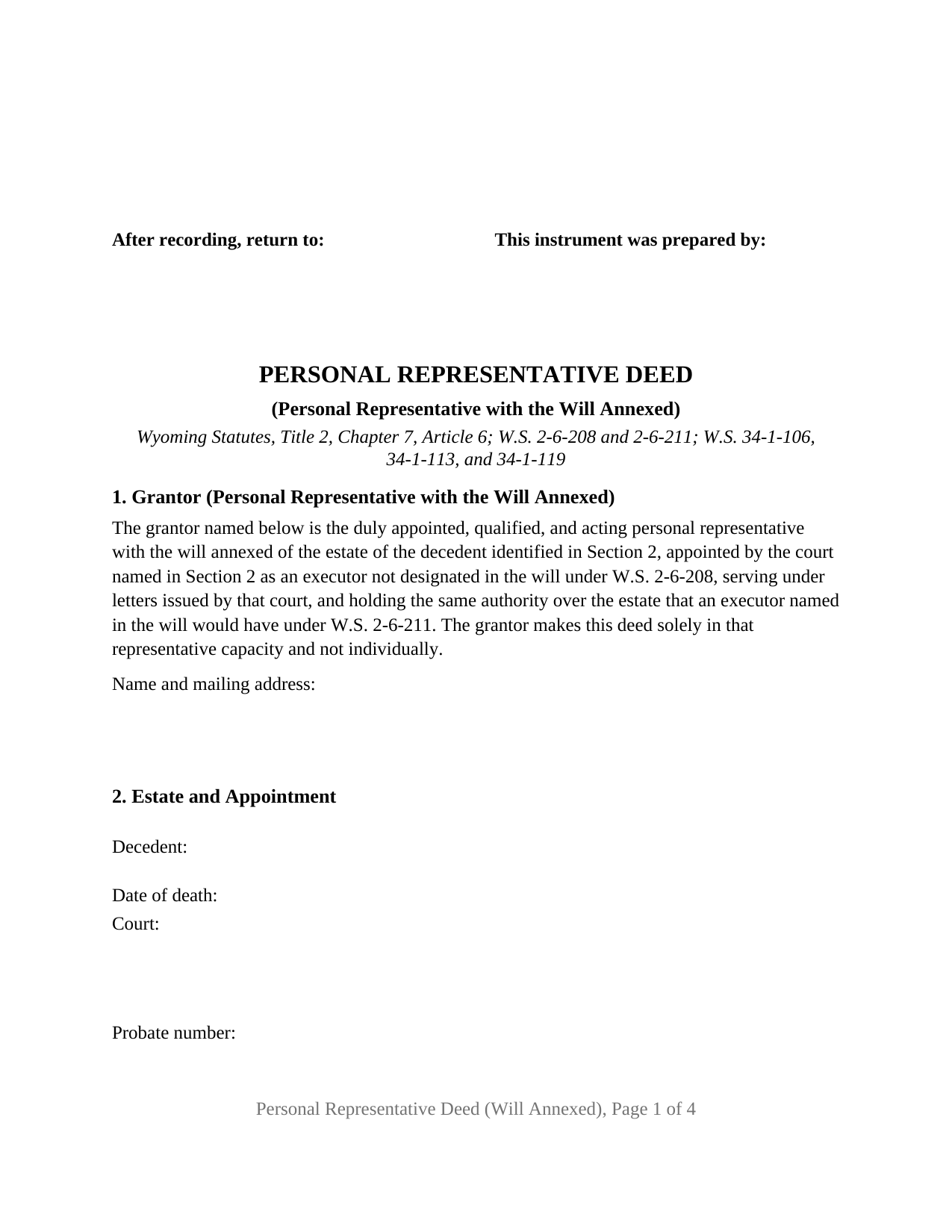
A will can name an executor who never serves: the nominee has died, declined, moved away, or simply never petitioned the court. The estate still has a will, and Wyoming's district court still appoints someone to carry it out. This Wyoming Personal Representative Deed (Will Annexed) is the deed that person signs when the estate sells real property. It is configured for one grantor, a personal representative with the will annexed, appointed under the Wyoming Probate Code to administer a testate estate without being the executor the will designated, and it recites on its face the statutory rule that lets that appointee exercise the will's own power of sale.
The appointee the will did not name
The Wyoming Probate Code reaches this fiduciary through its definitions rather than through a separate office. W.S. 2-1-301(a)(xv) defines an executor as any person appointed by the court to administer the estate of a testate decedent, and W.S. 2-6-208(a) lists who may be appointed, in order: the person the will designates; any beneficiary named in the will, or a person the beneficiaries nominate; a creditor of the decedent or a creditor's nominee; and any other person the court finds qualified. An appointment under the second, third, or fourth rung produces the fiduciary this deed describes. The Code calls that appointee a personal representative with the will annexed in W.S. 2-3-122, which governs the moment a will is proved after letters of administration had issued on the assumption of intestacy, and it speaks of letters of administration with the will annexed in W.S. 2-6-207(c), which governs letters on a lost or destroyed will once it is established. W.S. 2-6-202 supplies one route: a named executor who fails to petition for probate within thirty days of learning of the death and the nomination may be held to have renounced, and the court may appoint another competent person unless good cause for the delay is shown. W.S. 2-3-124 supplies another, where every personal representative has died, become incapable, or had their authority revoked and new letters issue in the original order of preference.
Why the will's power of sale travels with the appointment
The question a buyer's title examiner asks of this deed is whether a fiduciary the will never named can use the power of sale the will gave its executor. W.S. 2-6-211 answers it in one sentence: executors who are not designated in the will have the same authority over the estate which executors named in the will have. Read with W.S. 2-7-609, which provides that when a will gives any personal representative power to sell property of the estate the statutory sale requirements do not apply, the section means that a will with a power of sale supports a sale by the court-appointed representative without a petition, hearing, order, or confirmation. Where the will contains no such power, the appointee sells the way any personal representative does, by petition and order under Title 2, Chapter 7, Article 6, with the court's confirmation of the sale under W.S. 2-7-624 supplying the authority. Section 3 of the deed is a factual entry that identifies which of those two authorities the conveyance rests on: the article of the will granting the power, or the confirmation order by its title and date. The operative paragraph then grants, sells, and conveys, under the authority stated in Section 3, all of the right, title, and interest in the property that the decedent held at death and that the estate holds, without any covenant or warranty of title by the grantor in a representative capacity or individually.
The will annexed configuration
This deed recites exactly one grantor: an individual appointed by a Wyoming district court, not designated in the will as executor, serving under letters issued by that court. A fixed recital opens the first section and states that standing in the Code's own terms, naming W.S. 2-6-208 for the appointment and W.S. 2-6-211 for the authority, and the grantor's name and mailing address are the only entries beside it. The second section identifies the estate by the decedent, the date of death, the court, the probate number, the date the will was admitted, and the date the letters issued, whatever caption the clerk gave those letters. The form carries one signature block, headed GRANTOR (PERSONAL REPRESENTATIVE WITH THE WILL ANNEXED), and one acknowledgment certificate in the representative-capacity short form of W.S. 32-3-115(a)(ii), which names the signer, the capacity, and the estate on whose behalf the deed was signed. The grantee section is free-form and takes one or more grantees with the words describing how they hold title; the guide's section on co-ownership describes each form Wyoming recognizes. A devisee appointed after the named executor's death, selling under the will's power to pay the estate's debts, and a nominee of the devisees appointed after the named executor renounced, selling under a confirmed court sale, present the pattern this deed recites. The form is not set up as a deed by an executor serving under the will's own designation, by an administrator of an intestate estate, by two co-representatives on one instrument, by a special administrator, or by a foreign personal representative, and it is not a deed of distribution under a final decree.
Recording with the county clerk
The deed is recorded in the county where the land lies, and the Wyoming clerk reads it beside two documents that are prepared separately and are not part of this package. On a sale the court confirmed, W.S. 2-7-626 directs the personal representative to file a certified copy of the confirmation order with the instrument of conveyance; on a sale under the will's power there is no confirmation order, and the probated will and the letters are the record of authority. On every sale, the grantee's sworn Statement of Consideration under W.S. 34-1-142 travels with the deed, since the clerk may not accept a transfer instrument until it is received, and the clerk records nothing until the grantee's address is furnished under W.S. 34-1-119(a), which is why the grantee section carries a mailing address entry. The statewide fee of W.S. 18-3-402(a)(xvi) is twelve dollars for the first page and three dollars for each page after it, and Wyoming imposes no transfer tax.
Other names for this deed
Title companies and families searching for this instrument call it an administrator with the will annexed deed, an administrator CTA deed, a cum testamento annexo deed, a probate deed, or an estate deed. Wyoming's Probate Code uses the phrase personal representative with the will annexed, and this form carries that phrase, with the statutory basis for the appointment, on the recorded page.
The package contains the fillable deed, a completed example filled in for a Campbell County estate whose court-appointed representative sells under a power of sale in the will, and the guide, which walks through the appointment statutes, each numbered section, the acknowledgment, and the recording process. This description and the guide describe the form and the governing Wyoming statutes in general terms; they are not legal advice.
Important: County-Specific Forms
Our personal representative deed (will annexed) forms are specifically formatted for each of the 23 counties in Wyoming.
After selecting your county, you'll receive forms that meet all local recording requirements, ensuring your documents will be accepted without delays or rejection fees.