Alabama Warranty Deed (Two Grantors)
County Specific Legal Forms Validated as recently as October 8, 2026 by our Forms Development Team
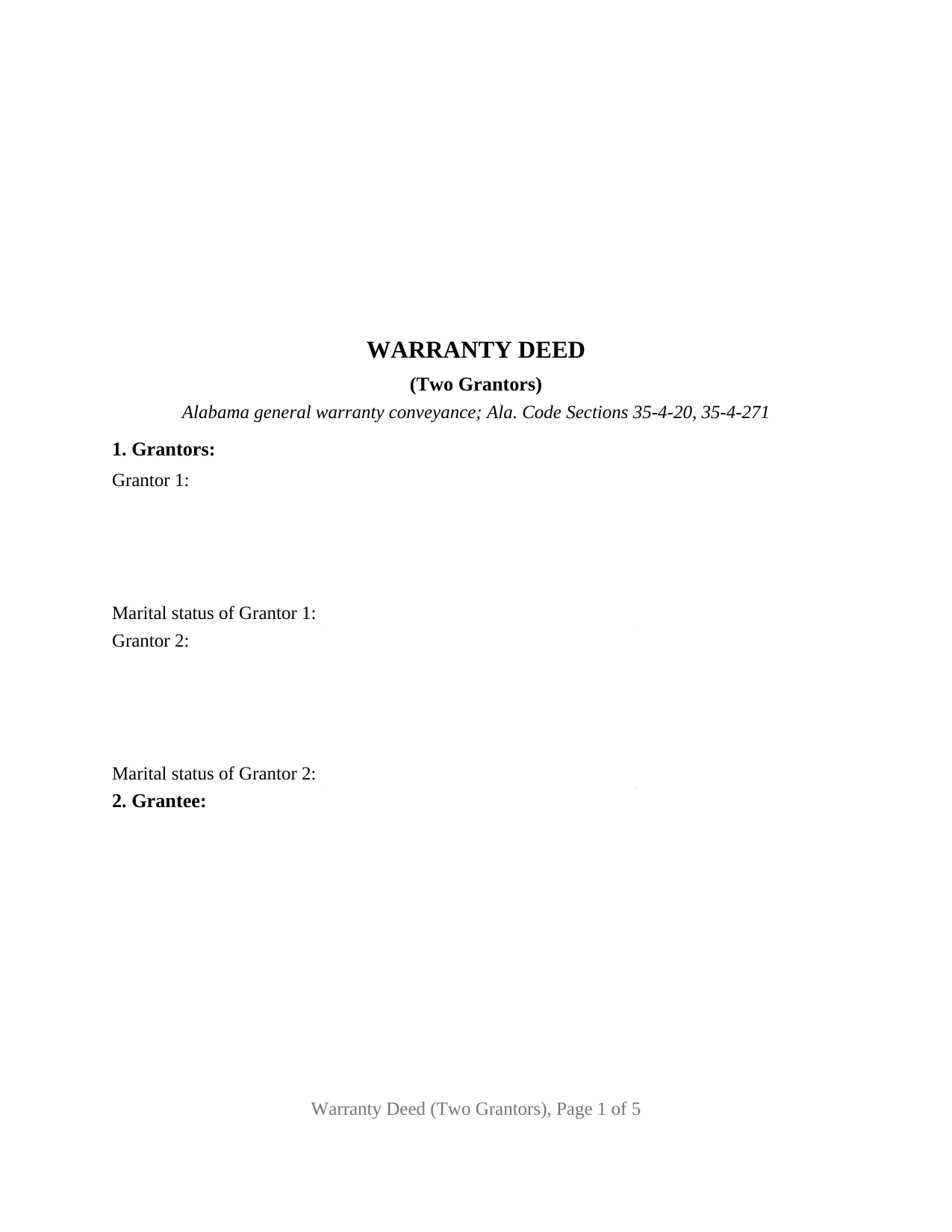
About the Alabama Warranty Deed (Two Grantors)
How to Use This Form
- Select your county from the list
- Download the county-specific form
- Fill in the required information
- Have the document notarized if required
- Record with your county recorder's office
What Others Like You Are Saying
"I was quite impressed by the quality of your documents and the ease of the download."
"Great site! I found everything I needed."
"I wish you could send copy in mail"
"So happy to have found this site. It’s just what I was looking for."
"THIS IS MY FIRST EXPERIENCE WITH DEEDS.COM. I DLED THE ESTATE DEED FORM THAT I HOPE WILL GO THROUGH …"
4.8/5 from 4,825 reviews. Read all
Two grantors, two signature lines, two acknowledgment certificates, and a marital status entry for each: the Alabama Warranty Deed (Two Grantors) carries the joint conveyance pattern for Alabama real estate held by two individual owners. Both owners join in one deed, covenant general warranty title together, and each supplies the recitation of marital status that Ala. Code § 35-4-73 counts once per individual grantor before a probate judge accepts the deed for record.
Two owners, one instrument
The form recites exactly two grantors, each a natural person and a record owner. Married couples selling the home they own together, and unmarried co-owners such as two siblings or two heirs holding fractional interests, present the two-grantor pattern this deed recites. Each grantor's entry block in Section 1 pairs a name and mailing address with that grantor's own marital status line, so a deed by a married couple carries the status twice, once for each signer, the way the recording statute counts it. A sole owner conveying alone, three or more co-owners, and entity or fiduciary grantors present patterns this form is not set up to recite.
The homestead signatures already on the page
Alabama's homestead statute is the reason many deeds carry two signatures in the first place. Under Ala. Code § 6-10-3, a conveyance of a married person's homestead is not valid without the spouse's voluntary signature and assent, with that assent shown by examination before an authorized officer whose certificate memorializes it. When the two grantors are married to each other, this deed's architecture answers the statute by construction: both spouses sign, and each acknowledges before an officer who certifies it. Dower and curtesy are long abolished in Alabama (Ala. Code § 43-8-57), which leaves the homestead rule as the spousal signature rule reaching a lifetime conveyance. A married grantor whose spouse is not the other grantor presents a homestead pattern this form carries no extra block for.
Covenants two grantors make together
The deed conveys with the words grant, bargain, sell, and convey, then says expressly what a general warranty means: lawful seisin in fee simple, a good right to sell and convey, freedom from encumbrances other than the matters listed in the exceptions section, and a promise to forever defend the title against the lawful claims of all persons. Alabama reads covenants into the words grant, bargain, or sell (Ala. Code § 35-4-271), but those implied covenants stop at the grantors' own acts; the express statement is what carries the warranty back through the whole chain of title. And because two people are promising, the deed states that the covenants are joint and several, so each grantor stands behind the entire warranty rather than half of it.
Two certificates, one recording package
Each grantor acknowledges separately, and the form prints a certificate for each in the substance of Alabama's statutory individual acknowledgment (Ala. Code § 35-4-29). Separate certificates let the two grantors sign on different days, in different counties, or in different states, a practical point whenever co-owners live apart; the completed example shows acknowledgments taken three days apart before two different notaries. An acknowledgment also satisfies the witness attestation of Ala. Code § 35-4-20 (§ 35-4-23), so no witness lines appear. The finished deed records with the judge of probate of the county where the land lies, accompanied by the deed tax of fifty cents per five hundred dollars of value, or fraction (Ala. Code § 40-22-1), and the sales validation information probate offices collect alongside a deed. The first page reserves stamp space for the probate recording data, and the preparer endorsement of Ala. Code §§ 35-4-110 and 35-4-113 prints above the return address block.
The package assembles the whole filing: the fillable two-grantor warranty deed form, a completed example showing a realistic Jefferson County conveyance by a married couple, and a guide that walks through each numbered section, the two-signer execution ceremony, and recording with the judge of probate. The materials are informational and are not legal advice.
Important: County-Specific Forms
Our warranty deed (two grantors) forms are specifically formatted for each of the 67 counties in Alabama.
After selecting your county, you'll receive forms that meet all local recording requirements, ensuring your documents will be accepted without delays or rejection fees.