Alabama Gift Deed
County Specific Legal Forms Validated as recently as October 21, 2026 by our Forms Development Team
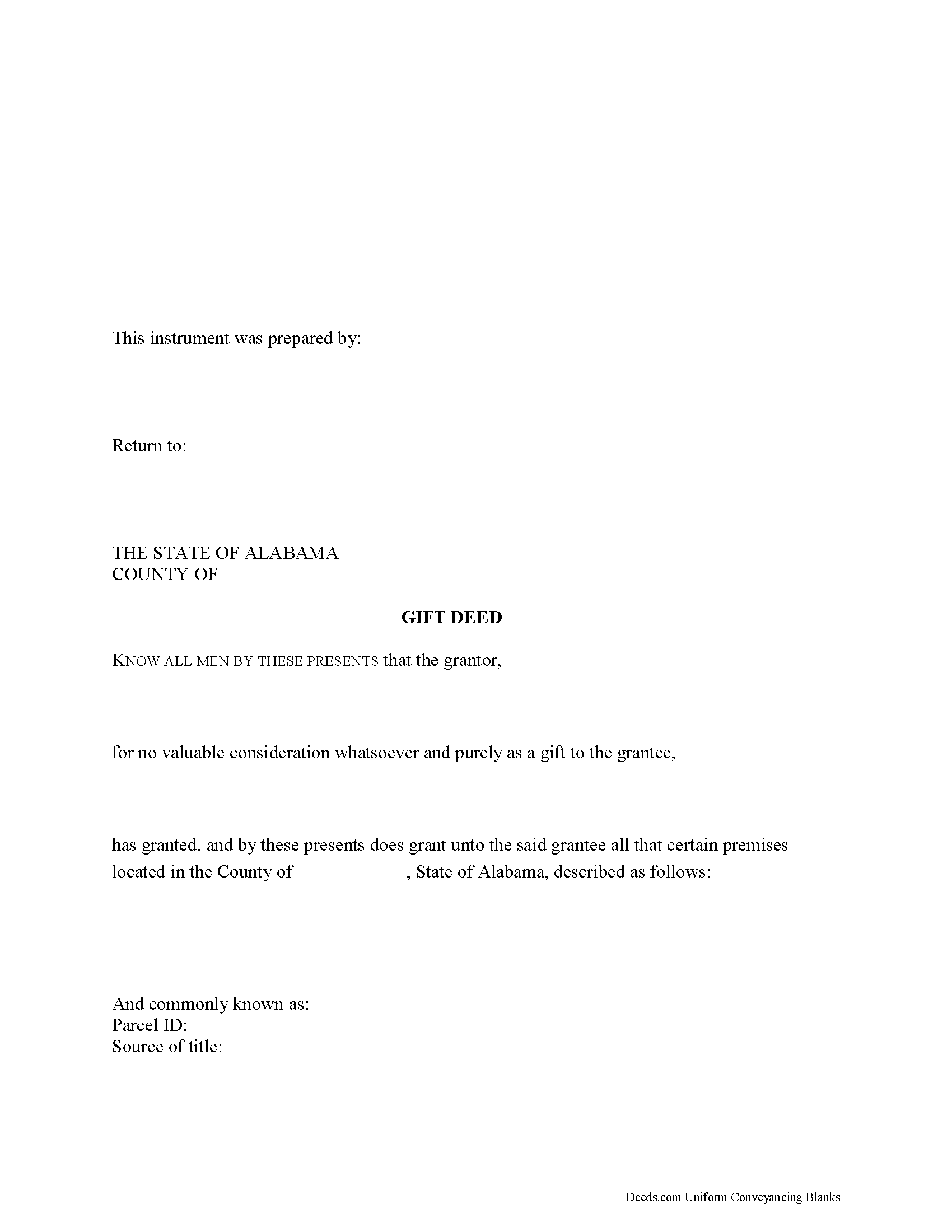
About the Alabama Gift Deed
How to Use This Form
- Select your county from the list
- Download the county-specific form
- Fill in the required information
- Have the document notarized if required
- Record with your county recorder's office
What Others Like You Are Saying
"Very helpful Got information and form I wanted."
"Second time using Deeds.com. Easy and professional"
"Very helpful and informative. It has saved me time going to get the forms at county recorder / clerk…"
"Simple and quick recording."
"Prompt efficient service."
4.8/5 from 4,829 reviews. Read all
An Alabama gift deed transfers real property from one party to another with no exchange of consideration — no money, no services, nothing of value in return. The transfer happens during the grantor's lifetime, which distinguishes it from a testamentary transfer through a will. Gift deeds are most commonly used to transfer property between family members, to move real estate into a trust, or to make a charitable donation of real property.
Because the absence of consideration is the defining characteristic of a gift deed, the language used in the deed matters more than in most other transfers. A deed that implies consideration was expected — even indirectly — can be challenged and potentially voided.
No-consideration language is essential
The deed must explicitly state that no consideration is expected or required. Any reference to consideration, even nominal language like "for one dollar and other valuable consideration," creates ambiguity that makes the deed contestable. Our forms use language specifically drafted for Alabama gift deeds to eliminate this risk.
What the deed must contain
A lawful Alabama gift deed includes:
- Grantor information — full legal name and marital status
- Grantee information — full legal name, marital status, vesting, and mailing address
- Legal description — a complete description of the property; if the description references a recorded plat, the plat should be attached or the deed should identify the plat book and office where it can be found (Ala. Code § 35-4-74)
- Source of title — a reference to the prior deed or recorded instrument through which the grantor acquired the property, establishing a clear chain of title
- Any restrictions — easements, covenants, or other encumbrances affecting the property
Vesting and the right of survivorship
Vesting describes how the grantee holds title. For Alabama property transferred to two or more people, this is a decision with long-term consequences.
Tenancy in common is the default in Alabama. Each owner holds a separate, divisible interest that can be sold, mortgaged, or passed through their estate independently.
Joint tenancy with right of survivorship means that when one owner dies, their interest passes automatically to the surviving owner — outside of probate. However, in Alabama the right of survivorship is not presumed and must be expressly stated in the deed (Ala. Code § 35-4-7). A deed that simply names two grantees without specifying survivorship creates a tenancy in common by default. If survivorship is the intent, the deed must say so explicitly.
Signatures and witnesses
The grantor must sign and acknowledge the deed in the presence of two credible witnesses. One of the two witnesses may be the notary (Ala. Code § 35-4-65). The grantee's signature is not required on a gift deed.
Recording with the Probate Judge
Like all Alabama real estate instruments, the gift deed must be recorded in the Probate Judge's office in the county where the property is located. Alabama is one of the few states that records deeds through the Probate Judge rather than a county recorder. Contact the Probate Judge's office in the relevant county to confirm accepted forms of payment before recording.
Recording promptly after execution protects the grantee. Under Alabama's recording statutes, a later instrument that is recorded first can take priority over an earlier unrecorded transfer.
County-specific forms included
Each Alabama county has its own recording standards, and the Probate Judge's office can reject documents that don't meet local requirements. Our forms are prepared and validated for each Alabama county. Your download includes the gift deed form, a completed example for reference, a line-by-line guide, and the Alabama supplemental documents required at recording. Select your county from the list to get the forms for your specific jurisdiction.
Important: County-Specific Forms
Our gift deed forms are specifically formatted for each of the 67 counties in Alabama.
After selecting your county, you'll receive forms that meet all local recording requirements, ensuring your documents will be accepted without delays or rejection fees.