Alabama Special Warranty Deed
County Specific Legal Forms Validated as recently as October 9, 2026 by our Forms Development Team
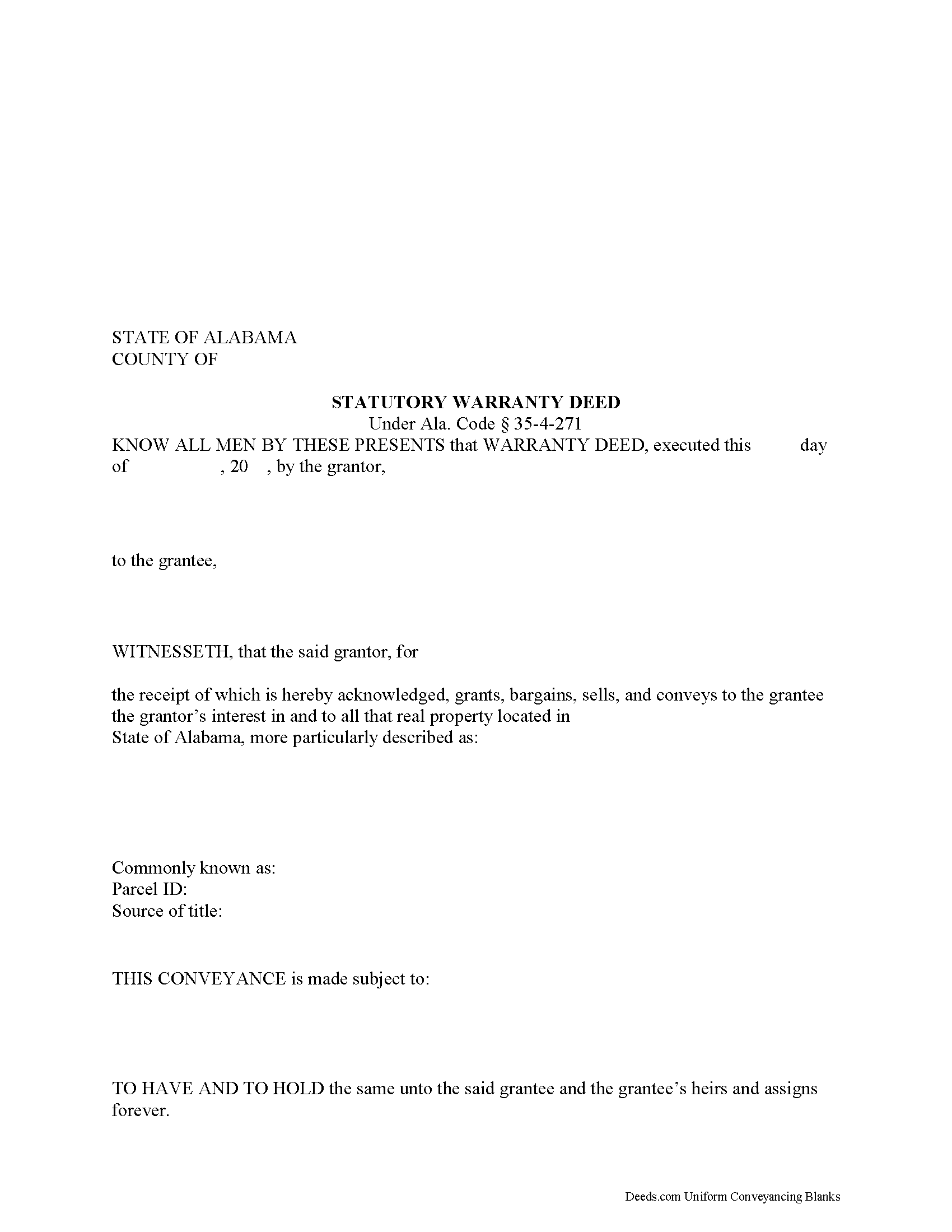
About the Alabama Special Warranty Deed
How to Use This Form
- Select your county from the list
- Download the county-specific form
- Fill in the required information
- Have the document notarized if required
- Record with your county recorder's office
What Others Like You Are Saying
"It was fast and easy to use."
"I had a problem because I was using a phone, so had to get my daughter to request again in her name …"
"This is a very valuable resource. It was user friendly and made transfer happen in a day!"
"Very good website. All government should be that clear and efficient."
"Easy to use and quickly filed documents!"
4.8/5 from 4,836 reviews. Read all
An Alabama Special Warranty Deed is often used when the grantor is willing to stand behind title problems that arose only during that grantor's period of ownership, not defects from earlier owners. In Alabama, that limited warranty matters because the deed still has to satisfy the state's own recording and execution rules, including probate-office recording, marital-status recitals, and other county-level filing expectations that can affect whether the deed is accepted and how clearly the title chain reads later.
When an Alabama Special Warranty Deed is commonly used
An Alabama Special Warranty Deed transfers whatever title the grantor holds to the grantee and includes a limited promise to defend the title only against claims arising by, through, or under the grantor, but not against older defects in the chain. In Alabama practice, this deed is commonly seen in commercial transfers, transfers by entities, fiduciary conveyances, and other situations where a full general warranty is not being given but the conveyance is still intended to include more protection than a quitclaim-style transfer.
Alabama statutory requirements for a valid deed
Alabama requires conveyances of land to be in writing and signed at the end by the grantor or the grantor's authorized agent, and the deed must be properly executed to be recordable (Ala. Code 35-4-20). A recordable Alabama Special Warranty Deed should clearly identify the grantor and grantee, state the consideration, include a sufficient legal description, and contain language showing that the grantor is conveying the property with a special warranty rather than a full general warranty.
Because this is Alabama, the deed should also reflect state-specific information that title examiners and probate recording offices expect to see, including the grantor's marital status and complete property identification. If the property lies in a platted subdivision, the deed should include the plat reference or the book and page where the plat is recorded when that information is needed to describe the land accurately (Ala. Code 35-4-74).
Execution requirements in Alabama
Alabama does not follow the same signing pattern used in every state. A grantor who signs an Alabama deed must have the signature attested by at least one witness, unless the deed is properly acknowledged before an authorized officer, and a proper acknowledgment can satisfy the witness requirement for recording purposes (Ala. Code 35-4-20, 35-4-22, 35-4-23). If the grantor signs by mark because the grantor cannot write, two witnesses are required under Alabama's execution statute (Ala. Code 35-4-20).
In practical terms, most Alabama deeds are signed before a notary with a recordable acknowledgment. That acknowledgment should follow Alabama's statutory form closely enough to avoid recording problems (Ala. Code 35-4-29). If more than one person is conveying title, each grantor whose interest is being transferred should execute the deed.
Alabama-specific traps that cause recording or title problems
- Marital-status recital: Alabama specifically requires a recitation of the grantor's or vendor's marital status in a recorded conveyance. Leaving that out can create avoidable title questions later, even if the probate office records the instrument (Ala. Code 35-4-73).
- Homestead spousal assent: If the property is homestead property, a married owner's conveyance is not valid without the voluntary signature and assent of the spouse, shown by the spouse's acknowledgment as required by statute (Ala. Code 6-10-3).
- Survivorship is not automatic: Alabama does not presume survivorship just because two grantees take title together. If the intent is to create a survivorship estate, the deed needs express survivorship language; otherwise, the co-owners generally take without that feature (Ala. Code 35-4-7).
- Plat references and legal descriptions: A street address alone is not enough. If the property is in a recorded subdivision or on a recorded plat, the deed should use the full legal description and any necessary plat book reference so the land can be identified from the record (Ala. Code 35-4-74).
- Limited warranty language: The wording should make clear that the warranty is limited to the grantor's period of ownership. Using language that sounds like a general warranty can create a mismatch between the intended deed type and the promises actually made in the instrument.
- Deed tax and value reporting: Alabama deed recording usually involves deed tax based on value, together with value reporting that the probate office uses at recording. If the transfer is exempt, the exemption should be stated correctly instead of leaving the tax section ambiguous (Ala. Code 40-22-1).
- Preparer and return information: Even when not framed as a statewide deed-validity element, probate offices commonly expect the instrument to show who prepared it and where the recorded deed should be returned. Omitting that information can slow intake or create avoidable clerk questions.
Recording an Alabama Special Warranty Deed
An Alabama Special Warranty Deed should be recorded in the office of the judge of probate in the county where the real property is located. Recording places the conveyance in the public land records and helps protect the grantee against later purchasers, mortgagees, and judgment creditors without notice (Ala. Code 35-4-50, 35-4-90).
Prompt recording matters in Alabama because an unrecorded conveyance can lose priority to a later party who takes without notice and records first. At recording, the probate office will also address the applicable recording fees, deed tax, and required value reporting, which is commonly handled through Alabama's real estate sales validation process when applicable (Ala. Code 40-22-1).
Vesting and ownership language under Alabama law
The grantee section of an Alabama Special Warranty Deed should match the way title is intended to be held after the transfer. Alabama law does not automatically attach a right of survivorship when two or more people receive title together, so survivorship intent should be stated expressly in the deed if that is how title is meant to vest (Ala. Code 35-4-7). Careful vesting language is especially important in Alabama because the recorded deed often becomes the starting point for later title review, refinancing, and probate-related questions.
What is included in the download package
The Alabama Special Warranty Deed package includes the form, step-by-step instructions, and a completed example. The materials are prepared by Deeds.com's forms development team for county-specific use in Alabama so the package is easier to complete, sign, and take to the appropriate probate office for recording.
Important: County-Specific Forms
Our special warranty deed forms are specifically formatted for each of the 67 counties in Alabama.
After selecting your county, you'll receive forms that meet all local recording requirements, ensuring your documents will be accepted without delays or rejection fees.