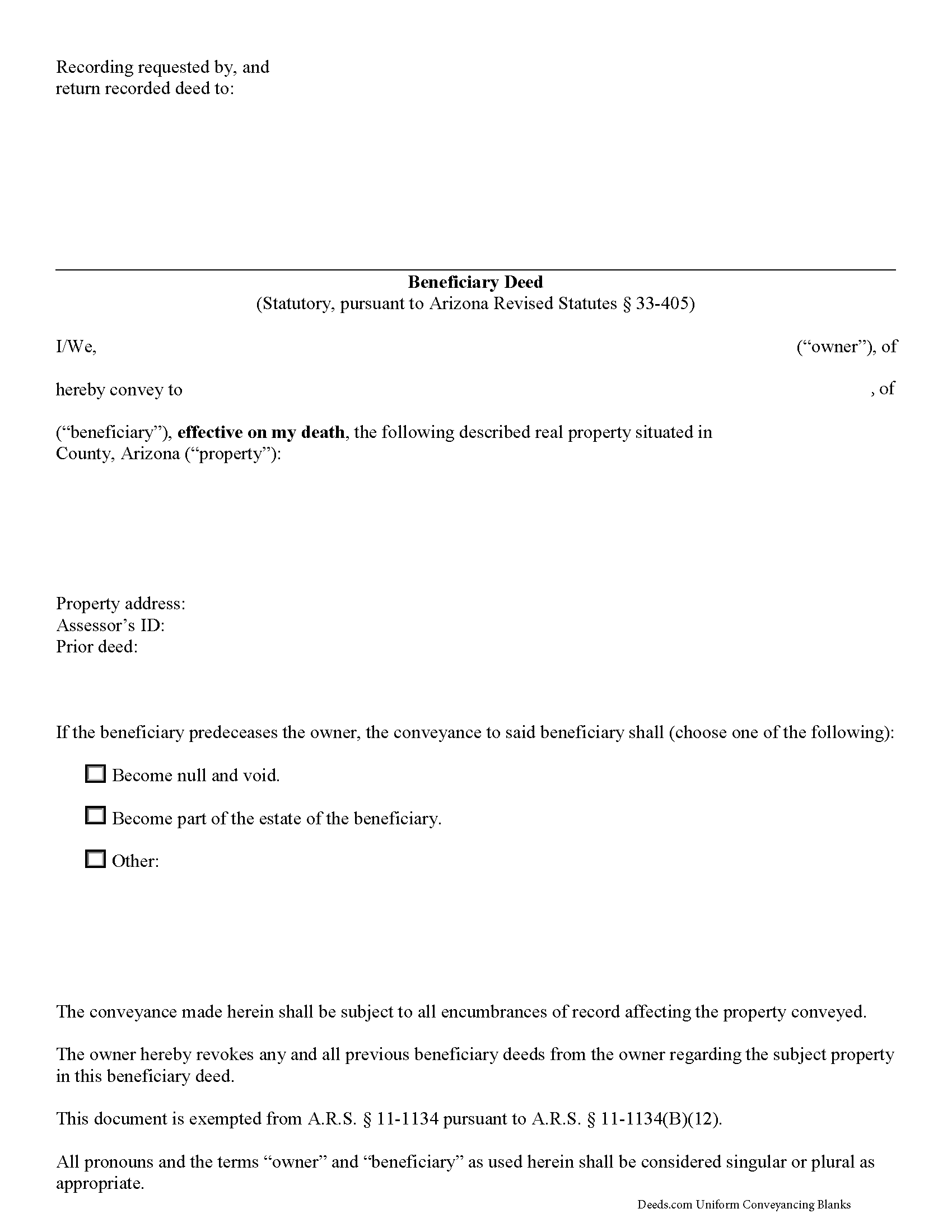
Arizona Beneficiary Deed

County Specific Legal Forms Validated as recently as April 30, 2026 by our Forms Development Team

About the Arizona Beneficiary Deed

Arizona Beneficiary Deed
Select County from List

How to Use This Form

  1. Select your county from the list on the left
  2. Download the county-specific form
  3. Fill in the required information
  4. Have the document notarized if required
  5. Record with your county recorder's office

What Others Like You Are Saying

— Anthony G.

"I have only used the service on one occasion but so far it has been great. Extremely simple to use."

— DOUGLAS H.

"Just as promised My quitclaim deed went through the county recorders office with no problem."

— Frank G B.

"site is very helpful and easy to use."

— Tricia M.

"The document I purchased (QuitClaim Deed) had detailed directions explaining how to complete the for…"

— Marsella F.

"Thank you so much!! This is a fantastic tool!! Marsella F."

The Arizona Beneficiary Deed is a non-probate transfer instrument under ARS 33-405 that designates a beneficiary to take real property at the owner's death, while leaving the owner in full control during life. Arizona was one of the first states in the country to adopt this form of deed — the statute has been on the books since 2001 — and the Arizona version is widely considered the model for what many other states later called a transfer on death deed or TOD deed. The two terms describe the same instrument; Arizona's legislature chose "beneficiary deed" to emphasize that the deed designates a recipient rather than transferring anything at the time of signing. The deed's essential feature — and its biggest failure point — is the requirement in ARS 33-405(E) that the instrument be recorded in the county where the property sits during the owner's lifetime. An unrecorded beneficiary deed, or one recorded only after the owner's death, is void.

When the Arizona Beneficiary Deed Is Used

Beneficiary deeds are used as a targeted, low-cost estate planning tool for Arizona real property. They avoid probate on the property, preserve the owner's absolute control during life, and do not require the beneficiary's signature, consent, or knowledge. Common uses include passing a primary residence to adult children, keeping a vacation home in the family without transferring current ownership, adding certainty to an informal estate plan without establishing a revocable living trust, and holding secondary properties that would otherwise drive up the size and cost of a probate estate. The deed is a useful complement to — not a substitute for — a will or a living trust, because it reaches only the specific property described in the deed and does nothing for personal property, bank accounts, or real estate owned elsewhere.

The Lifetime Recording Requirement

ARS 33-405(E) makes the lifetime recording rule unambiguous: a beneficiary deed is valid only if it is executed and recorded as provided by law in the office of the county recorder of the county in which the property is located before the death of the owner. A deed signed and acknowledged during life but sitting in a desk drawer when the owner dies has no effect. A deed discovered by family members after the funeral and recorded then has no effect. This is materially different from how ordinary deeds of conveyance work — an inter vivos transfer between two living parties is binding between them from the moment of delivery and is merely vulnerable to third-party claims until recording. A beneficiary deed has no existence as a conveyance at all unless it is on the record before the owner dies. For this reason, the signing appointment and the recording trip should happen at the same time, not as separate errands.

Owner's Retained Rights and Revocability

ARS 33-405 preserves every meaningful right the owner had before executing the deed. The owner keeps full legal title during life and may sell the property, mortgage it, lease it, grant easements on it, use it, waste it, or otherwise deal with it without any duty to the beneficiary. The beneficiary has no interest in the property during the owner's life — not a future interest, not a vested remainder, not a contingent remainder in the traditional property law sense. The beneficiary has only an expectancy that can be eliminated at any time by the owner. If the owner sells the property during life, the beneficiary deed simply has no property to operate on at death.

Revocation is equally flexible. The owner may revoke a beneficiary deed at any time by recording a revocation instrument that complies with ARS 33-405, by recording a new beneficiary deed that names a different beneficiary (which supersedes the earlier deed), or by selling or otherwise conveying the property during life. Revocation does not require the beneficiary's consent, knowledge, or cooperation, and the owner has no obligation to notify the beneficiary of the change. What the owner cannot do is revoke the deed by will — ARS 33-405 is specific that a purported revocation in a will has no effect, because the deed's validity depends on recorded instruments in the real property records, not on testamentary documents.

Community Property and Joint Owners

Arizona is a community property state, and the deed has to account for how the property is titled. When spouses own real property as community property or community property with right of survivorship, both spouses should sign the beneficiary deed. If one spouse signs alone, the deed is effective only as to that spouse's interest, and its practical effect at death depends on how the couple's ownership was structured and which spouse dies first. When the property is held in joint tenancy with right of survivorship, the beneficiary deed operates only after the last joint tenant dies — the survivorship between the joint tenants takes precedence, so if one joint tenant dies first, the full interest passes to the surviving joint tenant, and the beneficiary deed affects the property only if that surviving joint tenant does not revoke or supersede it. When title is held in one spouse's name as sole and separate property, that spouse can execute the beneficiary deed alone, but a disclaimer deed from the other spouse or an express recital of the separate-property character is often used to keep the chain clean.

Primary and Successor Beneficiaries

ARS 33-405 permits an owner to name one or more primary beneficiaries and one or more successor beneficiaries who take if the primary beneficiary does not survive the owner. Multiple primary beneficiaries can take as joint tenants, tenants in common, or in specified percentages — the deed must say which. Naming successor beneficiaries is strongly recommended, because without them, if the primary beneficiary predeceases the owner, the property falls back into the probate estate and the main purpose of the deed is defeated. The beneficiary may be an individual, a trust, a charitable organization, or any other legal entity capable of receiving title.

What the Beneficiary Takes

The beneficiary takes the property subject to everything it was subject to at the owner's death: mortgages, deeds of trust, judgment liens, tax liens, mechanic's liens, easements, CC&Rs, and any other encumbrances recorded against the property during the owner's life. ARS 33-405 does not strip those interests; the beneficiary steps into title, not into a clean slate. The beneficiary also takes subject to the owner's creditors — in particular, ARS 33-405 specifically preserves claims of the Arizona Health Care Cost Containment System (AHCCCS) for estate recovery of Medicaid expenses. A beneficiary deed does not shield the property from a valid AHCCCS recovery claim against the deceased owner's estate, and families relying on the deed for Medicaid planning should consult counsel who specifically handles Arizona estate recovery rules.

Divorce and Beneficiary Designations

Arizona's revocation-on-divorce statute at ARS 14-2804 automatically revokes any revocable beneficiary designation in favor of a former spouse upon the entry of a final decree of divorce or annulment. By its terms, the statute reaches governing instruments generally and has been applied to beneficiary deeds as well as to wills, trusts, and other non-probate transfer instruments. An owner who divorces after recording a beneficiary deed naming the former spouse cannot rely on the deed continuing to name that person — the designation is stripped by operation of law. The cleaner practice is to record a new beneficiary deed or a revocation after the divorce rather than relying on the statutory revocation alone, because the record of the original deed still sits in the county recorder's office and may generate title questions later.

Perfecting Title After the Owner's Death

When the owner dies, the property passes to the beneficiary automatically under ARS 33-405, but the record needs to reflect the death for title purposes. The beneficiary typically records a certified copy of the owner's death certificate along with any affidavit of succession or other instrument required by the county recorder and the beneficiary's title insurer. Some counties and title companies prefer a specific beneficiary deed affidavit; others accept a death certificate alone. The property is not subject to probate administration, but creditor claim and estate recovery periods may still apply before the beneficiary can deal with the property free of those claims, and beneficiaries are generally well served by allowing the statutory claim periods to run before selling.

Execution and Acknowledgment

Under ARS 33-401 and 33-405, the beneficiary deed must be in writing, subscribed by the owner, and acknowledged before a notary public or other officer authorized to take acknowledgments. Arizona does not require subscribing witnesses. The beneficiary does not sign — the deed is a one-way designation, and the beneficiary's acceptance occurs only at the owner's death by operation of law and by the beneficiary's subsequent recording of a death certificate. The deed is exempt from the Affidavit of Property Value under ARS 11-1134 as a non-consideration transfer, and the exemption should be claimed on the face of the deed with a citation to the specific exemption subsection below the legal description.

Formatting and Recording

ARS 11-480 sets formatting requirements for every recordable instrument: legible type of at least ten points, white paper no larger than 8.5 by 14 inches, a caption identifying the document (for example, "Beneficiary Deed"), a top margin of at least two inches on the first page reserved for the recorder's stamp, and minimum half-inch margins elsewhere. Record in the county where the property is located, and confirm current fees and accepted forms of payment with the recorder's office in advance. Because the lifetime recording requirement is absolute, it is worth verifying recording the same day — a beneficiary deed mailed for recording and never confirmed as indexed is a meaningful risk if the owner dies before the recording is completed.

What's Included in the Download Package

The Arizona Beneficiary Deed package includes the deed form drafted to satisfy the ARS 33-405 requirements for primary and successor beneficiary designations, detailed guidelines covering the Arizona-specific drafting and lifetime recording requirements, and a completed example showing how the form should look for a typical designation. All files are available for instant download after purchase.

How to Use This Form

  1. Select your county from the list above
  2. Download the county-specific form
  3. Fill in the required information
  4. Have the document notarized if required
  5. Record with your county recorder's office

What Others Like You Are Saying

— Anthony G.

"I have only used the service on one occasion but so far it has been great. Extremely simple to use."

— DOUGLAS H.

"Just as promised My quitclaim deed went through the county recorders office with no problem."

— Frank G B.

"site is very helpful and easy to use."

— Tricia M.

"The document I purchased (QuitClaim Deed) had detailed directions explaining how to complete the for…"

— Marsella F.

"Thank you so much!! This is a fantastic tool!! Marsella F."

Common Uses for Beneficiary Deed

  • Provide for a loved one without giving up current ownership
  • Avoid probate costs and delays for your heirs
  • Retain full control of your property during your lifetime
  • Designate multiple beneficiaries for a property
  • Designate a beneficiary to receive property upon your death
  • Change a previously named property beneficiary

Important: County-Specific Forms

Our beneficiary deed forms are specifically formatted for each county in Arizona.

After selecting your county, you'll receive forms that meet all local recording requirements, ensuring your documents will be accepted without delays or rejection fees.