Arizona Correction Deed
County Specific Legal Forms Validated as recently as October 6, 2026 by our Forms Development Team
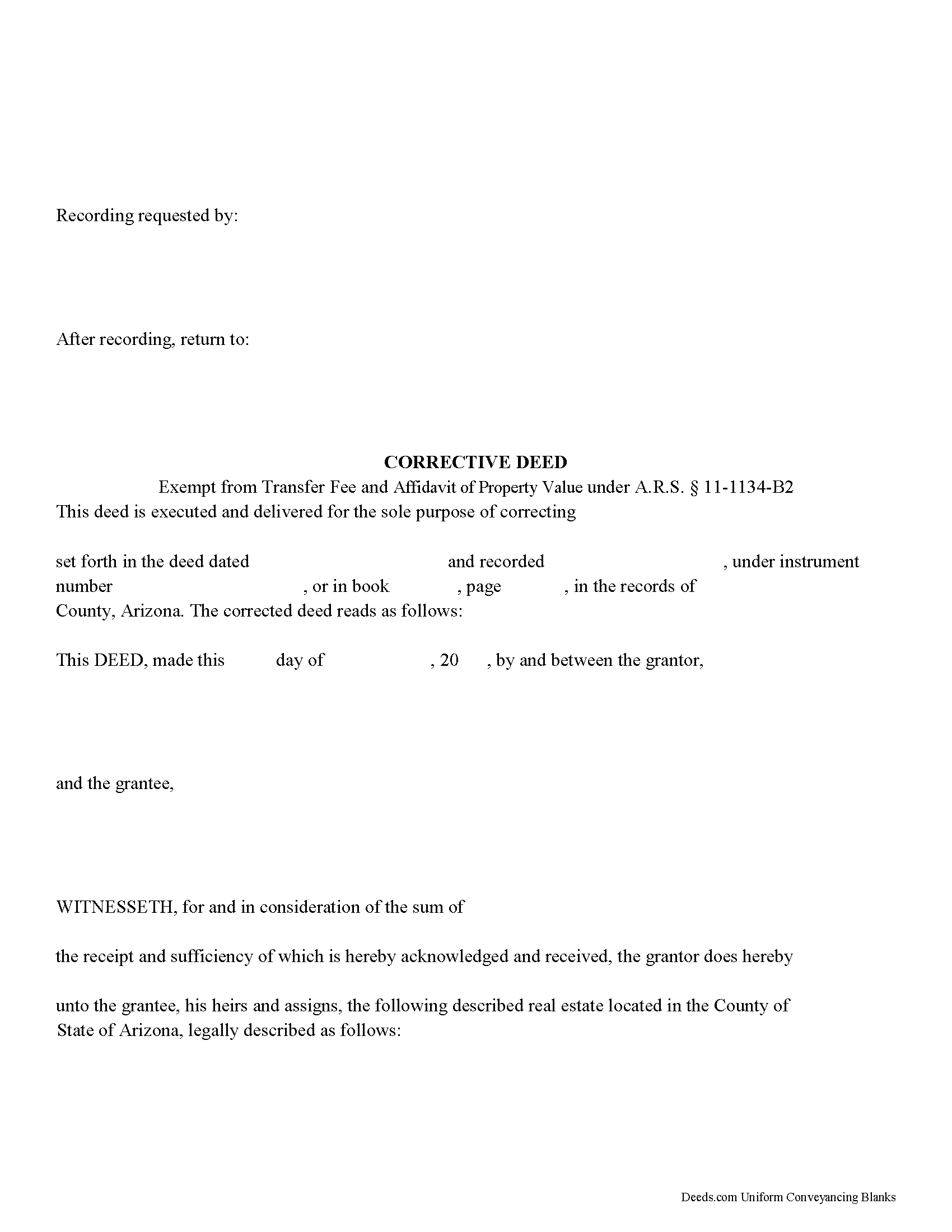
About the Arizona Correction Deed
How to Use This Form
- Select your county from the list
- Download the county-specific form
- Fill in the required information
- Have the document notarized if required
- Record with your county recorder's office
What Others Like You Are Saying
"Great service got everything I needed with a click of a tab. Thank You..."
"Very easy to find what I needed. Really liked the instructions included with the forms and also the …"
"Your documents were very helpful. I went ahead and filled in all the info for the Release of Lien do…"
"I was very pleased with the service and the product. All the extras were a nice addition to my order…"
"I downloaded documents easy. But haven't started work on them yet. Seems to be ok."
4.8/5 from 4,815 reviews. Read all
The Arizona Correction Deed is the instrument used to fix a non-material error in a previously recorded deed without re-conveying the property. Arizona treats a correction deed as a supplementary instrument rather than a new transfer: the underlying conveyance stands, the correction deed amends the record, and — because no change in ownership is actually occurring — the transaction falls within the exemptions to the Affidavit of Property Value under ARS 11-1134. That exemption is the practical reason correction deeds are used instead of re-recording a full new deed; it keeps the county assessor from treating a typographical fix as a fresh sale and generating a new reported transaction value.
When the Arizona Correction Deed Is Used
Correction deeds are limited to fixing errors that do not change the substance of the original conveyance. Appropriate uses include correcting a misspelled grantor or grantee name, adding an omitted middle initial or suffix, fixing a scrivener's typographical error in the legal description, correcting a transposed lot number that can be confirmed against the recorded plat, repairing a missing or garbled recording reference to a prior instrument, and similar non-substantive fixes. Errors that actually change what was conveyed or who received it — adding or removing a grantee, changing the vesting from community property to joint tenancy, substituting one parcel for another, altering a reserved interest — require a new deed of conveyance, not a correction. The line between a non-material correction and a substantive change is not always obvious, and when the error touches who owns what or how, the safer route is usually a new deed rather than a correction.
Reference to the Erroneous Deed
A correction deed must tie itself to the original instrument it is fixing. The deed should identify the original deed by its recording date, its recording reference (docket and page, or instrument number), the county where it was recorded, and the names of the original grantor and grantee. The deed should then state the nature of the error — what was wrong, where in the original deed it appeared — and supply the correct information in the body of the corrective instrument. Without that explicit tie, the county recorder's index will not show the connection between the two documents, and a title examiner running the chain may not find the correction when it matters.
Who Must Sign
All parties who signed the original deed must sign the correction deed. If the original grantors are two spouses, both must sign the correction. If the original conveyance was by an entity, the same entity must execute the correction through an authorized signatory. When the original grantor has since died or become incapacitated, a correction deed is generally not available — the correction must be handled through a scrivener's affidavit, a successor instrument from the estate, or in more serious cases a quiet title action. Arizona is a community property state, and when the grantor is currently married and the property being corrected is or was community property, both spouses should sign the correction deed even if only one spouse signed the original (ARS 25-211); a correction that silently drops a required spousal signature can raise questions about its validity later in the chain.
Execution and Acknowledgment
Under ARS 33-401, the correction deed must be in writing, subscribed by the grantor, and acknowledged before a notary public or other officer authorized to take acknowledgments. Arizona does not require subscribing witnesses on a deed. Acknowledgments taken outside Arizona must comply with ARS 33-501, which recognizes notaries, judges and clerks of courts of record, and any other officer authorized to perform notarial acts in the jurisdiction where the acknowledgment is taken. The execution formality is the same as for the original deed; nothing about the corrective nature of the instrument relaxes it.
Affidavit of Property Value Exemption
Arizona requires an Affidavit of Property Value to accompany nearly every instrument that transfers an interest in real property (ARS 11-1133), but correction deeds are exempt under ARS 11-1134 because no new transfer is occurring — the deed is fixing a defect in a transaction that has already taken place. The exemption still has to be claimed correctly on the face of the deed: a statement that the transfer is exempt, together with a citation to the specific exemption subsection, must appear below the legal description. Correction deeds that omit the exemption recital are routinely rejected at the recorder's window as non-conforming, even though the transaction itself is unquestionably exempt. This is the single most common filing failure for correction deeds in Arizona.
Alternatives to a Correction Deed
Arizona practice recognizes a scrivener's affidavit as an alternative vehicle for certain very small errors — mostly clear typographical mistakes where no ambiguity about the parties' intent exists and the signers of the original deed are unavailable. A scrivener's affidavit is signed by the person who prepared the deed (or by someone with personal knowledge of the error) rather than by the original parties, and it is indexed alongside the original deed. Whether to proceed by correction deed or scrivener's affidavit depends on the nature of the error and the availability of the original signatories; title companies often have strong preferences on which vehicle they will accept for insuring purposes.
Formatting and Recording
ARS 11-480 sets formatting requirements for every recordable instrument in Arizona: legible type of at least ten points, white paper no larger than 8.5 by 14 inches, a caption identifying the document type ("Correction Deed" or similar), a top margin of at least two inches on the first page reserved for the recorder's stamp, and minimum half-inch margins elsewhere. County recorders reject non-conforming documents, and the first-page margin rule is enforced strictly in several counties. Record the correction deed in the same county where the original deed was recorded, and confirm current fees and accepted forms of payment with the recorder's office in advance. Although ARS 33-411.01's sixty-day recording duty speaks to documents evidencing a sale or transfer, the practical rule for a correction deed is to record it as promptly as possible — the correction has no effect on the record until it is actually indexed.
What's Included in the Download Package
The Arizona Correction Deed package includes the deed form built to reference the prior recording, recite the nature of the error, and claim the ARS 11-1134 exemption on the face of the instrument, detailed guidelines covering the Arizona-specific drafting and recording requirements, and a completed example showing how the form should look for a typical scrivener's correction. All files are available for instant download after purchase.
Important: County-Specific Forms
Our correction deed forms are specifically formatted for each of the 15 counties in Arizona.
After selecting your county, you'll receive forms that meet all local recording requirements, ensuring your documents will be accepted without delays or rejection fees.