Arizona Quitclaim Deed (Individual Grantor)
County Specific Legal Forms Validated as recently as October 22, 2026 by our Forms Development Team
About the Arizona Quitclaim Deed (Individual Grantor)
How to Use This Form
- Select your county from the list
- Download the county-specific form
- Fill in the required information
- Have the document notarized if required
- Record with your county recorder's office
What Others Like You Are Saying
"Instructions easy to follow, example form was a big help."
"Excellent customer service and value!"
"I received prompt attention to the package I submitted. It was submitted promptly the recorders offi…"
"Excellent andeasy to navigate website for non-lawyers. Needed some forms for a specific county in a …"
"Rating 5 stars"
4.8/5 from 4,836 reviews. Read all
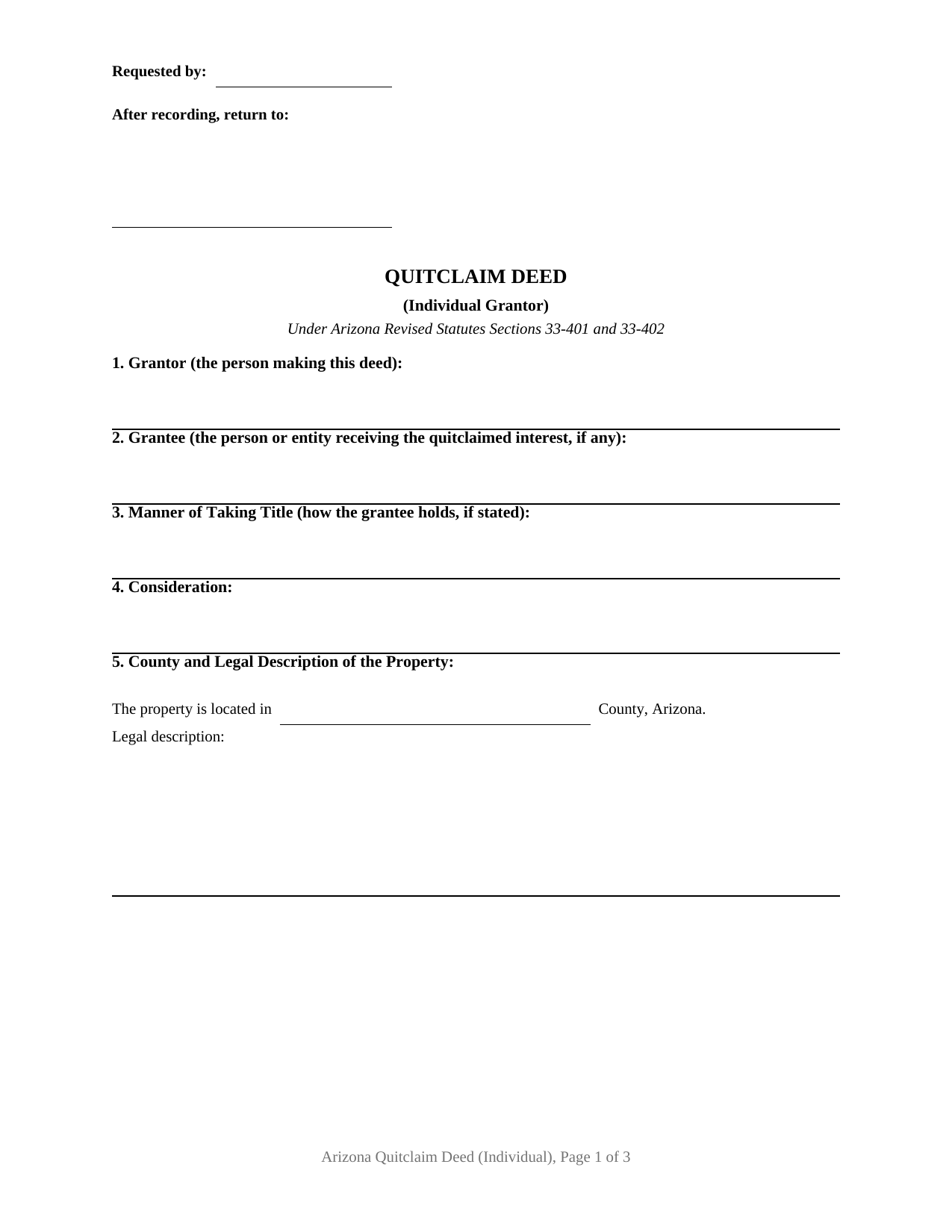
The same name can appear on both sides of this Arizona quitclaim deed. The form is drafted for a single individual grantor: one person who signs alone before a notary and quitclaims whatever right, title, interest, or claim, if any, that person holds in Arizona real property, in the statutory wording of A.R.S. Section 33-402(1), with no covenant or warranty of title. And because Arizona lets an owner convey to himself or herself and others to create a stated form of ownership, that one signature can move title standing in one name into any vesting Section 33-431 recognizes, including the survivorship estate the completed example creates.
One grantor, one signature, and why that is enough
Arizona's two-signature rule belongs to community real property: under Section 25-211, what either spouse acquires during the marriage is presumed community, and both spouses join in any disposition or encumbrance of an interest in community real property under Section 25-214(C). Separate property answers to a different section. Under Section 25-213, property owned before marriage or acquired by gift, devise, or descent is the owning spouse's separate property, and Section 25-214(A) gives that spouse sole management and disposition rights over it, so a married grantor conveying separate property signs alone, and an unmarried grantor never had a second signer to begin with. The form recites exactly that configuration: one grantor block with a marital status statement, one signature line, and one acknowledgment certificate on the Section 41-265 short form. It carries no second grantor block and no spousal joinder line.
From one name to a survivorship title
Section 3 of the deed records the manner in which the grantee takes title, and the completed example puts it to work. A married owner in Tempe holds a house as her sole and separate property; she quitclaims to herself and her husband, and Section 3 reads as community property with right of survivorship. Section 33-431(C) expressly permits creating that estate by a transfer from either husband or wife to both husband and wife, so the grantor appears in the grantee section too, and hers is the only signature on the deed. On the first spouse's death the estate vests in the survivor without probate. A deed that states no manner of taking leaves the line reading None stated, and Arizona's statutory defaults take over.
Code B10 on the face of the deed
An Arizona deed that transfers title reaches the recorder with a completed Affidavit of Property Value, Department of Revenue Form 82162, or with a statutory exemption noted on its face; under Section 11-1133(C) a deed carrying neither is refused. The example transfer carries its own entry in the exemption list: Section 11-1134(B)(10) covers a transfer from a husband and wife, or one of them, to both husband and wife to create an estate in community property with right of survivorship, and Section 6 of the deed shows the county convention for claiming it, the notation A.R.S. 11-1134 B10 in the space beneath the legal description. Other entries in the statutory list reach this form's territory as well, among them the no-monetary-consideration quitclaim and the gift. Recording costs the flat thirty dollar statutory fee in every Arizona county, with the two dollar transfer fee of Section 11-1132 already inside it.
Delivered now, recorded for protection
The quitclaim takes effect between grantor and grantee when the deed is delivered. Recording, at the recorder of the county where the property is located, is what protects the grantee afterward: under Section 33-412, an unrecorded conveyance is void as to creditors and later purchasers for value without notice, though it stays binding between the parties themselves. The form is laid out to the Section 11-480 standards, with the caption, ten point minimum type, and the reserved two inch top band on page one whose left portion carries the requesting party and the after-recording return address. One date matters for later signings: beginning September 12, 2026, Arizona's anti-fraud act adds the deed signer's thumbprint to the notary journal and calls for photo identification when a document is recorded in person.
The download contains three pieces: the blank deed as a fillable PDF, a completed example prepared for a Maricopa County parcel, and a section by section guide to the numbered entries, the exemption codes, notarization, and recording. The materials are informational and are not legal advice.
Important: County-Specific Forms
Our quitclaim deed (individual grantor) forms are specifically formatted for each of the 15 counties in Arizona.
After selecting your county, you'll receive forms that meet all local recording requirements, ensuring your documents will be accepted without delays or rejection fees.