Graham County Termination, Cancellation of Easement / Right of Way Form
Last validated October 16, 2026 by our Forms Development TeamFormatted for recording in Graham County, for property anywhere in the county: rural and unincorporated areas as well as Bylas, Central, Eden, Fort Thomas, Pima, Safford, Solomon, Thatcher.
- 3 documents included
- Immediate PDF download
- Formatting guarantee
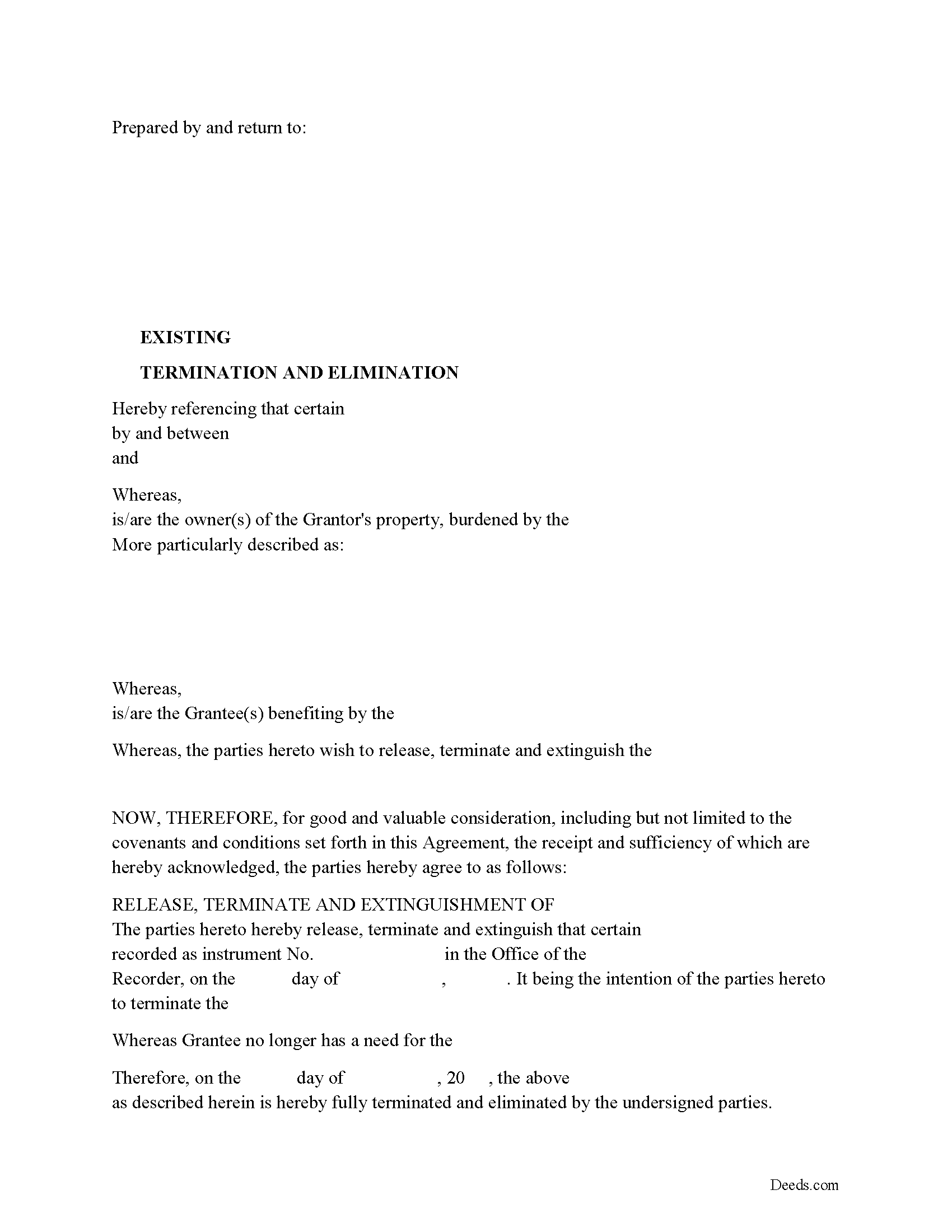
Graham County Release of Easement, Right of Way Form
Fill in the blank form formatted to comply with all recording and content requirements.
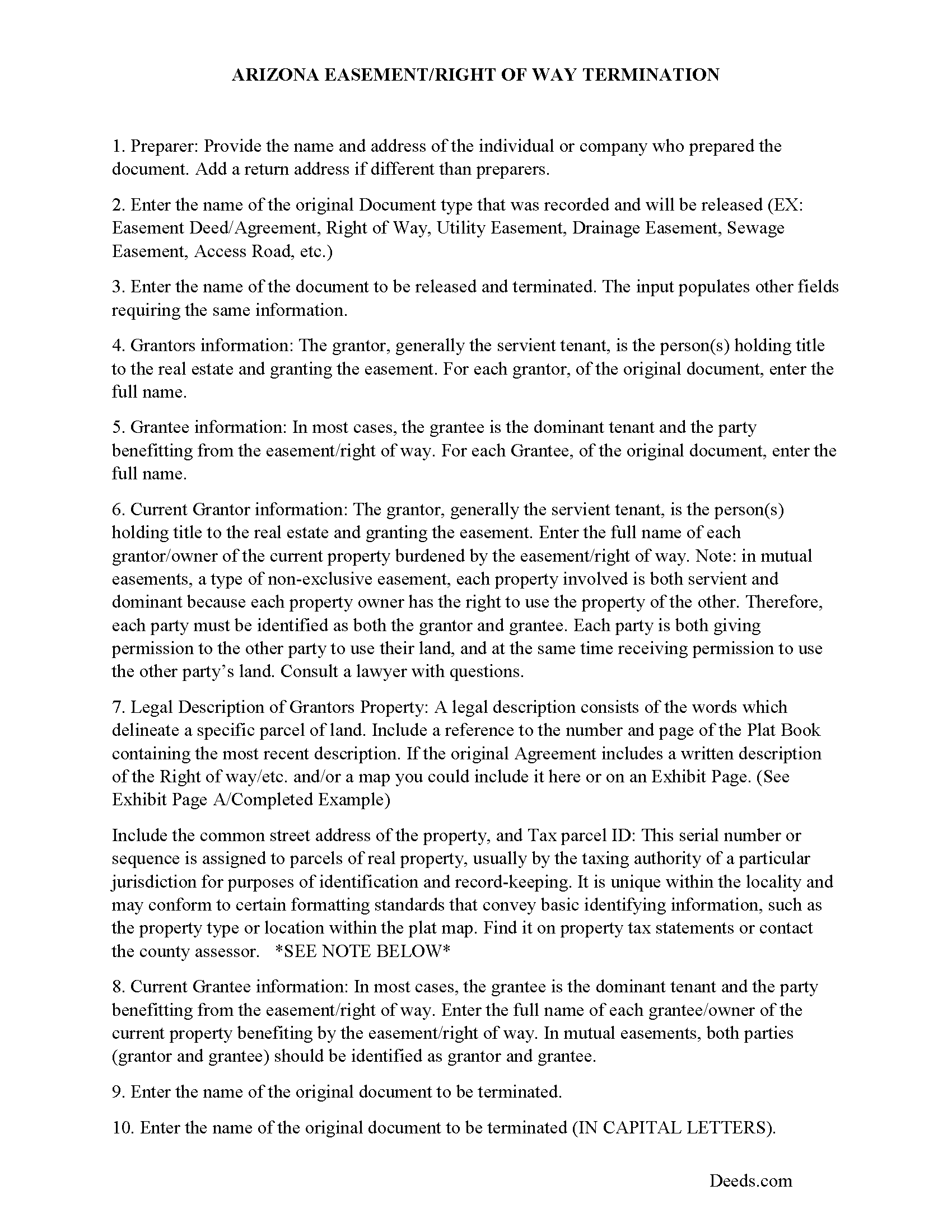
Graham County Guidelines for Release of Easement / Access
Line by line guide explaining every blank on the form.
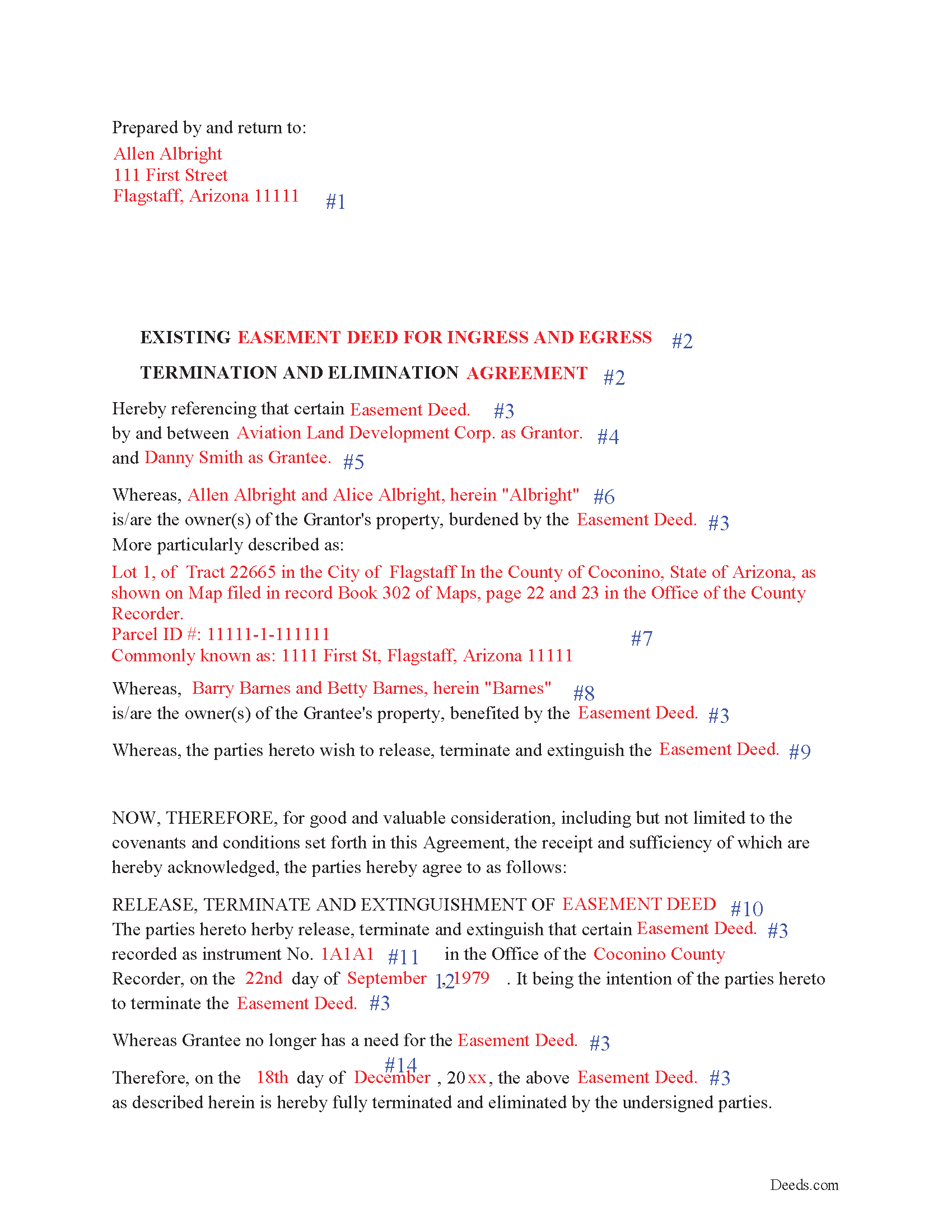
Graham County Completed Example of the Release of Easement / Access Document
Example of a properly completed form for reference.
All 3 documents above included • One-time purchase • No recurring fees
Immediate Download • Secure Checkout
Additional Arizona and Graham County documents included at no extra charge:
Where to Record Your Documents
County Recorder
Safford, Arizona 85546 / 85548
Hours: 7:00 a.m. to 6:00 p.m. Monday through Thursday / e-Recording until 5 on Friday
Phone: 928-428-3560
Recording Tips for Graham County:
- Bring your driver's license or state-issued photo ID
- Ensure all signatures are in blue or black ink
- Leave recording info boxes blank - the office fills these
- Make copies of your documents before recording - keep originals safe
- Recorded documents become public record - avoid including SSNs
Cities and Jurisdictions in Graham County
Properties in any of these areas use Graham County forms:
- Bylas
- Central
- Eden
- Fort Thomas
- Pima
- Safford
- Solomon
- Thatcher
Hours, fees, requirements, and more for Graham County
How do I get my forms?
Forms are available for immediate download after payment. The Graham County forms will be in your account ready to download to your computer. An account is created for you during checkout if you don't have one. Forms are NOT emailed.
Are these forms guaranteed to be recordable in Graham County?
Yes. Our form blanks are guaranteed to meet or exceed the applicable formatting requirements used for recording in Graham County, including margin requirements, font requirements, and other layout standards. This guarantee applies to formatting, not to the legal sufficiency of information entered by the user or the suitability of a form for a particular transaction.
Can I reuse these forms?
Yes. You can reuse the forms for your personal use. For example, if you have multiple properties in Graham County you only need to order once.
What do I need to use these forms?
The forms are PDFs that you fill out on your computer. The free Adobe Acrobat Reader is recommended, and most PDF apps also work. You do NOT enter your property information online - you download the blank forms and complete them privately on your own computer.
Are there any recurring fees?
No. This is a one-time purchase. Nothing to cancel, no memberships, no recurring fees.
How much does it cost to record in Graham County?
Recording fees in Graham County vary. Contact the recorder's office at 928-428-3560 for current fees.
Questions answered? Let's get started!
The Arizona Termination of Easement form releases a previously recorded easement or right-of-way interest and clears the encumbrance from the servient parcel's title. Because an easement is a real property interest under Arizona law, extinguishing it requires the same formalities as creating it — a written instrument signed by the party giving up the right, acknowledged before a notary, and recorded in the county where the burdened property is located. Until the termination is recorded, the easement remains a cloud on the title: a buyer running a title search will still find the original grant and will assume the right continues to exist, regardless of any private understanding between the parties.
When the Arizona Termination of Easement Is Used
This form is used when the holder of an easement — the party with the right to use or cross someone else's land — no longer needs the access and is willing to release the interest back to the servient owner. Typical scenarios include a driveway easement that becomes unnecessary when the benefiting parcel gains direct road frontage, a utility easement that is abandoned when lines are relocated or decommissioned, a drainage easement that is released when drainage is rerouted, a right-of-way that becomes redundant after a subdivision reconfiguration, and shared-access easements that are mutually released when the parties agree the arrangement is no longer serving its purpose. The instrument is also used at the conclusion of a time-limited easement, to put the expiration clearly on the record rather than relying on the stated term alone.
How Easements End Under Arizona Law
Arizona recognizes several ways an easement can terminate, and the termination deed is only one of them. A written release by the easement holder, acknowledged and recorded, is the cleanest method and the one this form is built for. Easements also terminate by merger, when the dominant and servient estates come into common ownership — the interest cannot burden land the same party owns in fee. Easements may end by their own terms when a stated duration expires or a stated purpose is accomplished, by abandonment where the holder's conduct shows a clear intent to relinquish the right, and in limited circumstances by adverse possession or prescription when the servient owner uses the easement area in a way inconsistent with the easement for the statutory period. Regardless of which doctrine actually ended the interest, recording an express termination is the practical way to clear the title record, because a title examiner cannot verify merger, abandonment, or prescription from the indexed documents alone.
Reference to the Original Easement
A termination deed must be tied to the specific easement it is releasing. The instrument should identify the original easement by the recording date, recording reference (docket and page or instrument number), county of recording, and the names of the original grantor and grantee on the easement grant. The legal description of the servient parcel from the original easement should be recited, along with a description of the easement area if the easement covered only a defined portion of the property. Without that explicit tie, the county recorder's index will not link the termination to the original, and a later title search may pick up the original grant without finding the release. This is not a drafting detail — it is the mechanism by which the release actually clears the title.
Who Must Sign
The essential signature is the easement holder's — the party releasing the interest. For an appurtenant easement, that is the current owner of the dominant estate, which may or may not be the original grantee named in the easement grant (the interest runs with the dominant land and passes to successor owners). For an easement in gross, it is the individual or entity that holds the right directly — typically a utility company for utility easements. Many termination deeds are signed by both the releasing party and the servient owner, which is not strictly required in every case but is the cleaner practice: it confirms both parties' understanding of what is being released and avoids later arguments about the scope of the termination.
When the releasing party is an entity or utility, the signatory's representative capacity should appear in the signature block, and any underlying authority should be available if the recorder or a title insurer requests it. Arizona is a community property state, and when the holder of the easement is a married individual rather than an entity, both spouses should sign if the easement is community property under ARS 25-211, because it is an interest in real property and a release by one spouse alone is voidable by the other.
Conservation Easements Require Different Treatment
Termination of a conservation easement under ARS 33-271 et seq. is not a matter a typical release form can handle. Conservation easements are generally created in perpetuity and carry meaningful public-benefit consequences — federal tax deductions on the original grant, state and local conservation programs relying on the continued restriction, and public or charitable holders with fiduciary duties. Termination or substantial modification of a conservation easement typically requires judicial proceedings, consent of the governmental or charitable holder, and in many cases consent of the attorney general or other state officer charged with oversight of charitable trusts. The Arizona Termination of Easement form in this package is not appropriate for conservation easements; those releases should be handled through counsel with specific experience in conservation easement law.
Execution and Acknowledgment
Under ARS 33-401, a release of an interest in real property must be in writing, subscribed by the party releasing, and acknowledged before a notary public or other officer authorized to take acknowledgments. Arizona does not require subscribing witnesses. Acknowledgments taken outside Arizona must comply with ARS 33-501, which recognizes notaries, judges and clerks of courts of record, and any other officer authorized to perform notarial acts in the jurisdiction where the acknowledgment is taken. The execution formality for a release is identical to the formality for the original grant.
Affidavit of Property Value Exemption
Arizona requires an Affidavit of Property Value to accompany most instruments transferring an interest in real property (ARS 11-1133), and by its terms the requirement reaches documents affecting easements. A termination deed typically qualifies for an exemption under ARS 11-1134 because no property is actually being transferred — the instrument is releasing an existing interest back to the servient owner, usually without consideration. The exemption still has to be claimed on the face of the instrument: a statement that the transfer is exempt, with a citation to the specific exemption subsection, must appear below the legal description. When a release is given for meaningful consideration — for example, a utility paying the servient owner to relinquish a corridor it no longer needs — the transaction may not be exempt and the affidavit may be required.
Formatting and Recording
ARS 11-480 sets formatting requirements for every recordable instrument: legible type of at least ten points, white paper no larger than 8.5 by 14 inches, a caption identifying the document (for example, "Termination of Easement" or "Release of Easement"), a top margin of at least two inches on the first page reserved for the recorder's stamp, and minimum half-inch margins elsewhere. County recorders reject non-conforming documents, and several counties enforce the first-page margin rule strictly.
Record the termination in the same county where the original easement was recorded. Recording is what actually removes the easement from the chain of title — an unrecorded release leaves the easement visible to later title examiners, who will treat it as a continuing encumbrance on the servient parcel. Arizona's race-notice rule at ARS 33-412 means that unrecorded releases are ineffective against subsequent purchasers for value who record first without notice of the release. Contact the county recorder in advance to confirm current fees and accepted forms of payment.
What's Included in the Download Package
The Arizona Termination of Easement package includes the form drafted to reference the original easement's recording information, recite the release, and claim the ARS 11-1134 exemption on the face of the instrument, detailed guidelines covering the Arizona-specific drafting and recording requirements, and a completed example showing how the form should look for a typical easement release. All files are available for instant download after purchase.
Important: Your property must be located in Graham County to use these forms. Documents should be recorded at the county recording office listed above.
This Termination, Cancellation of Easement / Right of Way meets all recording requirements specific to Graham County.
Our Promise
The documents you receive here are guaranteed to meet or exceed the applicable Graham County recording format requirements. If there is a rejection caused by our formatting, we will correct the issue or refund your payment. This guarantee applies to document formatting only and does not extend to information entered by the user, the selection of the form, or the legal effect of the completed document.
Save Time and Money
Get your Graham County Termination, Cancellation of Easement / Right of Way form done right the first time with Deeds.com Uniform Conveyancing Blanks. At Deeds.com, we understand that your time and money are valuable resources, and we don't want you to face a penalty fee or rejection imposed by a county recorder for submitting nonstandard documents. We constantly review and update our forms to meet rapidly changing state and county recording requirements for roughly 3,500 counties and local jurisdictions.
4.8 out of 5 - ( 4,830 Reviews )
Carol D. 5 out of 5 stars
No review provided.
Thank you!
Jessica H. 5 out of 5 stars
As a first time user I was a little skeptical of the service. But Deeds.com put all my worries aside. Their service is quick and easy. I will definitely be using it again.
We appreciate your business and value your feedback. Thank you. Have a wonderful day!
Julius D. 5 out of 5 stars
Worked great....WV accepted this document and made the whole process easy...thanks
We appreciate your business and value your feedback. Thank you. Have a wonderful day!
Nick J. 4 out of 5 stars
We aimed to handle a survivorship affidavit (deed change) without a lawyer following my dad's death. After some searching, deeds.com seemed to have the most comprehensive and "correct looking" form we could find for our locale, so we went with it, and it was accepted by our recorder's office. I'm not sure why our local government office doesn't offer a standard form, but they don't, and deeds.com came through for us in a pinch.
We appreciate your business and value your feedback. Thank you. Have a wonderful day!
Marcia H. 5 out of 5 stars
This was so easy and fast! Plus it had all the information I needed in one place. The example was right on point too!
Thank you for your feedback. We really appreciate it. Have a great day!
Daniel C. 5 out of 5 stars
This is a wonderful service and your staff is very responsive through the chat. My one suggestion is that there be an added sentence to your instructions that sates that once you upload there is nothing more to do as in a "submit" or "Finished uploading" button. After uploading instinct says there is something to click to let you all know that we have finished with our uploads.
Your feedback is valuable to us and helps us improve. Thank you for sharing your thoughts!
Dale S. 5 out of 5 stars
I used the Affidavit of Death form provided by Deeds.com. The form and directions were easy to follow. I took the form to the county clerk's office for filing after getting it notarized. They accepted the form with no issues. A task that many people go to a lawyer complete was completed easily by me in less than an hour.
Thanks, Dale! Glad it worked exactly as it should — clear form, smooth filing, no issues at the clerk's office. That's the goal every time.
Donna J. 5 out of 5 stars
what do you do with it once filled out. doesn't tell you
Generally, once the documents are completed and executed they are recorded with the recorder where the property is located.
LEON S. 5 out of 5 stars
recorded deed space to small for corrective deed requirement
Thank you for your feedback. We really appreciate it. Have a great day!
Darrell D. 5 out of 5 stars
Thx. Easy to research and download. Now proof is in the pudding. :-)
Thank you for your feedback. We really appreciate it. Have a great day!
Frank T. 5 out of 5 stars
Great service, fast easy to use, accurate forms for our project. Thank you. FTM
Thank you for your feedback. We really appreciate it. Have a great day!
Melody P. 5 out of 5 stars
Thanks again for such excellent service, and always a pleasure!
Thank you!
Bryan A. 5 out of 5 stars
Very easy thank you for this quick process.
Thank you for the kind words Bryan.
Linda P. 5 out of 5 stars
Once I found this site the rest was easy. I read through the guide but the example really helped the most. Very easy!!!
We appreciate your business and value your feedback. Thank you. Have a wonderful day!
Steve F. 5 out of 5 stars
Fast Service, Easy to use. Highly Recommend!
Thank you!