Graham County Certificate of Trust Form
Last validated September 21, 2026 by our Forms Development TeamFormatted for recording in Graham County, for property anywhere in the county: rural and unincorporated areas as well as Bylas, Central, Eden, Fort Thomas, Pima, Safford, Solomon, Thatcher.
- 3 documents included
- Immediate PDF download
- Formatting guarantee
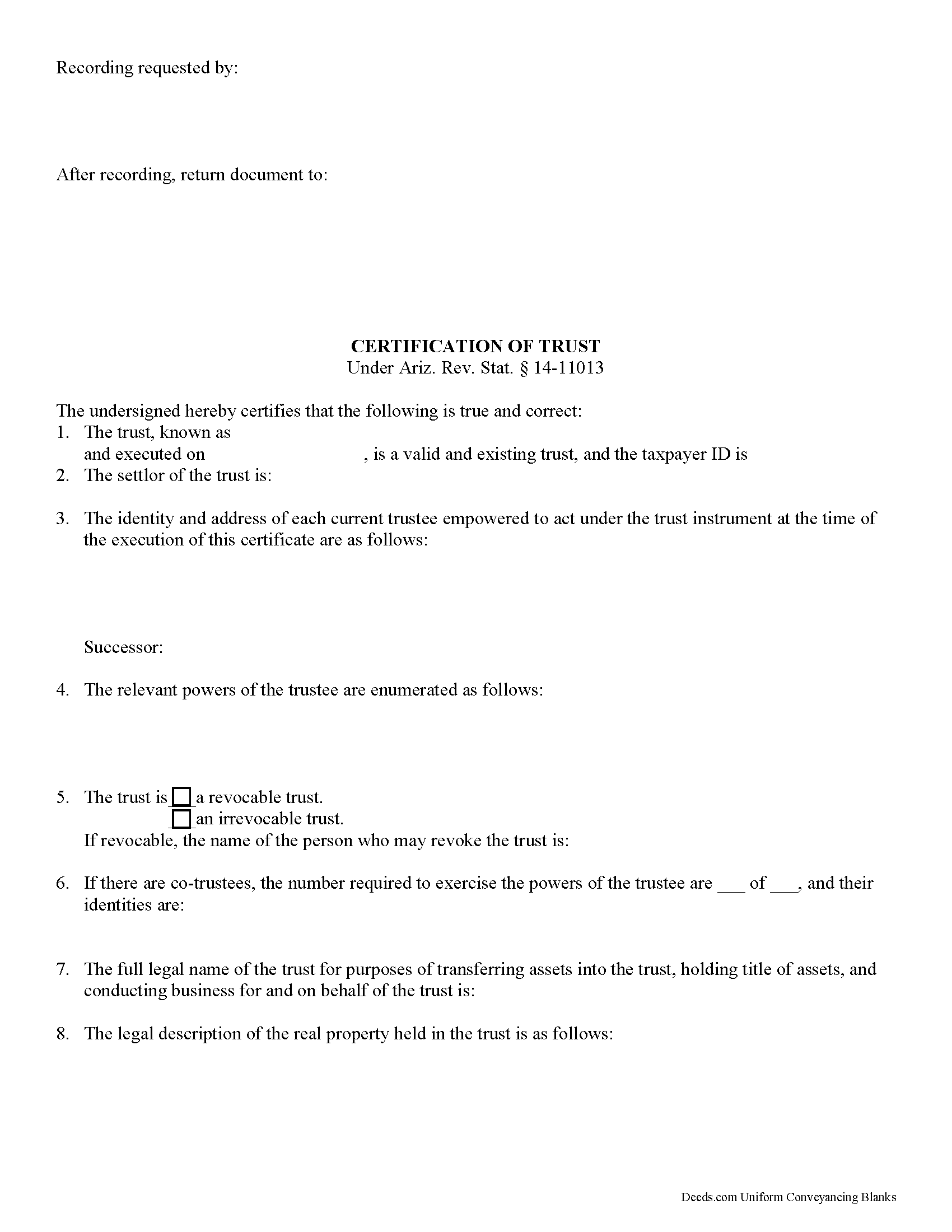
Graham County Certificate of Trust Form
Fill in the blank form formatted to comply with all recording and content requirements.
Graham County Certificate of Trust Guide
Line by line guide explaining every blank on the form.
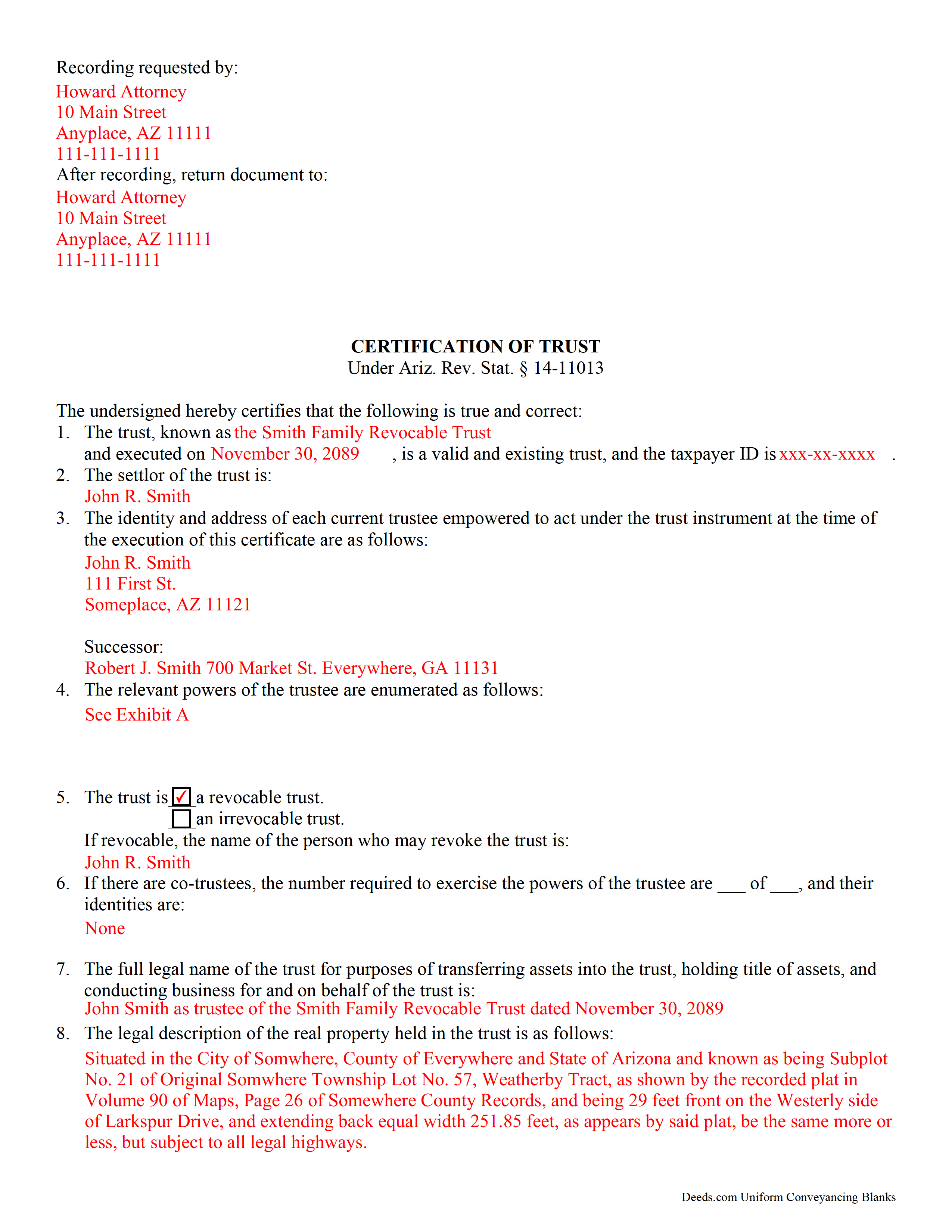
Graham County Completed Example of the Certificate of Trust Document
Example of a properly completed form for reference.
All 3 documents above included • One-time purchase • No recurring fees
Immediate Download • Secure Checkout
Additional Arizona and Graham County documents included at no extra charge:
Where to Record Your Documents
County Recorder
Safford, Arizona 85546 / 85548
Hours: 7:00 a.m. to 6:00 p.m. Monday through Thursday / e-Recording until 5 on Friday
Phone: 928-428-3560
Recording Tips for Graham County:
- Bring your driver's license or state-issued photo ID
- Ensure all signatures are in blue or black ink
- White-out or correction fluid may cause rejection
- Ask about their eRecording option for future transactions
- Avoid the last business day of the month when possible
Cities and Jurisdictions in Graham County
Properties in any of these areas use Graham County forms:
- Bylas
- Central
- Eden
- Fort Thomas
- Pima
- Safford
- Solomon
- Thatcher
Hours, fees, requirements, and more for Graham County
How do I get my forms?
Forms are available for immediate download after payment. The Graham County forms will be in your account ready to download to your computer. An account is created for you during checkout if you don't have one. Forms are NOT emailed.
Are these forms guaranteed to be recordable in Graham County?
Yes. Our form blanks are guaranteed to meet or exceed the applicable formatting requirements used for recording in Graham County, including margin requirements, font requirements, and other layout standards. This guarantee applies to formatting, not to the legal sufficiency of information entered by the user or the suitability of a form for a particular transaction.
Can I reuse these forms?
Yes. You can reuse the forms for your personal use. For example, if you have multiple properties in Graham County you only need to order once.
What do I need to use these forms?
The forms are PDFs that you fill out on your computer. The free Adobe Acrobat Reader is recommended, and most PDF apps also work. You do NOT enter your property information online - you download the blank forms and complete them privately on your own computer.
Are there any recurring fees?
No. This is a one-time purchase. Nothing to cancel, no memberships, no recurring fees.
How much does it cost to record in Graham County?
Recording fees in Graham County vary. Contact the recorder's office at 928-428-3560 for current fees.
Questions answered? Let's get started!
The Arizona Certificate of Trust is the statutory instrument authorized by ARS 14-11013 that establishes a trust's existence and a trustee's authority to act on behalf of the trust without requiring disclosure of the full trust instrument. The mechanism solves a specific problem Arizona trust beneficiaries and trustees otherwise face: every time the trust needs to deal with a bank, title company, broker, escrow officer, or other counterparty, that counterparty wants to see evidence of the trust before proceeding — and handing over the complete trust instrument would expose every dispositive provision, every beneficiary's share, every contingent distribution, and every family detail the settlor considered private. The certificate of trust lets the trustee prove what needs to be proven (the trust exists, the trustee is currently acting, the trustee has authority for this transaction) while keeping the rest of the document private. Arizona law, like the Uniform Trust Code it draws from, extends specific protection to parties who rely in good faith on a certification, so the certificate is not just a convenience — it is a legally sufficient substitute for the trust instrument in most transactional contexts.
When the Arizona Certificate of Trust Is Used
Certificates of trust are used whenever someone needs to verify a trust's existence and a trustee's authority but does not need the full details of the trust. Typical scenarios include opening a bank or brokerage account in the trust's name, selling or buying real estate held by the trust (where the title company and counterparty want to confirm the trust and the trustee's power), refinancing trust-held real estate with a new lender, executing leases of trust property, entering significant contracts on behalf of the trust, pledging trust assets as collateral, dealing with a government agency in the trust's name, and presenting trust documentation to insurance companies and other institutional counterparties. The certificate is typically requested at the beginning of each transaction or relationship and may need to be refreshed for significant transactions, because counterparties want current confirmation that the trust has not been revoked or the trustee replaced since any earlier certificate they saw.
What the Certificate Contains — ARS 14-11013
ARS 14-11013(B) specifies the content a certificate of trust should contain to function under the statute. The core elements are the statement that the trust exists and the date of the trust instrument, the identity of the settlor (the person who created the trust), the identity and address of the currently acting trustee, the powers of the trustee relevant to the transaction at hand, the manner in which title to trust property is taken (the convention used when naming the trustee on deeds and other ownership documents), the revocability or irrevocability of the trust, and whether more than one trustee is required to act or whether any trustee may act alone. The certificate may also contain any other matters the trustee considers appropriate to include, and it typically reflects any amendments to the trust that affect the information being certified.
The certificate should be signed by the trustee under penalty of perjury, with the certification that the statements are true and correct and that the trust is currently in force. When multiple trustees are acting, each should typically sign, though the specific practice depends on the trust instrument's requirements and the counterparty's preferences.
What the Certificate Intentionally Omits
The power of the certificate comes from what it leaves out as much as from what it includes. A certificate of trust does not disclose the dispositive provisions of the trust — who receives what, in what shares, at what ages, or under what conditions. It does not reveal successor beneficiary designations that might embarrass or upset current beneficiaries. It does not expose the settlor's estate planning rationale or any family dynamics the settlor wished to handle privately. It does not identify the specific assets in the trust beyond any relevant to the transaction at hand. It does not disclose tax planning features, generation-skipping provisions, or other sophisticated planning that the settlor may have preferred to keep within the family. The counterparty gets exactly what the counterparty needs — confirmation of the trust and the trustee's authority — and nothing else.
The Reliance Protection — ARS 14-11013(D)
ARS 14-11013(D) extends protection to parties who act in reliance on a certification of trust without knowing that the certification is materially incorrect. A person who relies in good faith on a certification is not liable for any action taken and is not required to inquire further into the matters certified. This reliance protection is what makes the certificate a full substitute for the trust instrument in practice — without it, a counterparty might demand the full trust document anyway out of caution. With it, the counterparty can rely on the certificate as evidence of the facts it certifies and conduct the transaction on that basis.
The protection runs to the counterparty, not to the trustee. A trustee who provides an inaccurate certification — whether intentionally or negligently — can be held liable for the consequences. The counterparty is protected because the counterparty relied in good faith; the trustee who made the inaccurate representations is not. This allocation of risk is why trustees should take the preparation of the certification seriously and should not simply fill in a boilerplate template without confirming the representations against the current state of the trust.
Trustee Liability for Certification Statements
The trustee's personal liability for the accuracy of the certification is a meaningful feature of the Arizona framework. Misrepresentations — whether about the trust's existence (claiming a current trust that has actually been revoked), the trustee's identity (certifying as trustee when the trustee has been replaced), the trust's revocability (representing a revocable trust as irrevocable or vice versa), or the trustee's powers (claiming authority the instrument does not grant) — can expose the trustee to claims by beneficiaries who were harmed, by counterparties who sue the certifying trustee when they discover the truth, and potentially to the trust itself through surcharge proceedings. Because the certification is signed under penalty of perjury, significant misrepresentations can also raise criminal concerns.
The practical consequence is that a trustee should prepare each certification from the current trust instrument, not from memory or from an old template that may be out of date. When the trust has been amended, the certification should reflect the amendments. When the trustee has changed, the new trustee should prepare their own certification rather than relying on the predecessor's. When the trustee's powers have been modified by amendment or by the trust's terms coming to operate differently as the beneficiaries reach different ages, the certification should reflect the current scope of authority. Cutting corners on the certification preparation undermines both the trustee's liability position and the effectiveness of the certificate as a substitute for the trust instrument.
The Right to Demand the Full Trust Instrument
ARS 14-11013(E) preserves a counterparty's right to request excerpts from the trust instrument that designate the trustee or confer the power being exercised, but generally prohibits the counterparty from demanding the full trust instrument merely as a condition of dealing with the trustee. In other words, a bank or title company can ask for the specific provisions relevant to the transaction (which might include the trustee designation provisions and the trustee powers provisions), but cannot refuse to deal with the trustee without seeing the dispositive beneficiary provisions. The counterparty who insists on the full instrument anyway may be liable for damages caused by unreasonable demands — the statute treats the certification as sufficient, and the counterparty who refuses to accept it does so at the counterparty's own risk.
In practice, well-run title companies, banks, and institutional counterparties are familiar with the certification framework and accept it without demanding more. Less experienced counterparties sometimes push for the full instrument out of unfamiliarity, and the trustee may need to educate them about the statute — or, if the counterparty remains uncooperative, find another counterparty willing to work within the Arizona framework. The trustee is not obligated to give up the trust's privacy to accommodate a counterparty's unfamiliarity with the statute.
Certificate Versus Affidavit of Successor Trustee
The certificate of trust is distinct from the affidavit of successor trustee that is recorded against specific real property when trusteeship changes. The affidavit of successor trustee is recorded in the county land records to update the chain of title for specific parcels when a trustee succession has occurred; it is a property-specific instrument that becomes part of the public record. The certificate of trust is a working document used in day-to-day transactions — not typically recorded — that serves as the current evidence of the trust's existence and the trustee's authority for the specific transaction at hand. Many trust administrations use both: the affidavit is recorded when trusteeship changes to update the chain for properties held in trust, and certificates are prepared as needed for specific transactions thereafter. The two work together without duplicating each other's function.
Revocable Versus Irrevocable Trusts
Both revocable and irrevocable trusts use certificates, but with different disclosures. For a revocable trust, the certificate typically states that the trust is revocable and may identify the person with the power to revoke (often the settlor). For an irrevocable trust, the certificate states that the trust is irrevocable and typically references the irrevocable character in its description of the trustee's authority. Counterparties sometimes need to know whether they are dealing with a revocable or irrevocable trust for their own purposes — particularly for tax withholding or reporting, for creditor protection analysis, or for estate planning coordination — and the certificate's statement on this point is the key representation.
Updating and Refreshing Certifications
Because a certification is a snapshot of the trust's current state, certifications should be updated when the underlying facts change. Trust amendments that change trustee powers should be reflected in new certifications prepared after the amendment. Successor trustees taking over should prepare their own certifications rather than rely on the predecessor's. A certification that is several years old may be questioned by counterparties for freshness, even when the trust has not changed — institutional practice often calls for a current certification (dated within a relatively short window before the transaction) even when the trustee could certify that nothing material has changed. Maintaining a current certification template in the trust's administrative records, ready to be signed and delivered when needed, eases the burden of repeated transactions.
Execution
The certification is signed by the trustee under penalty of perjury. Many Arizona practitioners notarize the signature even though the statute does not strictly require it, because counterparties find notarized documents easier to accept. When the trust requires multiple trustees to act, each should sign the certification as a co-certifier. The certification does not need to be recorded to be effective — it is delivered to the counterparty who needs it, and the counterparty retains it as part of the transaction file. When a specific transaction is going to be recorded (a deed, a deed of trust, an assignment), the underlying recorded instrument goes on the record, not the certification itself.
What's Included in the Download Package
The Arizona Certificate of Trust package includes the certification form drafted around the content requirements of ARS 14-11013(B), with appropriate execution and liability language, detailed guidelines covering the Arizona-specific drafting requirements and the reliance-protection framework that makes the certification work as a substitute for the full trust instrument, and a completed example showing how the form should look for a typical certification. All files are available for instant download after purchase.
Important: Your property must be located in Graham County to use these forms. Documents should be recorded at the county recording office listed above.
This Certificate of Trust meets all recording requirements specific to Graham County.
Our Promise
The documents you receive here are guaranteed to meet or exceed the applicable Graham County recording format requirements. If there is a rejection caused by our formatting, we will correct the issue or refund your payment. This guarantee applies to document formatting only and does not extend to information entered by the user, the selection of the form, or the legal effect of the completed document.
Save Time and Money
Get your Graham County Certificate of Trust form done right the first time with Deeds.com Uniform Conveyancing Blanks. At Deeds.com, we understand that your time and money are valuable resources, and we don't want you to face a penalty fee or rejection imposed by a county recorder for submitting nonstandard documents. We constantly review and update our forms to meet rapidly changing state and county recording requirements for roughly 3,500 counties and local jurisdictions.
4.8 out of 5 - ( 4,830 Reviews )
Ellen O K. 5 out of 5 stars
Good experience. Easy peasy. :)
Thank you Ellen, have a wonderful day!
Robin B. 5 out of 5 stars
I came, I saw, I ordered, I downloaded.
Thank you!
Susan B. 5 out of 5 stars
This package of documents from Deeds.com has been extremely helpful, particularly for one who has never needed this kind of service before and is unfamiliar with legal documents in general. It is well worth the price; I would recommend this company to anyone needing help with legal documents and information.
We appreciate your business and value your feedback. Thank you. Have a wonderful day!
GERALD P. 5 out of 5 stars
Product is as advertised. Most beneficial is including detailed instructions and examples. Most other options did not include instructions.
Thank you for your feedback. We really appreciate it. Have a great day!
Mark E. 5 out of 5 stars
Thank you for your Swift response. Have docs I was looking for!
Thank you for your feedback. We really appreciate it. Have a great day!
John R. 5 out of 5 stars
All the material included made preparing the quit claim deed very easy. Good product.
Thank you for your feedback. We really appreciate it. Have a great day!
John C. 5 out of 5 stars
Ease and speed of recording are remarkable. This is especially true of deeds with problems: I often get feedback within minutes and can correct problems immediately and still complete the filing in the same day. I wish more counties accepted electronic filing! It would be helpful to list counties that do/do not accept electronic filing so I would not have to upload documents to find out my effort was fruitless.
We are grateful for your feedback and looking forward to serving you again. Thank you!
Steve V. 5 out of 5 stars
This service is an amazing time saver. No more trips to the recorder's office. Well worth the service fee.
We are delighted to have been of service. Thank you for the positive review!
Melissa W. 5 out of 5 stars
So easy to use!
Thank you!
Justin S. 5 out of 5 stars
Very useful information
Thank you!
Theadore L. 5 out of 5 stars
Bought a transfer on death deed form and it worked great. Easy to fill out and record with the County. Got some helpful information from the county recorders office before filling out the form. I found out that I could use one deed for 2 properties. Saved me money not having to pay fees for 2 deeds.
We are delighted to have been of service. Thank you for the positive review!
Gary G. 5 out of 5 stars
I'm glad I found this service . Very useful. Time saving
Thank you for your feedback. We really appreciate it. Have a great day!
Michael L. 5 out of 5 stars
Quick and Easy. Much appreciated!
Thank you for your feedback. We really appreciate it. Have a great day!
Michelle D. 5 out of 5 stars
Very professional service, they were timely and proficient with answers and sending in the documents that I requested. Will work with them again in the future
We appreciate your business and value your feedback. Thank you. Have a wonderful day!
Jeff C. 5 out of 5 stars
Had the paperwork that I needed. Was a quick and easy transaction.
We appreciate your business and value your feedback. Thank you. Have a wonderful day!