Yavapai County Trustee Deed Foreclosure Form
Last validated August 28, 2026 by our Forms Development TeamFormatted for recording in Yavapai County, for property anywhere in the county: rural and unincorporated areas as well as Ash Fork, Bagdad, Black Canyon City, Camp Verde, Chino Valley, Clarkdale, Congress, Cornville and 17 more.
- 3 documents included
- Immediate PDF download
- Formatting guarantee
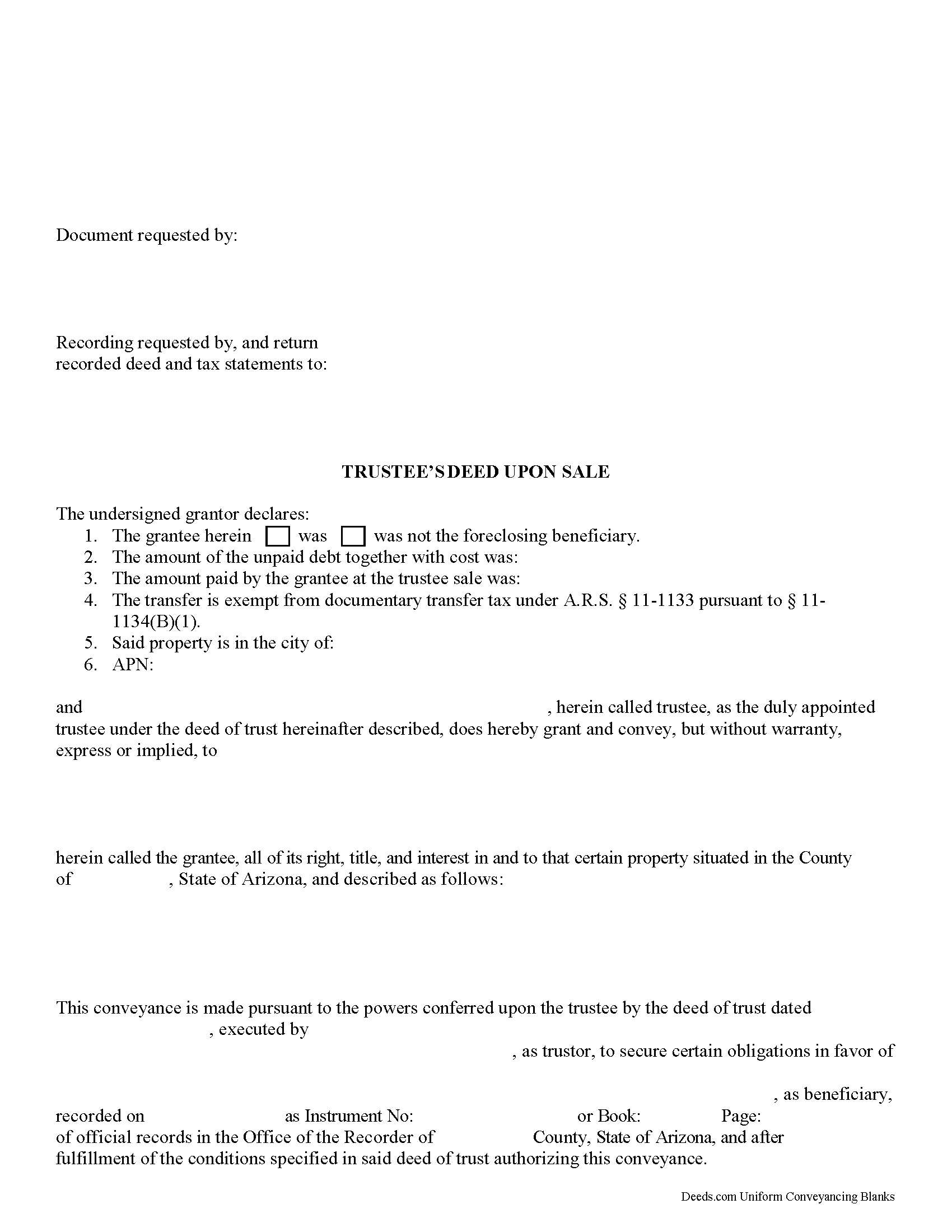
Yavapai County Trustee Deed Due Upon Sale Form
Fill in the blank form formatted to comply with all recording and content requirements.
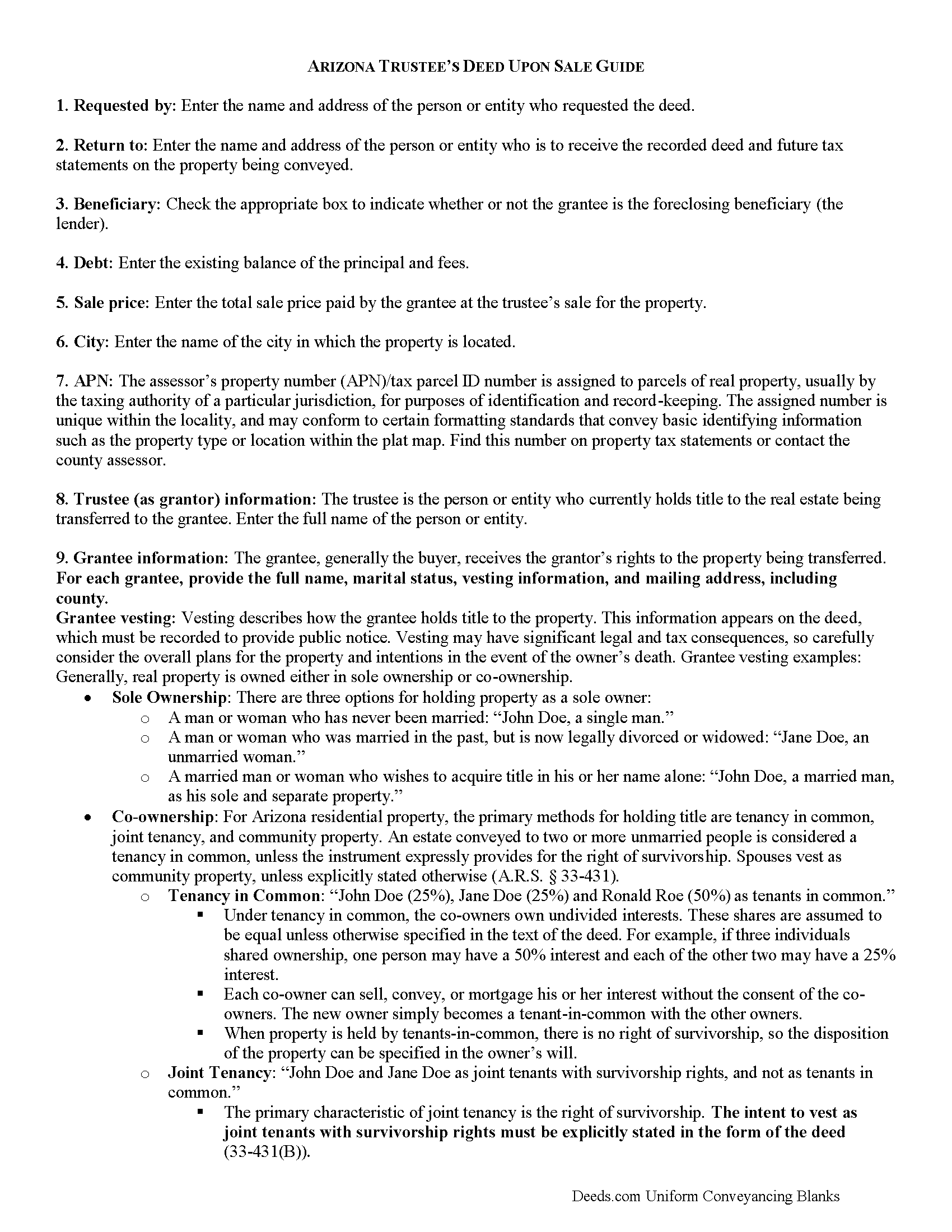
Yavapai County Trustee Deed Upon Sale Guide
Line by line guide explaining every blank on the form.
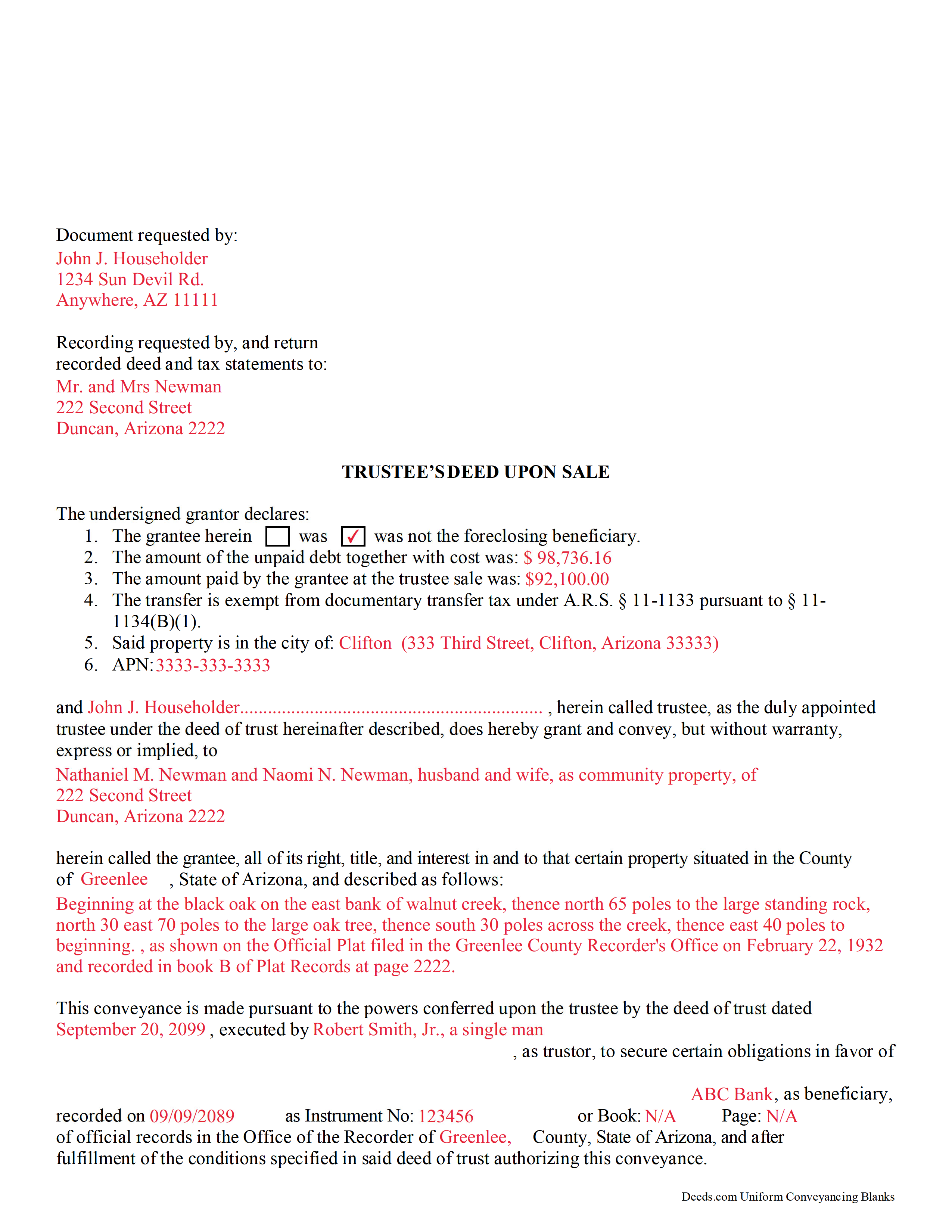
Yavapai County Completed Example of the Trustee Deed Document
Example of a properly completed form for reference.
All 3 documents above included • One-time purchase • No recurring fees
Immediate Download • Secure Checkout
Additional Arizona and Yavapai County documents included at no extra charge:
Where to Record Your Documents
Recorder's Office
Prescott, Arizona 86305-1852
Hours: Monday - Friday 8:00am - 5:00pm
Phone: 928-771-3244
Cottonwood Annex
Cottonwood, Arizona 86326
Hours: Monday - Friday 8:00am - 1:00 & 2:00 - 5:00pm
Phone: (928) 639-5807
Recording Tips for Yavapai County:
- Bring your driver's license or state-issued photo ID
- Ensure all signatures are in blue or black ink
- Check margin requirements - usually 1-2 inches at top
- Leave recording info boxes blank - the office fills these
- Make copies of your documents before recording - keep originals safe
Cities and Jurisdictions in Yavapai County
Properties in any of these areas use Yavapai County forms:
- Ash Fork
- Bagdad
- Black Canyon City
- Camp Verde
- Chino Valley
- Clarkdale
- Congress
- Cornville
- Cottonwood
- Crown King
- Dewey
- Humboldt
- Iron Springs
- Jerome
- Kirkland
- Lake Montezuma
- Mayer
- Paulden
- Prescott
- Prescott Valley
- Rimrock
- Sedona
- Seligman
- Skull Valley
- Yarnell
Hours, fees, requirements, and more for Yavapai County
How do I get my forms?
Forms are available for immediate download after payment. The Yavapai County forms will be in your account ready to download to your computer. An account is created for you during checkout if you don't have one. Forms are NOT emailed.
Are these forms guaranteed to be recordable in Yavapai County?
Yes. Our form blanks are guaranteed to meet or exceed the applicable formatting requirements used for recording in Yavapai County, including margin requirements, font requirements, and other layout standards. This guarantee applies to formatting, not to the legal sufficiency of information entered by the user or the suitability of a form for a particular transaction.
Can I reuse these forms?
Yes. You can reuse the forms for your personal use. For example, if you have multiple properties in Yavapai County you only need to order once.
What do I need to use these forms?
The forms are PDFs that you fill out on your computer. The free Adobe Acrobat Reader is recommended, and most PDF apps also work. You do NOT enter your property information online - you download the blank forms and complete them privately on your own computer.
Are there any recurring fees?
No. This is a one-time purchase. Nothing to cancel, no memberships, no recurring fees.
How much does it cost to record in Yavapai County?
Recording fees in Yavapai County vary. Contact the recorder's office at 928-771-3244 for current fees.
Questions answered? Let's get started!
The Arizona Trustee's Deed Upon Sale is the recorded instrument a trustee uses to convey real property to the successful bidder at the conclusion of a non-judicial foreclosure under ARS 33-807. Arizona's non-judicial foreclosure framework — one of the reasons deeds of trust dominate Arizona real estate financing — requires no court proceeding and moves on a statutory timeline that is materially faster than the judicial foreclosure of a mortgage under ARS 33-721. The trustee's deed is the document that consummates the process: after the trustee has given the required notices, conducted the public sale, and received the successful bidder's payment, the trustee executes and records the deed to transfer title. Because the instrument is issued without warranty and conveys whatever interest was foreclosed (subject to any senior liens), the drafting precision matters — the recital of the completed trustee's sale process is what gives the deed its effect, and defects in the process can translate into defects in the deed.
When the Arizona Trustee's Deed Upon Sale Is Used
This form is used exclusively to close out a non-judicial foreclosure of a deed of trust under ARS 33-807 — the sale of trust property on default. Typical applications include residential foreclosures where the borrower has defaulted on a purchase-money loan, commercial foreclosures where the borrower has defaulted on an investment property loan, private-investor foreclosures of seller-financed notes where the trustor stopped paying on the installment obligation, foreclosures of home equity lines of credit and second deeds of trust where the junior beneficiary proceeds independently, and foreclosures of timeshare estates under ARS 33-2211, where the association or managing entity acts as beneficiary against an owner delinquent in assessment payments. The form is not used for judicial foreclosures — those transfer title through a sheriff's deed after court proceedings — and it is not used for the type of trustee's deed that distributes property out of an inter vivos or testamentary trust, which is a different instrument under different statutes.
Non-Judicial Versus Judicial Foreclosure
Arizona's dual foreclosure system gives lenders a choice of remedies when a loan is secured by a deed of trust. Non-judicial foreclosure under ARS 33-807 moves through the trustee's sale process on a statutory timeline, typically completed in about four months from the recording of the notice of trustee's sale. Judicial foreclosure under ARS 33-721 (traditionally used for mortgages, though available for deeds of trust as well) requires filing a lawsuit, obtaining judgment, and conducting a sheriff's sale — a process that takes many months to more than a year and costs substantially more. The non-judicial path's critical trade-off for the lender is that Arizona's anti-deficiency statute at ARS 33-814 generally prevents the beneficiary from pursuing a deficiency judgment after a trustee's sale on a purchase-money loan secured by residential property of 2.5 acres or less used as a one- or two-family dwelling. Lenders who expect a deficiency and whose loan does not fit the anti-deficiency framework sometimes choose judicial foreclosure specifically to preserve the deficiency claim. For most residential situations, however, non-judicial foreclosure through the trustee's sale process is the default path.
The Trustee's Role and Qualifications
ARS 33-803 limits who may serve as trustee of an Arizona deed of trust. Qualified trustees include active Arizona-licensed attorneys, Arizona-licensed escrow agents, licensed title insurance companies doing business in Arizona, certain banks and savings institutions, and Arizona-licensed real estate brokers acting as escrow agents. These qualification rules apply at the time the trustee conducts the sale, not just at the original execution of the deed of trust. When the named trustee on an older deed of trust is no longer qualified or unavailable, the beneficiary substitutes a successor trustee under ARS 33-804 by recording a substitution of trustee. The substituted trustee then carries out the foreclosure and signs the trustee's deed upon sale. An improperly substituted trustee — or an unqualified trustee proceeding to sale — produces a void or voidable sale, and challenges to trustee qualification are among the more common substantive attacks on trustee's sales.
The Statutory Notice Framework
ARS 33-808 sets the notice requirements that precede a trustee's sale. The trustee records a Notice of Trustee's Sale in the county where the property is located; the notice must contain the specific content required by ARS 33-808(C), including the names of the trustor, beneficiary, and trustee, a description of the property, information about the underlying deed of trust and the default, the date and time of the sale, the sale location, and other statutorily required details. Notice must then be served by mail on the trustor and on other parties entitled to notice under ARS 33-809 — including junior lienholders of record, occupants of the property, and certain other statutorily identified parties. The notice must also be published in a newspaper of general circulation in the county once a week for four consecutive weeks, with the last publication at least ten days before the sale, and posted on the property itself at least twenty days before the sale.
The sale cannot occur earlier than ninety-one days after the notice of trustee's sale is recorded (ARS 33-807(D)), which sets the floor on the timeline from default acceleration to the actual sale. Notice defects — omitted content, deficient service on required parties, publication or posting lapses — are a primary source of trustee's sale challenges, and careful trustees document their compliance meticulously because the burden to show proper notice falls on them when challenges arise.
The Trustor's Right to Reinstate
ARS 33-813 gives the trustor a statutory right to reinstate the loan by paying only the defaulted amount — not the full accelerated balance — together with trustee's fees and statutory costs. This right extends until 5:00 p.m. on the day before the scheduled sale. Reinstatement stops the foreclosure cold: the default is cured, the acceleration is unwound, the notice of trustee's sale is cancelled, and the loan continues on its original terms. This mid-process cure right distinguishes Arizona from jurisdictions where the borrower's only options during foreclosure are payment in full or losing the property, and it is a meaningful protection for borrowers in temporary distress who can catch up but cannot pay off the entire loan. When reinstatement occurs, no trustee's deed upon sale is executed because no sale takes place.
The Sale and the Successful Bidder
The sale itself is conducted by the trustee at the date, time, and location specified in the notice — typically at the courthouse of the county where the property is located, although the trustee may specify another location allowed by statute. The sale is a public auction: the trustee announces the property, opens bidding, and accepts bids until the highest bid is reached. The beneficiary is often the highest bidder, submitting a credit bid up to the amount of the outstanding debt (a credit bid effectively forgives that amount of the debt in exchange for the property). Third-party bidders compete with the beneficiary for cash, and the successful third-party bidder pays the bid amount within the statutory period and takes the property. The successful bidder's payment typically must be tendered immediately or within a short window defined by the notice and statute.
Execution and Recording of the Trustee's Deed
Under ARS 33-811(B), the trustee must execute the trustee's deed upon sale and submit it for recording within seven business days after receiving payment of the successful bid. The deed conveys to the purchaser all of the trustor's right, title, interest, and claim in the property as of the date the deed of trust was recorded, plus any interest the trustor acquired afterward. Under ARS 33-811(E), the deed is issued without warranty — the trustee makes no representations about the quality of title, and the purchaser takes subject to any senior liens that were not extinguished by the foreclosure. Junior liens and interests subordinate to the foreclosed deed of trust are extinguished by the trustee's sale; senior liens and interests continue.
The trustee's deed should recite the key facts of the foreclosure: the underlying deed of trust by recording information, the default and acceleration, the recording of the notice of trustee's sale, the required notices given, the date and location of the sale, the successful bid amount, and the identity of the purchaser. These recitals are important because they establish on the face of the deed that the statutory process was followed. A title examiner evaluating the deed later will rely on the recitals; a well-drafted trustee's deed upon sale contains enough recital detail that the subsequent title chain can be confirmed from the deed itself.
No Post-Sale Redemption
Arizona does not provide a statutory post-sale redemption period for non-judicial foreclosures. Once the trustee's deed upon sale is recorded, the purchaser owns the property; the former trustor has no right to redeem by paying the debt after the sale. This absence of post-sale redemption is one of the primary reasons deeds of trust are preferred over mortgages in Arizona — judicial foreclosure of a mortgage does trigger a statutory redemption period during which the former borrower can recover the property by paying the foreclosure bid amount plus costs. The non-judicial trustee's sale eliminates this post-sale uncertainty for the purchaser.
Effect on Junior Liens and Occupants
The foreclosure extinguishes liens and interests junior to the foreclosed deed of trust. Second deeds of trust, home equity lines, mechanics' liens that attached after the recording of the foreclosed deed of trust, judgment liens recorded against the trustor after the deed of trust, and similar junior encumbrances are wiped out by the trustee's sale. The holders of those junior interests had the right to protect themselves during the foreclosure process by paying off the senior debt, bidding at the sale, or pursuing a judicial action — if they did not, their interests are extinguished. Senior liens — typically a first deed of trust or property tax liens — are not affected by the foreclosure and continue to encumber the property, meaning the purchaser at the trustee's sale of a junior lien takes subject to the senior debt. Occupants of the property (tenants and others) are subject to ARS 33-811(D) and related provisions; tenants with leases predating the deed of trust may have some continuing rights, while tenants who came in later are generally subject to removal by the new owner.
Timeshare Foreclosures Under ARS 33-2211
Arizona's timeshare statute at ARS 33-2211 extends the trustee's sale process to timeshare estates, with the association or other managing entity acting as beneficiary against an owner who is delinquent in assessment payments. The trigger is delinquency for a period of at least one year under ARS 33-2211(A), and the association must issue a notice of delinquency giving the owner thirty days to cure under ARS 33-2211(F). If the delinquency is not cured, the association initiates non-judicial foreclosure under ARS 33-803.01 et seq. — a parallel track to the general ARS 33-807 foreclosure framework, adapted for the specific circumstances of timeshare ownership. The trustee's deed upon sale is used in the same way to convey the timeshare estate to the purchaser at the sale, unless the timeshare instrument itself mandates judicial foreclosure as the sole method under ARS 33-2211(K). Timeshare foreclosures are a specific application of the general framework, and the procedural details under the 33-2200 series should be consulted directly when the foreclosure involves a timeshare.
Affidavit of Property Value
Trustee's deeds upon sale are typically subject to the Affidavit of Property Value requirement under ARS 11-1133, with the consideration reported as the successful bid amount. Specific exemption categories under ARS 11-1134 may apply depending on the circumstances — for example, when the beneficiary acquires the property by credit bid for an amount that does not exceed the outstanding debt, certain reporting accommodations apply. The exemption or applicable affidavit treatment should be confirmed for each sale; the sale amount and the characterization of the successful bidder (beneficiary by credit bid versus third-party purchaser for cash) affect which framework applies.
Formatting and Recording
ARS 11-480 sets the formatting requirements for every recordable instrument: legible type of at least ten points, white paper no larger than 8.5 by 14 inches, a caption identifying the document (for example, "Trustee's Deed Upon Sale"), a top margin of at least two inches on the first page reserved for the recorder's stamp, and minimum half-inch margins elsewhere. Record the trustee's deed upon sale in the county where the property is located within the seven-business-day window of ARS 33-811(B). Confirm current recording fees and accepted forms of payment with the county recorder's office in advance.
What's Included in the Download Package
The Arizona Trustee's Deed Upon Sale package includes the deed form drafted around the ARS 33-811 execution and recording requirements with appropriate recitals for the underlying deed of trust, the notice of sale, the sale itself, and the identity of the purchaser, detailed guidelines covering the Arizona-specific non-judicial foreclosure framework and the drafting and recording requirements for the deed, and a completed example showing how the form should look for a typical trustee's sale transaction. All files are available for instant download after purchase.
Important: Your property must be located in Yavapai County to use these forms. Documents should be recorded at the county recording office listed above.
This Trustee Deed Foreclosure meets all recording requirements specific to Yavapai County.
Our Promise
The documents you receive here are guaranteed to meet or exceed the applicable Yavapai County recording format requirements. If there is a rejection caused by our formatting, we will correct the issue or refund your payment. This guarantee applies to document formatting only and does not extend to information entered by the user, the selection of the form, or the legal effect of the completed document.
Save Time and Money
Get your Yavapai County Trustee Deed Foreclosure form done right the first time with Deeds.com Uniform Conveyancing Blanks. At Deeds.com, we understand that your time and money are valuable resources, and we don't want you to face a penalty fee or rejection imposed by a county recorder for submitting nonstandard documents. We constantly review and update our forms to meet rapidly changing state and county recording requirements for roughly 3,500 counties and local jurisdictions.
4.8 out of 5 - ( 4,836 Reviews )
Martin E. 5 out of 5 stars
documents and guidance need to properly comply with court
Thank you!
Roy C. 5 out of 5 stars
Great Product no problems filing
Thank you for your feedback. We really appreciate it. Have a great day!
Stanley C. 5 out of 5 stars
Amazingly simple, easy to download and use. Excellent service, Thank You
Thank you!
Steven M. 5 out of 5 stars
They always get me the information I need, in a timely manner.
We appreciate your business and value your feedback. Thank you. Have a wonderful day!
John S. 5 out of 5 stars
Your service is refreshingly clear, simple, and free of superfluous claims or unnecessary marketing. And, more affordable than other online legal document providers I've looked at. So nice! I forgot I had used it some years ago for another deed so glad you are still around for this time.
Thank you for the kind words John. Have a fantastic day!
Shawn S. 5 out of 5 stars
Seems to be exactly whst j needed. Great job!
Thank you!
james h. 5 out of 5 stars
Service was quick and easy to use. I got not only the necessary forms, but instructions and sample forms filled out. Highly recommended.
Thank you!
Alfred M. 5 out of 5 stars
It was a simple process and easily understood the process was seamless and I would highly recommend this to anyone looking to do this.
Thank you for your feedback. We really appreciate it. Have a great day!
Deborah Anne C. 5 out of 5 stars
Easy, Comprehensive and most importantly Easy!
We appreciate your business and value your feedback. Thank you. Have a wonderful day!
William M. 5 out of 5 stars
On multiple tries, I could not get validation mail through my Yahoo email address. I tried Gmail, worked the first time. The rest of the process was super easy and fast.
Thank you!
Deborah P. 5 out of 5 stars
Very good information. Easy access and easy to download. All the forms needed for TOD to be notarized and recorded with the county office. Much better than working with a Trust and the expense of lawyers, especially when several parties are involved and the owner of said property knows exactly to whom the property should go. Having forms and instructions available for the public to have their wishes recorded and confirmed makes handling final planning much easier and prevents family members from having the unnecessary task of going through court to solve property distribution issues. Thank you for this site and the forms you provide. I will recommend Deeds.com to those I know who are making final plans.
We appreciate your business and value your feedback. Thank you. Have a wonderful day!
Sam A. 5 out of 5 stars
User friendly website and deeds are very easy to maneuver. I'm very happy with everything Deeds.com has to offer. It truly helped me with the business that I had to take care of.
Thank you!
Bobby Y. 5 out of 5 stars
I like the content and the availability to conduct valuable business online
Thank you!
Jack A. 5 out of 5 stars
First time user. Great service. If I need other forms, I'll definitely be using Deeds.
We appreciate your business and value your feedback. Thank you. Have a wonderful day!
Rachelle S. 5 out of 5 stars
Wow that was easy
Thank you!