Yavapai County Affidavit of Surviving Joint Tenant Form
Last validated October 19, 2026 by our Forms Development TeamFormatted for recording in Yavapai County, for property anywhere in the county: rural and unincorporated areas as well as Ash Fork, Bagdad, Black Canyon City, Camp Verde, Chino Valley, Clarkdale, Congress, Cornville and 17 more.
- 3 documents included
- Immediate PDF download
- Formatting guarantee
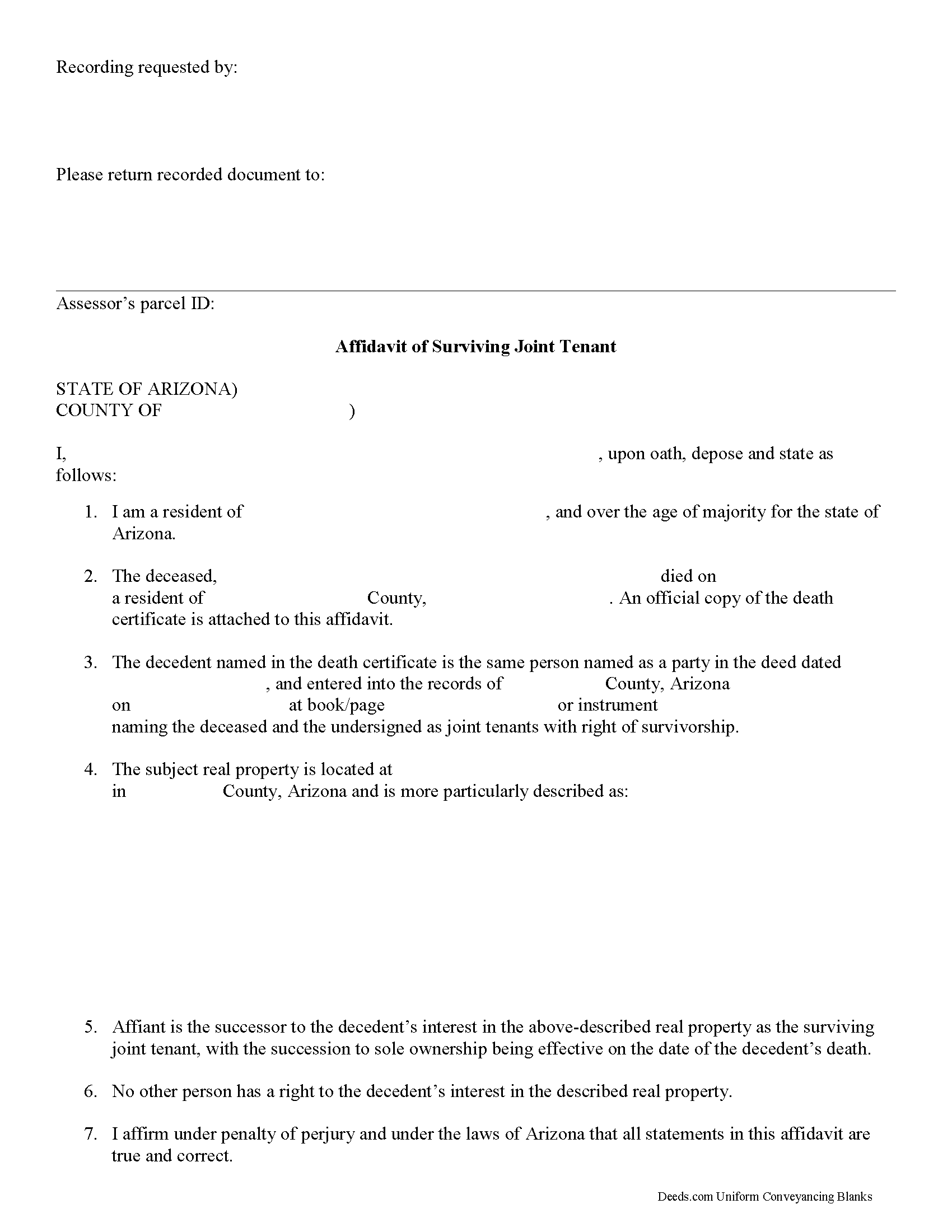
Yavapai County Affidavit of Surviving Joint Tenant Form
Fill in the blank form formatted to comply with all recording and content requirements.
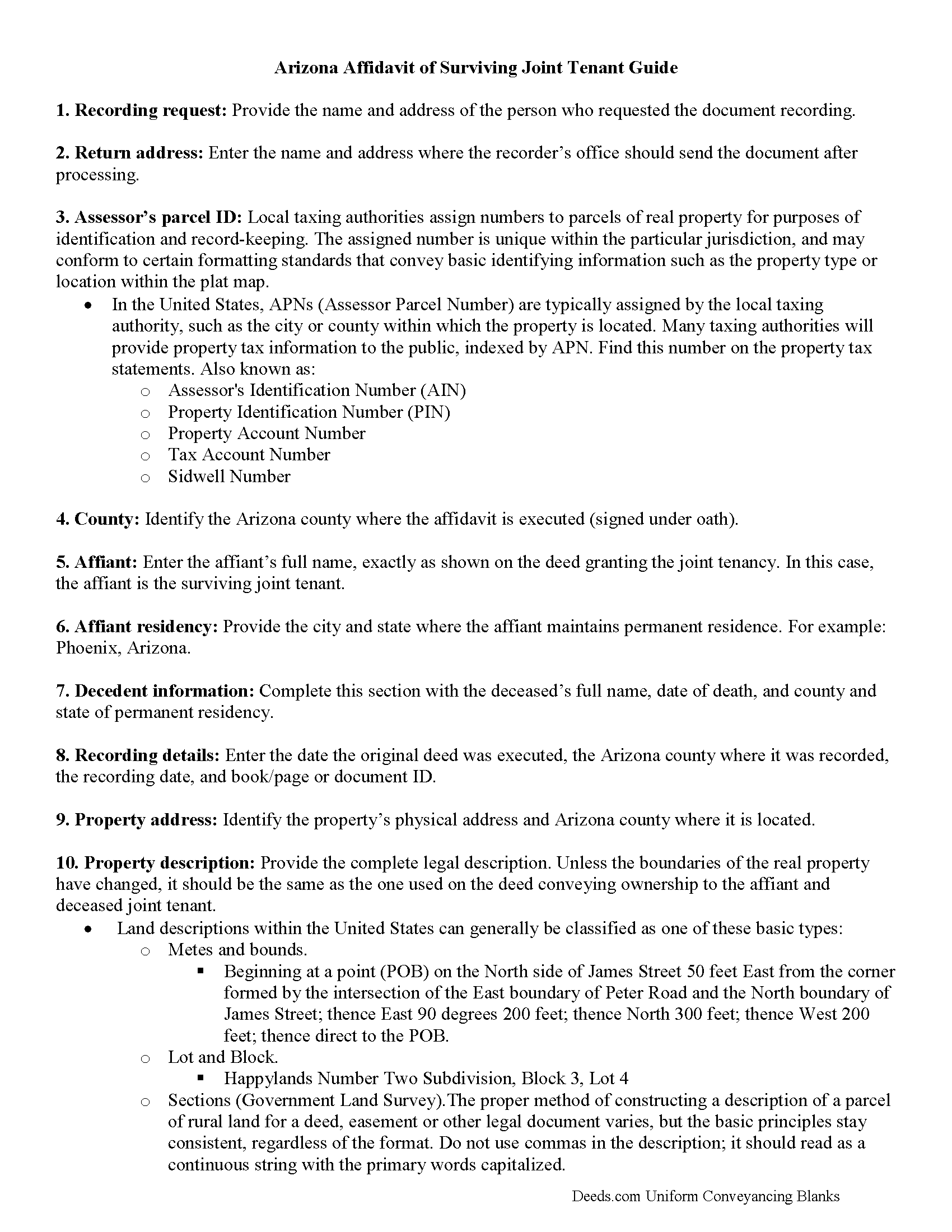
Yavapai County Affidavit of Surviving Joint Tenant Guide
Line by line guide explaining every blank on the form.
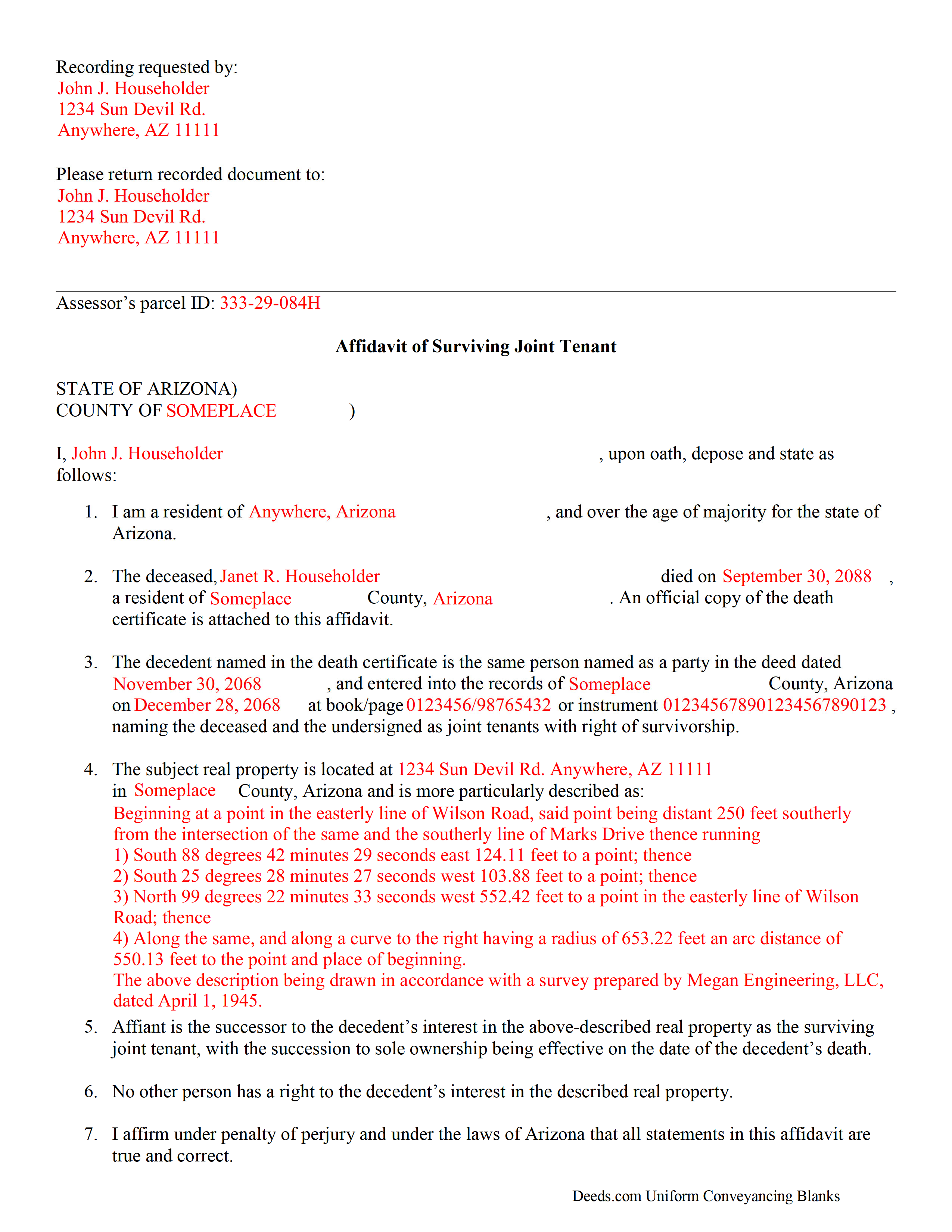
Yavapai County Completed Example of the Affidavit of Surviving Joint Tenant Document
Example of a properly completed form for reference.
All 3 documents above included • One-time purchase • No recurring fees
Immediate Download • Secure Checkout
Additional Arizona and Yavapai County documents included at no extra charge:
Where to Record Your Documents
Recorder's Office
Prescott, Arizona 86305-1852
Hours: Monday - Friday 8:00am - 5:00pm
Phone: 928-771-3244
Cottonwood Annex
Cottonwood, Arizona 86326
Hours: Monday - Friday 8:00am - 1:00 & 2:00 - 5:00pm
Phone: (928) 639-5807
Recording Tips for Yavapai County:
- Bring your driver's license or state-issued photo ID
- Ensure all signatures are in blue or black ink
- Verify all names are spelled correctly before recording
- White-out or correction fluid may cause rejection
- Ask about their eRecording option for future transactions
Cities and Jurisdictions in Yavapai County
Properties in any of these areas use Yavapai County forms:
- Ash Fork
- Bagdad
- Black Canyon City
- Camp Verde
- Chino Valley
- Clarkdale
- Congress
- Cornville
- Cottonwood
- Crown King
- Dewey
- Humboldt
- Iron Springs
- Jerome
- Kirkland
- Lake Montezuma
- Mayer
- Paulden
- Prescott
- Prescott Valley
- Rimrock
- Sedona
- Seligman
- Skull Valley
- Yarnell
Hours, fees, requirements, and more for Yavapai County
How do I get my forms?
Forms are available for immediate download after payment. The Yavapai County forms will be in your account ready to download to your computer. An account is created for you during checkout if you don't have one. Forms are NOT emailed.
Are these forms guaranteed to be recordable in Yavapai County?
Yes. Our form blanks are guaranteed to meet or exceed the applicable formatting requirements used for recording in Yavapai County, including margin requirements, font requirements, and other layout standards. This guarantee applies to formatting, not to the legal sufficiency of information entered by the user or the suitability of a form for a particular transaction.
Can I reuse these forms?
Yes. You can reuse the forms for your personal use. For example, if you have multiple properties in Yavapai County you only need to order once.
What do I need to use these forms?
The forms are PDFs that you fill out on your computer. The free Adobe Acrobat Reader is recommended, and most PDF apps also work. You do NOT enter your property information online - you download the blank forms and complete them privately on your own computer.
Are there any recurring fees?
No. This is a one-time purchase. Nothing to cancel, no memberships, no recurring fees.
How much does it cost to record in Yavapai County?
Recording fees in Yavapai County vary. Contact the recorder's office at 928-771-3244 for current fees.
Questions answered? Let's get started!
The Arizona Affidavit of Surviving Joint Tenant is the recorded instrument used to confirm that real property held in joint tenancy with right of survivorship has passed to the surviving co-owner at the death of another joint tenant. Arizona joint tenancy works automatically: the moment a joint tenant dies, that tenant's interest extinguishes and the survivor owns the whole, without any court process or probate. But Arizona's recorder of deeds does not know about the death until someone records something that brings it into the chain of title. Until that happens, the public record continues to show the deceased tenant on title alongside the survivor, which blocks resale, refinance, and clean title insurance. This affidavit — recorded with a certified copy of the death certificate — is the most common way to update the record and put the survivor's sole ownership on the books.
When the Arizona Affidavit of Surviving Joint Tenant Is Used
This affidavit is used specifically for Arizona real property held in joint tenancy with right of survivorship, where one joint tenant has died and the surviving tenant wants to confirm sole ownership on the record. Typical scenarios include a spouse dying when the property was deeded to the couple as joint tenants with right of survivorship (as opposed to community property or community property with right of survivorship, which are separate Arizona forms discussed below), a parent-child joint tenancy where the parent dies, siblings holding inherited family property in joint tenancy where one has died, and unrelated co-owners who chose joint tenancy for survivorship planning. The affidavit is not appropriate for property held as tenants in common — tenants in common have no survivorship rights, so the decedent's share passes by will or intestacy through probate rather than to the surviving co-owner.
Joint Tenancy Versus Community Property in Arizona
Arizona recognizes several forms of concurrent ownership, and they do not all transfer at death the same way. This matters because the wrong form can be used out of habit or inattention, and the recorded documents need to match the actual vesting. ARS 33-431 covers the forms available under Arizona law: tenancy in common (no survivorship), joint tenancy with right of survivorship (survivorship rights, available to married and unmarried co-owners), community property (available only to married couples, no survivorship, decedent's half passes through the estate), and community property with right of survivorship (available only to married couples, survivorship rights, preferred form for married homeownership because it combines survivorship with the full stepped-up basis available under community property rules).
A surviving joint tenant affidavit is for joint tenancy with right of survivorship. When the property was held as community property with right of survivorship — a common vesting for Arizona married couples — a similar but distinct affidavit, usually styled as an Affidavit of Surviving Spouse, is the correct instrument, because the underlying property law is different even though the effect is comparable. When the property was held simply as community property without the survivorship feature, no affidavit clears it; the decedent's half passes through the probate estate and requires different documents. The affidavit form, the recitals, and the supporting documents all need to match the actual form of vesting shown on the most recent deed into the co-owners.
What the Affidavit Establishes
The affidavit is a sworn statement that puts the facts required to confirm survivorship on the record. The content typically includes the identity of the deceased joint tenant, the date and place of death, the identity of the surviving joint tenant making the affidavit, a reference to the deed that vested the property in the co-owners as joint tenants (by recording date and recording number), the legal description of the property matching that deed, and a statement that the affiant is the surviving joint tenant entitled to take the whole by operation of law. The affidavit is signed by the surviving tenant under penalty of perjury and acknowledged before a notary public. A certified copy of the deceased tenant's death certificate, issued by the vital records office with its official seal, should accompany the affidavit when it is presented for recording.
Removing the Decedent from the Record Completely
The affidavit of surviving joint tenant, together with the death certificate, updates the record by putting a notice of the death into the chain of title — but the deceased tenant's name still appears on the deed that vested the property in the co-owners. For most purposes that is sufficient; a title examiner running the chain will see the original joint tenancy deed, then the recorded affidavit and death certificate, and will conclude that title stands in the survivor alone. For a cleaner record — especially when the survivor plans to sell, refinance, or hold the property long term — the practice is to record a confirmatory deed from "[Deceased Joint Tenant] (deceased) and [Surviving Joint Tenant]" as grantors to the surviving tenant as sole grantee. That confirmatory deed may be recorded with the affidavit or at a later date. It is not required, but it produces a deed in the survivor's name alone that many title companies, lenders, and buyers prefer.
What the Survivor Takes Subject To
The surviving joint tenant takes the property in whatever condition it was in at the deceased tenant's death. Mortgages, deeds of trust, judgment liens against either joint tenant that attached during joint ownership, tax liens, easements, CC&Rs, and other recorded encumbrances continue against the property. The survivor takes the whole subject to these interests; survivorship clears the decedent's interest but does not clear liens. One Arizona-specific wrinkle: a judgment lien against only the deceased joint tenant generally does not survive the deceased tenant's death as to the survivor's full interest, because the lienor's interest was limited to the decedent's joint tenancy interest, which extinguished at death. A judgment lien against the survivor, by contrast, attaches to the whole once the survivor owns the whole. Specific lien situations should be reviewed before relying on this distinction.
AHCCCS Estate Recovery and Creditor Claims
Unlike a beneficiary deed, a joint tenancy transfer at death does not pass through the Arizona non-probate transferee framework the same way, and the traditional rule has been that joint tenancy property is not reachable for general creditor claims or for AHCCCS estate recovery because the decedent's interest extinguished at death rather than passing to the survivor. Arizona's estate recovery rules and case law in this area have developed over time, and a survivor who knows the decedent received Medicaid or long-term care benefits during life is well served by consulting counsel before treating the property as fully unencumbered. The interaction between survivorship property and estate recovery is a specialized area where the wrong assumption can be expensive.
Who Signs and Execution
The surviving joint tenant signs the affidavit. When there were more than two joint tenants and one has died, the affidavit is signed by one or more of the surviving tenants confirming the decedent's death — the survivors continue to hold as joint tenants among themselves, with the decedent's interest extinguished. The affiant signs under penalty of perjury, and the signature must be acknowledged before a notary public or other officer authorized to take acknowledgments under ARS 33-401 and ARS 33-501. Arizona does not require subscribing witnesses.
Affidavit of Property Value Exemption
Arizona generally requires an Affidavit of Property Value to accompany instruments affecting interests in real property (ARS 11-1133), but the transfer at death to a surviving joint tenant is exempt under ARS 11-1134 because no transfer in the taxable-conveyance sense is occurring — the decedent's interest extinguishes and the survivor's existing interest expands to cover the whole by operation of law. The exemption should be claimed on the face of the affidavit with a statement that the transfer is exempt and a citation to the specific exemption subsection, placed below the legal description. When a confirmatory deed is recorded alongside the affidavit, the exemption recital belongs on that deed as well; recorders reject exempt instruments that omit the recital, even though the transaction itself qualifies.
Formatting and Recording
ARS 11-480 sets the formatting requirements for every recordable instrument: legible type of at least ten points, white paper no larger than 8.5 by 14 inches, a caption identifying the document (for example, "Affidavit of Surviving Joint Tenant"), a top margin of at least two inches on the first page reserved for the recorder's stamp, and minimum half-inch margins elsewhere. Record the affidavit in the county where the property is located. When the property sits in more than one county, record in each. Confirm current recording fees and accepted forms of payment with the recorder's office in advance.
What's Included in the Download Package
The Arizona Affidavit of Surviving Joint Tenant package includes the affidavit form drafted to reference the original joint tenancy deed, identify the deceased and surviving tenants, and claim the ARS 11-1134 exemption on the face of the instrument, detailed guidelines covering the Arizona-specific drafting and recording requirements and the documents to record alongside the affidavit, and a completed example showing how the form should look for a typical survivorship perfection. All files are available for instant download after purchase.
Important: Your property must be located in Yavapai County to use these forms. Documents should be recorded at the county recording office listed above.
This Affidavit of Surviving Joint Tenant meets all recording requirements specific to Yavapai County.
Our Promise
The documents you receive here are guaranteed to meet or exceed the applicable Yavapai County recording format requirements. If there is a rejection caused by our formatting, we will correct the issue or refund your payment. This guarantee applies to document formatting only and does not extend to information entered by the user, the selection of the form, or the legal effect of the completed document.
Save Time and Money
Get your Yavapai County Affidavit of Surviving Joint Tenant form done right the first time with Deeds.com Uniform Conveyancing Blanks. At Deeds.com, we understand that your time and money are valuable resources, and we don't want you to face a penalty fee or rejection imposed by a county recorder for submitting nonstandard documents. We constantly review and update our forms to meet rapidly changing state and county recording requirements for roughly 3,500 counties and local jurisdictions.
4.8 out of 5 - ( 4,836 Reviews )
Miranda C. 3 out of 5 stars
very expensive
Thank you for your continued trust and repeated purchases with us over the past year. We deeply value our loyal customers and understand the importance of providing value for your investment. Our pricing reflects the meticulous care, research, and expertise we put into each of our legal forms. However, we always strive to improve and genuinely value your feedback.
Emanuel W. 5 out of 5 stars
Excellent service! We surely use again
Thank you for your feedback. We really appreciate it. Have a great day!
Linda E. 5 out of 5 stars
Forms were perfect, guide was very helpful. Passed recording official's scrutiny with flying colors. Will be back should the need arise.
Thank you!
Adelola O. 5 out of 5 stars
I called the county clerk office yesterday that i wanted to get a deed e-filed and recorded. I was told they are not accepting documents in person because of the COVID 19 pandemic that I have to mail it. I found Deeds.com online and in less than 24hrs i have my document. Thank you!!!!! $15....Totally worth it.
Thanks Adelola, glad we could help.
John B. 5 out of 5 stars
Simply amazing. I had absolutely no idea how to properly file a deed, until someone told me about deeds.com. It's just such a well designed service, with fantastic customer support, and speed. Bravo to everyone at deeds.
We appreciate your business and value your feedback. Thank you. Have a wonderful day!
Rhoads H. 5 out of 5 stars
Excellent, thank you.
Thank you!
JOANNE W. 5 out of 5 stars
Excellent product and so easily obtained. Well worth the price.
Thank you for your feedback. We really appreciate it. Have a great day!
Tonya B. 5 out of 5 stars
Easy and fast. I will definitely use this service again.
Thank you for your feedback. We really appreciate it. Have a great day!
MATUS C. 5 out of 5 stars
Quick, easy way to get the forms I needed
Thank you for your feedback. We really appreciate it. Have a great day!
Mark S. 5 out of 5 stars
Excellent service, quick and very efficient! Thanks for your great service!
We appreciate your business and value your feedback. Thank you. Have a wonderful day!
Barbara B. 5 out of 5 stars
A great help! Thank you.
Thank you!
Caroline E. 5 out of 5 stars
Very easy!
Thank you for your feedback. We really appreciate it. Have a great day!
Kari G. 5 out of 5 stars
The service was prompt and attentive to my questions. I would've just appreciated a heads up that I also needed to contact the county directly (and provide contact info) to receive a certified copy of the document (Notice of Commencement) in order to submit the certified copy to the Building Department. This was an extra step that I haven't had to complete before using another eRecording service. Even if this extra step is a result of the county's system. I would still have expected a head's up (since there wasn't any info regarding this on the county's site for eRecording).
Thank you for your feedback. We really appreciate it. Have a great day!
Kimberly E. 2 out of 5 stars
It was very easy to order,download, and print. The only issue I have is that the guide that came with my form really did not help me filling it out. I feel the explanations could have been better and suited more for the standard person. I was still confused when filling it out and will probably have to get a lawyer to make sure it's filled out correctly
Thank you for your feedback. We really appreciate it. Have a great day!
Felice T. 5 out of 5 stars
Very easy to use and responsive.
Thank you for your feedback. We really appreciate it. Have a great day!