California Administrator Deed
County Specific Legal Forms Validated as recently as September 17, 2026 by our Forms Development Team
About the California Administrator Deed
How to Use This Form
- Select your county from the list
- Download the county-specific form
- Fill in the required information
- Have the document notarized if required
- Record with your county recorder's office
What Others Like You Are Saying
"The Oregon TODD transfer on death deed template worked great and was easy to use. They had instructi…"
"Where has this site been my entire career? Very helpful. This site made what would normally take thr…"
"Easy to use and fully comprehensive."
"Thanks"
"Good timely service. Returned my fee on a document that could not be located."
4.8/5 from 4,816 reviews. Read all
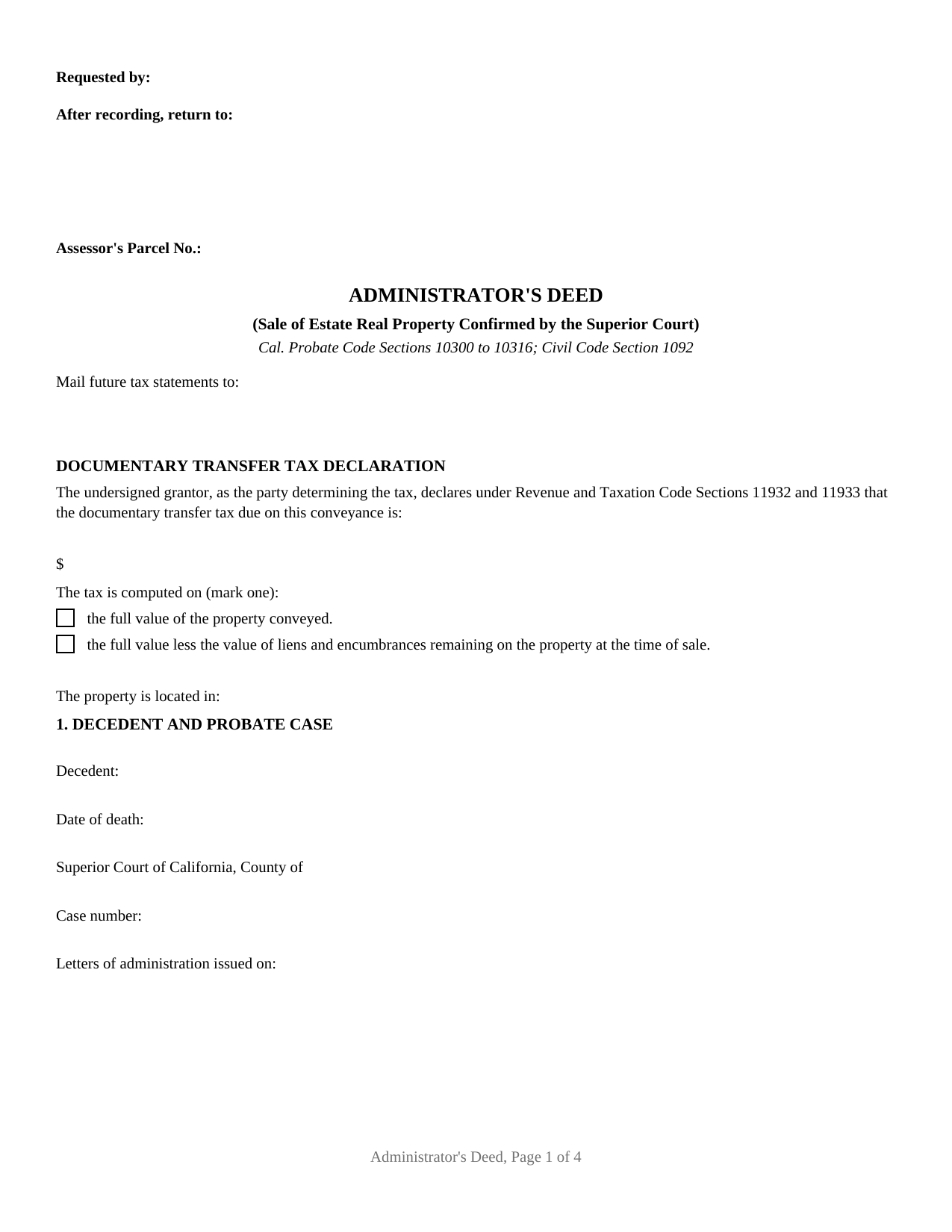
A California administrator's deed is the conveyance that closes a court-confirmed probate sale. When a person dies without a will, the superior court appoints an administrator to manage the estate, and the administrator's sale of estate real property ordinarily returns to the courtroom: under Probate Code Section 10308, the sale is reported to and confirmed by the court before title passes to the purchaser. This fillable administrator's deed is the instrument executed after that confirmation, prepared to California recording standards.
A deed that waits for the order
Court confirmation is what separates a probate sale from an ordinary sale. For a private sale, Probate Code Section 10309 requires an appraisal within one year before the confirmation hearing and an offer of at least 90 percent of the appraised value. At the hearing, the court weighs any higher bids the statute permits, then makes an order confirming the sale to the highest qualifying offer and directing a conveyance to be executed (Section 10313). Section 10314 puts the deed itself under statutory instruction: the personal representative executes a conveyance to the purchaser which refers to the order confirming the sale, and a certified copy of the order is recorded in the county where the property lies. The form's order section carries that statutory reference, with the probate case identified by court, county, and case number.
What the conveyance carries
The conveyance section tracks Probate Code Section 10314(c). Acting solely as administrator of the estate and not individually, the administrator grants the purchaser all of the right, title, and interest the decedent had in the property at death, together with any other or additional interest the estate acquired, by operation of law or otherwise, before the sale. Around that operative sentence, the instrument identifies the decedent and the date of death, the letters of administration, the date the confirming order was entered, the confirmed sale price, and the property by county, legal description, and street address. The grantee entry is free form: one or more purchasers, with any vesting designation California recognizes entered after the names, and the guide describes the recognized forms of ownership with their statutes.
Built for the recording counter
California recording law shapes the page. The top 2.5 inches of the first page stay clear for the recorder, with the requester, the return address, and the assessor's parcel number in the left portion of that space (Government Code Section 27361.6). The first page shows the name and address for future tax statements, a requirement Government Code Section 27321.5 attaches to every deed conveying fee title. A confirmed estate sale for value is ordinarily subject to documentary transfer tax, so the face of the deed carries the declaration of the amount due and how it was computed (Revenue and Taxation Code Sections 11932 and 11933), and the tax is paid when the deed records. The administrator's execution is acknowledged before a notarial officer, whose certificate carries the boxed notice and the wording California law prescribes (Civil Code Section 1189). Buyers and title companies sometimes search for this instrument as a probate deed, an estate deed, or a personal representative deed of sale; in a court-supervised California administration it is the administrator's deed, and its distinguishing mark is the order it refers to.
The purchase delivers this administrator's deed as a fillable PDF, a completed example showing a court-confirmed Stanislaus County sale, and a guide that walks the form section by section, from the transfer tax declaration through the acknowledgment certificate. Statutory process documents the sale involves, such as the petition for confirmation and the certified copy of the order confirming sale, are prepared through the court or its clerk separately and are not included in this package. The materials are informational only and are not legal advice.
Important: County-Specific Forms
Our administrator deed forms are specifically formatted for each of the 58 counties in California.
After selecting your county, you'll receive forms that meet all local recording requirements, ensuring your documents will be accepted without delays or rejection fees.