California Executor Deed
County Specific Legal Forms Validated as recently as October 12, 2026 by our Forms Development Team
About the California Executor Deed
How to Use This Form
- Select your county from the list
- Download the county-specific form
- Fill in the required information
- Have the document notarized if required
- Record with your county recorder's office
What Others Like You Are Saying
"Finding what I needed was quick and easy."
"Quick, super easy and very reasonable charge!!"
"Great service, convenient, fast and easy to use. Thumbs Up!!!!w"
"First time user and I was pleasantly surprised how quick and easy it was to get my Deed recorded. An…"
"EasyPeasy!"
4.8/5 from 4,836 reviews. Read all
A California executor deed is the conveyance that moves real property out of a probate estate: the personal representative named in the decedent's will, holding letters testamentary from the superior court, signs a deed transferring the estate's interest to the purchaser. This fillable form, also searched as an executor's deed, personal representative deed, or probate deed, prepares that conveyance under the California Probate Code.
Authority that comes from the probate file
Unlike an ordinary grant deed between living owners, an executor deed draws its force from the probate case. The letters the court clerk issues under Probate Code Section 8405 name the executor and state whether the appointment carries authority under the Independent Administration of Estates Act, and whether that authority includes the power to sell real property. A representative with full authority may sell estate real property after giving the notice of proposed action the act requires, without a confirmation hearing. In every other case, Probate Code Section 10308 has the sale reported to and confirmed by the court before title passes, at a hearing where higher bids may be received. The form is built around those facts: the decedent, the superior court and case number, the date letters testamentary issued, the authority for the sale, and, for a confirmed sale, the order confirming the sale, which Probate Code Section 10314 has the deed refer to on its face; a certified copy of the order, obtained from the court file separately from this package, is recorded in the county where the property lies.
A conveyance measured by the estate's title
The granting clause tracks Probate Code Section 10314(c): the deed conveys all of the right, title, and interest the decedent had in the property at death, together with any additional interest the estate acquired before the sale. The word grants does the operative work under Civil Code Section 1092, and the deed then expressly restrains the two covenants Civil Code Section 1113 would imply from that word, so the executor makes no personal covenant and the estate gives no warranty of title. That posture is what distinguishes a fiduciary conveyance: the purchaser's protection comes from the probate procedure, from the confirmation order where there is one, and from the title insurance issued for the sale, not from promises by the fiduciary who signs.
Built for California recording counters
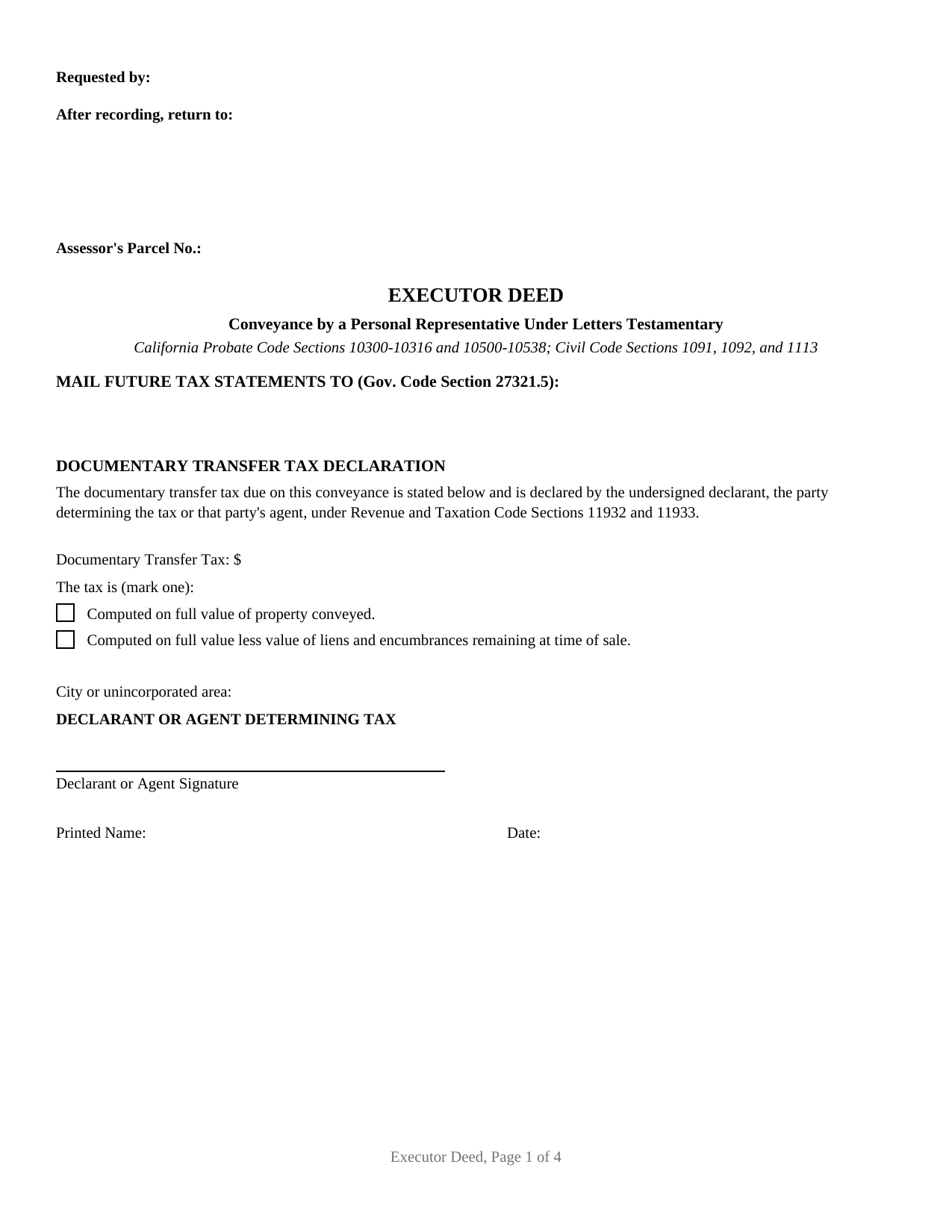
The first page carries what California recording offices look for: the requester line, the return address block, and the assessor parcel number in the reserved recording space under Government Code Section 27361.6, a title immediately below that space, the name and address for future tax statements under Government Code Section 27321.5, and the documentary transfer tax declaration under Revenue and Taxation Code Sections 11932 and 11933, with the amount, the computation statement, the city or unincorporated area, and the declarant's signature line. A probate sale for consideration is a taxable sale of realty, so the declaration matters here in a way it does not on gift deeds. The guide walks through the county recorder's fee layers, the preliminary change of ownership report the transferee files with the deed (a state assessor form prepared separately and not included in this package), and the acknowledgment before a notary that Government Code Section 27287 makes the gateway to recording. The notary certificate printed on the form is the California statutory certificate with its boxed notice, completed by the officer for the executor's representative-capacity acknowledgment.
One estate, one signer, both sale paths
The form recites a single grantor signing in a fiduciary role: an executor serving under letters testamentary. The recitals do not describe an administrator serving under letters of administration, a trustee conveying trust property, or a beneficiary claiming under a transfer on death deed; those transfers follow different instruments. Within that scope the deed serves either statutory sale path, and the guide shows the entries for each.
The download delivers this executor deed as a fillable PDF, a completed example showing a realistic Sonoma County confirmed sale from case number to recording references, and a section by section guide to completing, signing, and recording the deed. The materials describe California law in general terms and are not legal advice; an attorney can apply these statutes to a particular estate.
Important: County-Specific Forms
Our executor deed forms are specifically formatted for each of the 58 counties in California.
After selecting your county, you'll receive forms that meet all local recording requirements, ensuring your documents will be accepted without delays or rejection fees.