California Notice of Revocable Transfer on Death Deed
County Specific Legal Forms Validated as recently as September 16, 2026 by our Forms Development Team
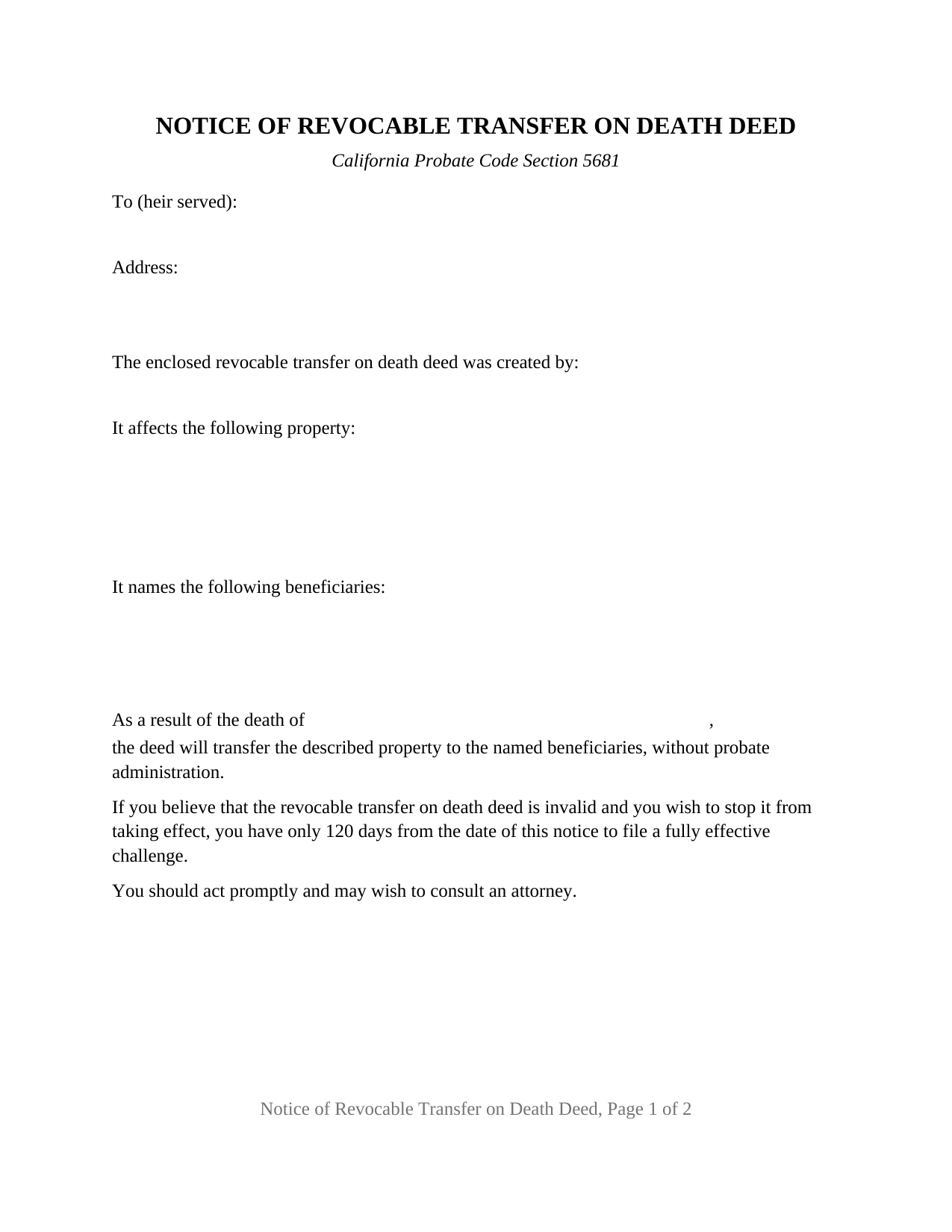
About the California Notice of Revocable Transfer on Death Deed
How to Use This Form
- Select your county from the list
- Download the county-specific form
- Fill in the required information
- Have the document notarized if required
- Record with your county recorder's office
What Others Like You Are Saying
"Easy to use, rapid response, excellent service."
"Thanks worked out great as the form was perfect and no problems filing it with the county."
"So far it seems good. I am still trying to send information to this company so they can help me with…"
"Quick and Easy"
"We have been waiting for a Title Company to put a release of Lien together for the past 3 months. I …"
4.8/5 from 4,818 reviews. Read all
A California revocable transfer on death deed sits in the county records during the owner's lifetime and moves the property at death without probate. What it does not do is tell the family. Probate Code Section 5681, added by Senate Bill 315 in 2021, closed that gap: after the transferor dies, the beneficiary serves notice on the transferor's heirs, along with a copy of the recorded transfer on death deed and a copy of the death certificate. This form is that notice, in the wording Section 5681(b) prescribes.
A notice that is delivered, not recorded
Almost every document in a California TOD deed file goes to the county recorder. This one does not. Section 5681(e) provides for delivery to the heir at the last known address by one of the methods described in Probate Code Section 1215, which covers mail, personal delivery, and, with the recipient's express consent on a Judicial Council form, electronic delivery. Because the notice is delivered rather than recorded, it carries no recording request block, no return address block, and no reserved stamp space at the top of the page. The form is what the statute describes: a letter to one heir, with the heir's name and address at the top and the statutory statements below.
The clock the notice starts
The prescribed wording ends with a warning about time: a challenge to the deed has only 120 days from the date of the notice to be fully effective. That is why the form carries a dated signature block for the beneficiary sending it, since the date entered there is the date the statutory sentence measures from. A separate 120 day period appears in Probate Code Sections 5652(b) and 5694, and runs from recordation of the affidavit described in Section 5682(c). The two periods have different starting points, and the guide sets them side by side with their citations.
Why a beneficiary keeps the record
Section 5682 is the reason the notification step matters to title. A buyer or lender dealing with the beneficiary in good faith and for value takes the rights and protections of a distributee under a final order for distribution, but only where an affidavit of death has been recorded for the property and an affidavit has been recorded containing a statement in substantially the form "I, [name of beneficiary], served the notice required by Probate Code Section 5681." Those two affidavits are separate recorded instruments, prepared and recorded separately, and neither is part of this package. The notice is the act the second affidavit swears to.
What the form carries
The form pairs one sender with one recipient: a beneficiary named in the recorded deed, and one heir of the transferor. Section 5681(f) provides that where a deed names more than one beneficiary, only one of them carries out the section, and Section 5681(c) leaves the identification of the heirs to that beneficiary, who relies on a final judicial determination of heirship where one is known and otherwise makes a good faith determination by any reasonable means. The entries follow the statute: the deceased transferor's name, the property description used on the deed, the beneficiaries named on the deed, and the transferor's name again in the operative sentence. Added at the end are the recording date, instrument number, and county of the enclosed deed, and the signature, printed name, and date of the beneficiary. Where a transferor left several heirs, a separate copy carries each heir's name and address.
The exposure the statute attaches
Section 5681(g) gives the step teeth. A beneficiary who fails to serve a known heir who is not a beneficiary is responsible for all damages caused by the failure, unless the beneficiary shows a reasonably diligent effort, which the statute defines as delivery under Section 1215 to the heir's last actually known address. The same subdivision protects a beneficiary who reasonably relied in good faith on another beneficiary's undertaking, and states that a beneficiary is not held to the same standard as a fiduciary. Subdivision (d) excuses a copy to an heir who is unknown, and to one who is known but cannot be located after reasonable diligence.
This package contains the fillable notice form, a completed example filled with a Riverside County fact pattern, and a guide that walks the form entry by entry and sets out the Section 5681 framework with citations. It is a self-help product and not legal advice; a California attorney can address how these rules apply to a particular estate.
Important: County-Specific Forms
Our notice of revocable transfer on death deed forms are specifically formatted for each of the 58 counties in California.
After selecting your county, you'll receive forms that meet all local recording requirements, ensuring your documents will be accepted without delays or rejection fees.