Florida Final Payment Affidavit
County Specific Legal Forms Validated as recently as October 9, 2026 by our Forms Development Team
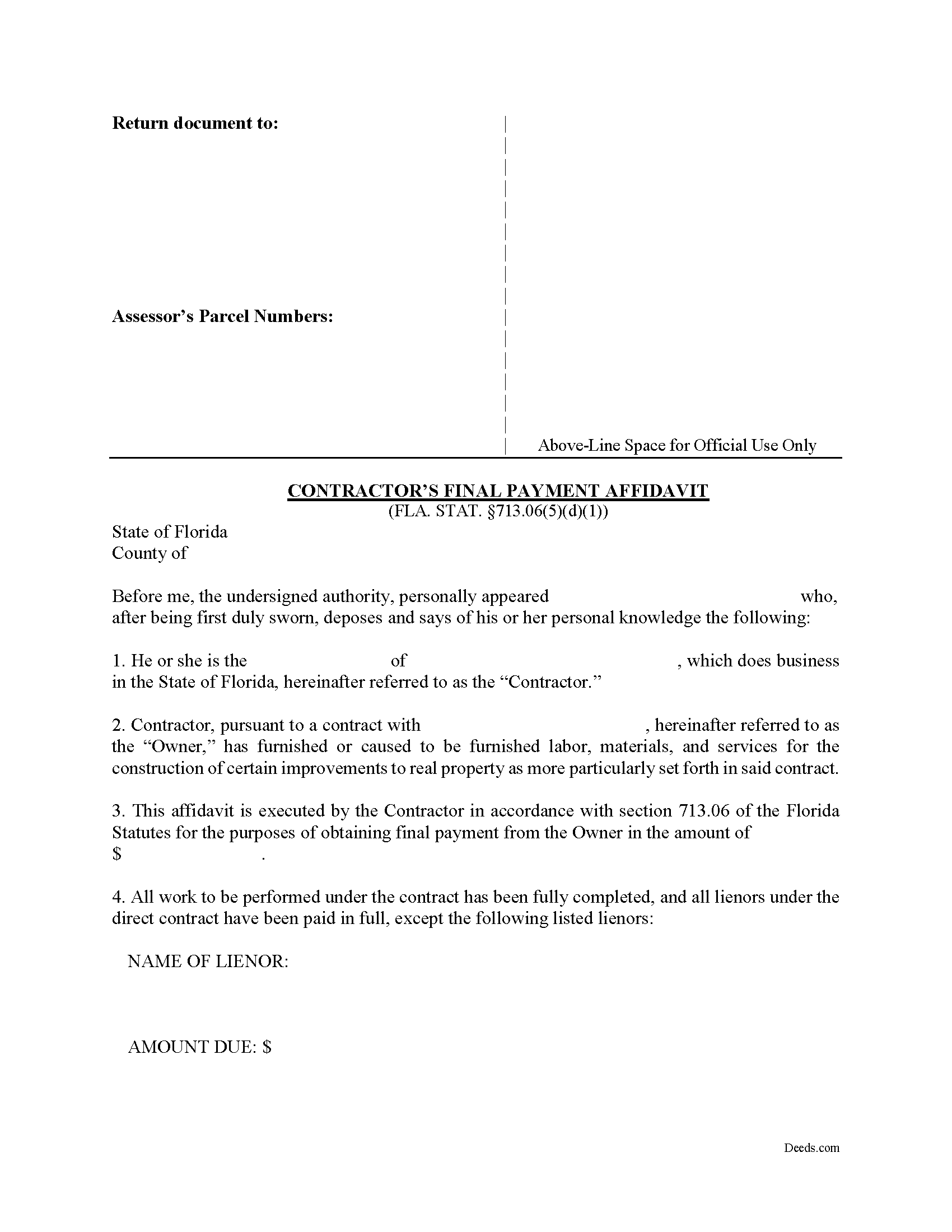
About the Florida Final Payment Affidavit
How to Use This Form
- Select your county from the list
- Download the county-specific form
- Fill in the required information
- Have the document notarized if required
- Record with your county recorder's office
What Others Like You Are Saying
"Thanks for the quick response. That really helps when you're under a time deadline."
"very simple to use"
"So easy, very simple to use. I was very pleased with the service Deeds provided. Would definely use …"
"Completed, notarized, and recorded with no issues."
"Saves a trip to the Recorders Office!"
4.8/5 from 4,836 reviews. Read all
A Florida Final Payment Affidavit is the Florida construction closeout affidavit a contractor gives to the property owner when final payment under a direct contract becomes due, and it is also a required step before a contractor files an action to enforce a Florida construction lien. Florida's version is unusually specific: Chapter 713 supplies the substance of the Contractor's Final Payment Affidavit, ties it to timely notices to owner, requires an oath before a notary, and withholds the contractor's lien remedy while the affidavit is missing (Fla. Stat. § 713.06(3)(d)1.).
What a Florida Final Payment Affidavit Does
This affidavit is commonly used at the end of a private Florida construction project by the contractor who has a direct contract with the owner. It states the final payment amount requested, identifies the owner and contractor, connects the work to the Florida real property improvement, and either confirms that lienors under the direct contract have been paid or lists the unpaid lienors and amounts due or to become due. The affidavit gives the owner sworn information needed before disbursing the final contract balance, especially because Florida lien law can expose an owner to claims from unpaid lienors even after the owner has paid the contractor.
Florida Statutory Requirements Under Section 713.06
Florida's final payment affidavit is part of the proper-payment system in the state's Construction Lien Law. The required information is not generic closeout language; it is tied to the owner, the direct contract, timely notices to owner, and the contractor's lien rights.
- Who gives it: The contractor gives the affidavit to the owner when final payment under the direct contract becomes due (Fla. Stat. § 713.06(3)(d)1.).
- What it must disclose: The affidavit must state that all lienors under the contractor's direct contract who timely served a notice to owner on both the owner and contractor have been paid in full, or it must list each unpaid lienor and the amount due or to become due for labor, services, or materials (Fla. Stat. § 713.06(3)(d)1.).
- Substantial statutory form: Florida requires the affidavit to be in substantially the statutory Contractor's Final Payment Affidavit form, including the contractor's role, the owner's name, the final payment amount, and the unpaid lienor schedule when applicable (Fla. Stat. § 713.06(3)(d)1.).
- Effect of not giving it: A contractor has no lien or right of action against the owner for labor, services, or materials furnished under the direct contract while in default for not giving the affidavit (Fla. Stat. § 713.06(3)(d)1.).
- Owner's reliance: The owner may rely on the contractor's affidavit in making final payment unless there are lienors who gave notice but are not listed in the affidavit (Fla. Stat. § 713.06(3)(d)4.).
- Final payment holdback: Florida directs the owner to retain the final payment due under the direct contract until the contractor's affidavit has been furnished (Fla. Stat. § 713.06(3)(d)5.).
Signing and Serving the Affidavit in Florida
The affidavit is sworn, not merely signed. The person signing for the contractor appears before a notary, states the facts from personal knowledge, and takes an oath as part of the statutory form (Fla. Stat. § 713.06(3)(d)1.). Unlike a Florida deed, the statutory affidavit form does not call for two subscribing witnesses; the key execution requirement is the sworn notarial acknowledgment required by Chapter 713.
For lien enforcement, the contractor must execute and deliver the affidavit to the owner at least five days before instituting an action to enforce the lien. Florida applies this rule even if final payment has not become due because the contract was terminated before completion, and even when the contractor had no lienors working under the contractor (Fla. Stat. § 713.06(3)(d)1.). Florida's service statute allows hand delivery, common carrier delivery service, or registered, Global Express Guaranteed, or certified mail with evidence of delivery; posting at the improvement site is available only when those delivery methods cannot be accomplished (Fla. Stat. § 713.18(1)).
Florida Recording and Lien Deadline Context
The Final Payment Affidavit is delivered to the owner; it is not the same document as a Florida claim of lien. A claim of lien is recorded in the clerk's office for the county where the improved real property is located, and if the property is in more than one county, the claim of lien is recorded in each county. Florida requires a claim of lien to be recorded no later than 90 days after the lienor's final furnishing of labor, services, or materials, and recording gives constructive notice of the claim (Fla. Stat. § 713.08(5)). The recorded claim of lien must also be served on the owner before recording or within 15 days after recording, subject to the prejudice standard in the statute (Fla. Stat. § 713.08(4)(c)).
Florida's enforcement deadlines operate alongside the affidavit requirement. A recorded construction lien generally does not continue for more than one year after recording unless an action to enforce the lien is commenced within that time, and an owner's notice of contest can shorten the enforcement period to 60 days after service of the notice (Fla. Stat. § 713.22(1)-(2)). When direct-contract funds are insufficient to pay all liens, Florida also sets a payment order that gives priority first to laborers, then to persons other than the contractor, and then to the contractor (Fla. Stat. § 713.06(4)(a)).
Florida Traps That Cause Affidavit Problems
- Listing the wrong unpaid parties: The affidavit is built around lienors under the contractor's direct contract who timely served a notice to owner on both the owner and contractor. A noticed lienor who is omitted, or an unpaid party listed without understanding Florida's notice timing, can affect how the owner makes proper final payment (Fla. Stat. §§ 713.06(2)(a), 713.06(3)(d)2.-4.).
- Treating it as a subcontractor form: Florida's statutory final payment affidavit is the contractor's affidavit. Subcontractors, sub-subcontractors, and suppliers generally preserve lien rights through the notice-to-owner and claim-of-lien process rather than by sending this contractor affidavit.
- Sending it too late: The five-day delivery requirement applies before the contractor institutes an action to enforce the lien, even when the direct contract ended before completion and even when the contractor had no lower-tier lienors (Fla. Stat. § 713.06(3)(d)1.).
- Releasing final payment too soon: Florida directs the owner to retain final payment until the affidavit is furnished, and premature disbursement can leave the improved property subject to valid liens of which the owner had notice when the affidavit was furnished (Fla. Stat. § 713.06(3)(d)5.-6.).
- Confusing the affidavit with a deed or transfer document: A Final Payment Affidavit does not convey title, create vesting, or trigger Florida deed recording issues such as documentary stamp tax, marital status recitals, homestead spousal joinder, or plat-reference requirements. Those issues belong to recorded conveyances; this affidavit supports final payment and construction lien compliance.
- Assuming mistakes are harmless: Florida says a negligent inclusion or omission that has not prejudiced the owner does not defeat an otherwise valid lien, but the affidavit is still a sworn statement and accuracy matters in any later dispute (Fla. Stat. § 713.06(3)(d)1.).
What Is Included with the Florida Final Payment Affidavit Download
The download package is prepared by Deeds.com's forms development team for use with Florida real property improvement projects and includes:
- Florida Final Payment Affidavit form in fillable PDF format
- Line-by-line completion guide based on Florida Statutes section 713.06
- Completed example showing how final payment and unpaid lienor entries are handled
- Delivery and county recording notes explaining how the affidavit relates to a Florida claim of lien
Important: County-Specific Forms
Our final payment affidavit forms are specifically formatted for each of the 67 counties in Florida.
After selecting your county, you'll receive forms that meet all local recording requirements, ensuring your documents will be accepted without delays or rejection fees.