Florida Notice of Contest of Claim Against Payment Bond
County Specific Legal Forms Validated as recently as October 1, 2026 by our Forms Development Team
About the Florida Notice of Contest of Claim Against Payment Bond
How to Use This Form
- Select your county from the list
- Download the county-specific form
- Fill in the required information
- Have the document notarized if required
- Record with your county recorder's office
What Others Like You Are Saying
"Thank you for your patience and help with filing the documents needed. You were helpful, prompt, cou…"
"So far, so good. Waiting for the County Recorder to accept and record my document, but use of the De…"
"World class forms and service. Downloaded and prepared the deed in minutes. Used the recording servi…"
"So far very good. I will know more when I complete the forms and submit them."
"Love Deeds.com. Fast turnaround and easy to work with."
4.8/5 from 4,828 reviews. Read all
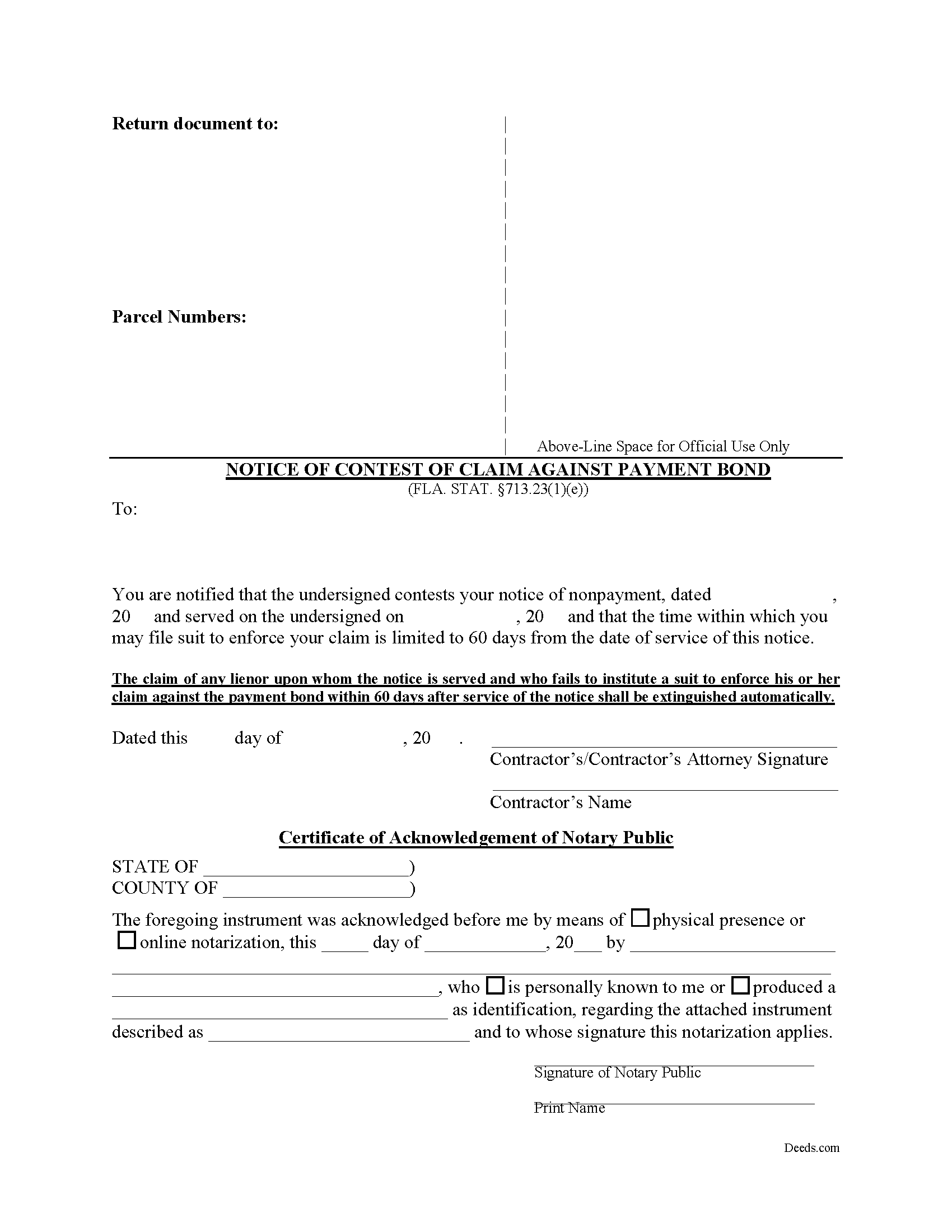
The Florida Notice of Contest of Claim Against Payment Bond is a defensive tool created by section 713.23(1)(e), Florida Statutes, that lets a contractor or surety compress the lienor's window to file suit on a bonded payment claim from one year down to sixty days. The contest belongs to Florida's chapter 713 construction lien framework — it operates only on private projects covered by a section 713.23 payment bond or the conditional payment bond authorized by section 713.245, and the form must follow the statutory wording closely to do its work.
What the Florida Notice of Contest of Claim Against Payment Bond Does
A contractor (or the contractor's attorney) on a project secured by a section 713.23 payment bond — or the conditional payment bond authorized by section 713.245 — uses this notice after a lienor has served a sworn Notice of Nonpayment and is sitting on what would otherwise be a one-year statutory window to sue. Recording and serving the contest forces the lienor to file suit within sixty days of service or watch the bond claim extinguish automatically. Contractors typically reach for it to clear stale claims off a closeout, force a fish-or-cut-bait decision before records and witnesses go cold, or remove a cloud from a bond before a follow-on project closes financing.
Statutory Framework
Section 713.23(1)(e), Florida Statutes, supplies both the authority and the substantial form. The statute fixes the underlying one-year period that the contest is overriding: action against the contractor or surety must be brought within one year of the lienor's last day of furnishing labor, services, or materials. Florida law specifies that the one-year clock cannot be measured by certificates of occupancy or substantial completion, and the contractor's contest is the only mechanism that contracts that window.
Prerequisites Before the Contest Has Anything to Attach To
The contest only works against a lienor who has actually triggered the bond claim sequence. Before this notice is appropriate:
- The lienor, if not in privity with the contractor, must have served a Notice to Contractor under 713.23(1)(c) within forty-five days of first furnishing.
- The lienor must have served a sworn Notice of Nonpayment under 713.23(1)(d) within ninety days of last furnishing.
- The contractor must have a copy of the Notice of Nonpayment with the lienor's address of record, because the contest must be served at the address shown in that notice or its most recent amendment.
If those prior notices are missing or defective, there is generally no payment-bond claim to contest in the first place.
Execution, Service, and Recording
Section 713.23(1)(e) is unusual among Florida construction-lien filings because it requires both service and recording. The contractor or the contractor's attorney must:
- Serve a copy of the notice on the lienor at the address shown in the Notice of Nonpayment;
- Certify that service on the face of the notice itself; and
- Record the notice in the official records of the county where the property is located.
Service is governed by section 713.18 — the construction-lien service statute that controls how all chapter 713 documents are delivered. The sixty-day clock that defeats the lienor's claim runs from the date of service, not from the date of recording, so dating and proof of service drive the calendar.
Florida-Specific Traps
Several recurring missteps cost contractors the benefit of the contest:
- Form deviation. The notice must be in substantially the form set out in 713.23(1)(e). A homemade objection letter — even one that fairly communicates the dispute — does not start the sixty-day clock.
- Missing the dual delivery. Service without recording, or recording without service, undermines the defensive effect. Both are statutory commands.
- Wrong address. Service must go to the address shown in the Notice of Nonpayment or its most recent amendment. Sending the contest to a different address — even one the contractor knows is current — invites argument that service was insufficient.
- Failure to certify service on the face. The certification must appear on the notice itself, not in a separate proof of service. Recording a contest that lacks the certification leaves a defective record.
- Confusing the bond contest with the lien contest. Section 713.22 governs contest of a recorded claim of lien — a parallel but distinct mechanism. Section 713.23(1)(e) is its bond-side cousin, and using the wrong form for the wrong instrument is a common error.
- Stretching to projects without a 713.23 bond. The contest only operates where a section 713.23 payment bond or section 713.245 conditional payment bond is in place. On non-bonded private projects, there is no payment-bond claim to contest.
Recording in the County of Record
The notice is recorded in the official records of the county where the project property sits — typically the same county where the Notice of Commencement and the payment bond appear. Prompt recording matters because the recorded contest puts third parties — including title examiners and prospective purchasers — on notice that the contractor is contesting the claim, which can be useful when the bond claim is being treated as a cloud on closeout records. Recording fees follow the standard county document-recording schedule.
What Happens After Service
The sixty-day extinguishment is self-executing. If the lienor does not file an action against the contractor or surety within that window, the bond claim is extinguished by operation of statute — no court order is required. A lienor who does file in time still proceeds under the direct right of action against the surety that 713.23(1)(f) recognizes, just on the contractor's compressed calendar.
Download Package
The Deeds.com Florida Notice of Contest of Claim Against Payment Bond download package includes the statutory form, a completed example showing how the dates of nonpayment notice and contest service are filled in, and a plain-language guide describing the prerequisites, the service-and-recording sequence, and the sixty-day extinguishment mechanic. Files are delivered as instant download in a fillable format, prepared by the Deeds.com forms development team for use across all Florida counties.
Important: County-Specific Forms
Our notice of contest of claim against payment bond forms are specifically formatted for each of the 67 counties in Florida.
After selecting your county, you'll receive forms that meet all local recording requirements, ensuring your documents will be accepted without delays or rejection fees.