Georgia Affidavit of Beneficiary Acceptance (Guardian or Conservator on behalf of a Minor or Ward)
County Specific Legal Forms Validated as recently as October 21, 2026 by our Forms Development Team
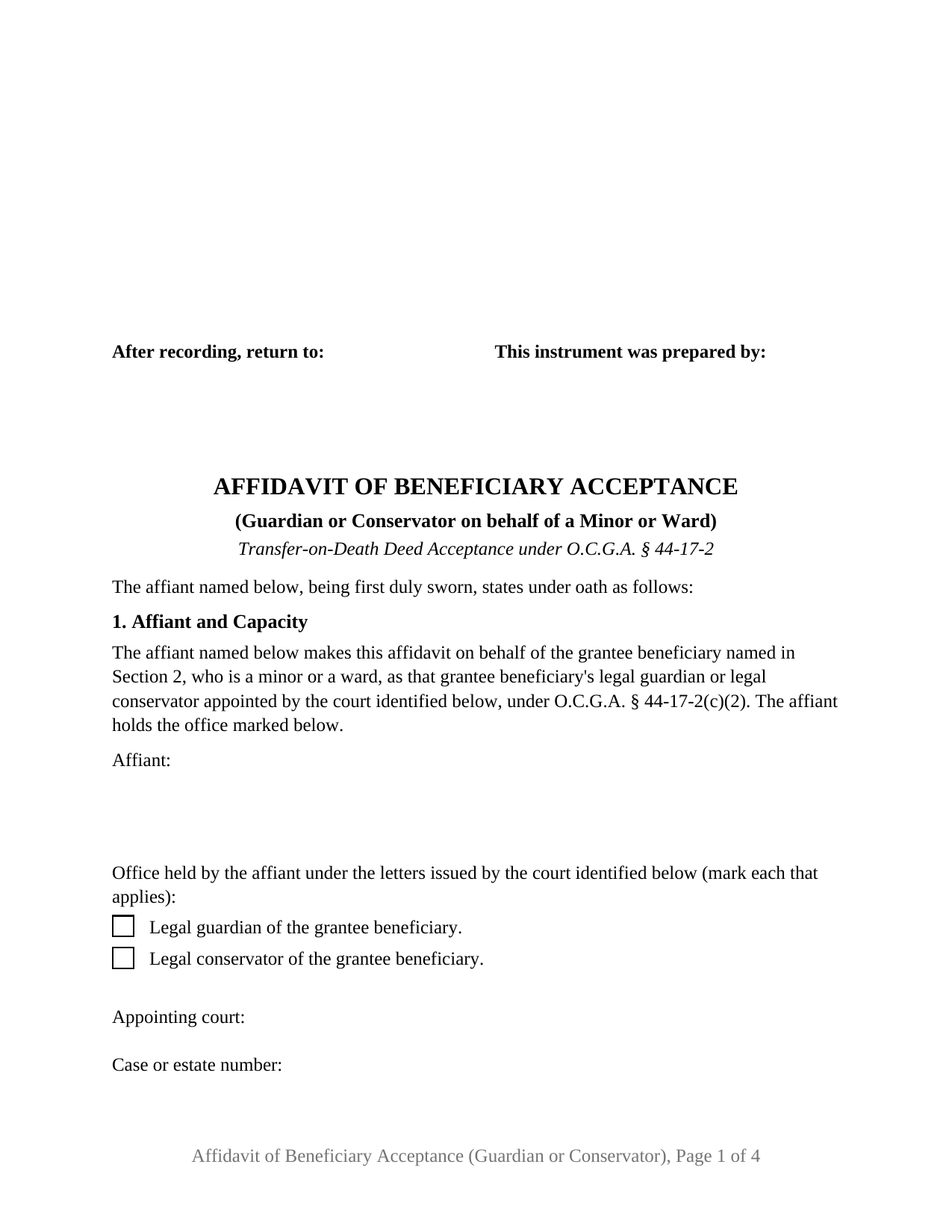
About the Georgia Affidavit of Beneficiary Acceptance (Guardian or Conservator on behalf of a Minor or Ward)
How to Use This Form
- Select your county from the list
- Download the county-specific form
- Fill in the required information
- Have the document notarized if required
- Record with your county recorder's office
What Others Like You Are Saying
"Very helpful and just what I needed for the job I was doing."
"I had a satisfying experience very informative and easy to navigate."
"It provided the forms I could not find elsewhere. Thank you."
"thank you for all the forms"
"Very clear and complete. Good value."
4.8/5 from 4,829 reviews. Read all
A Georgia transfer-on-death deed can name a grandchild who is still a child, or an adult who later comes under a conservatorship, and the acceptance that completes the transfer after the death then comes from someone holding court-granted authority. This Georgia Affidavit of Beneficiary Acceptance (Guardian or Conservator on behalf of a Minor or Ward) is the sworn acceptance a legal guardian or legal conservator executes and records on behalf of a grantee beneficiary who is a minor or a ward, under O.C.G.A. Section 44-17-2(c)(2).
Accepting for a beneficiary who cannot sign
Since the April 2026 amendments, a Georgia TOD deed transfers the record owner's interest only when an acceptance affidavit is executed and recorded after the death. Section 44-17-2(c)(2) names who may execute it, and its last sentence provides that if a designated grantee beneficiary is a ward or minor, a legal guardian or legal conservator may accept on behalf of that ward or minor; Section 44-17-2(c)(3) permits no one else to accept for a beneficiary. Under Title 29 a minor is under 18 and not emancipated, a ward is an adult under a guardianship or conservatorship, and the conservator is the fiduciary who receives and holds the protected person's property under Sections 29-3-22(a)(4) and 29-5-23(a)(4). Chapter 17 admits either office, so the form prints both as boxes and the affiant marks what the probate court's letters confer.
What the affidavit recites
Section 1 opens with a fixed recital that the affiant makes the affidavit on behalf of the grantee beneficiary named in Section 2, a minor or a ward, as that beneficiary's legal guardian or legal conservator appointed by the court identified below; the appointing probate court, the case or estate number, and the date the letters issued follow as entries. The four affirmations Section 44-17-2(d) requires are carried in order: verification of the record owner's death, with a copy of the death certificate attached; whether the record owner and the grantee beneficiary were married at the time of death, as two boxes with one marked; the deed book and page of the recorded deed; and the legal description. The operative section states that the affiant, in that fiduciary capacity and on the beneficiary's behalf, accepts the interest passing under the deed, under letters in effect on the date of the affidavit.
One fiduciary, one protected beneficiary, one deed
The form recites exactly one affiant holding a probate court appointment and exactly one grantee beneficiary who is a minor or a ward, with one signature block and one jurat. A grandparent's beneficiary deed naming a grandchild still under 18 at the grandparent's death, the child's parent having been appointed conservator, presents this pattern; so does a deed naming an adult who, by the record owner's death, is under a conservatorship. An adult with capacity accepting on that person's own behalf, a trustee, an entity, two beneficiaries under one deed, and two co-fiduciaries named in one set of letters each recite different facts, and the form is not set up as any of them.
Sworn before an officer, recorded with the PT-61
Because the statute calls for an affidavit, the affiant signs before a notary public or other officer authorized to administer oaths, who completes a jurat rather than an acknowledgment: the date, the venue, the affiant's name and representative capacity in the by-line, a signature in ink exactly as the name appears on the commission, and the seal Georgia notary law makes part of every official act, for which the form reserves a labeled area. The affidavit is recorded with the clerk of superior court of the county where the real estate is located, with the death certificate copy and the PT-61 transfer tax declaration completed through the GSCCCA system; a conservator filing without an attorney is a self-filer under Section 44-2-2 and presents it through the GSCCCA electronic filing portal. The amended statute sets no filing deadline; until the affidavit is recorded the interest remains in the deceased record owner's estate, and once accepted it is the minor's or ward's property in the conservator's hands.
Three items make up the package: the fillable affidavit, a completed example built on a Gwinnett County fact pattern in which a mother accepts as conservator for her minor daughter, and a guide covering every section, the oath, and the filing steps. The description above and that guide explain the form and the Georgia statutes behind it in general terms only; neither is legal advice.
Important: County-Specific Forms
Our affidavit of beneficiary acceptance (guardian or conservator on behalf of a minor or ward) forms are specifically formatted for each of the 159 counties in Georgia.
After selecting your county, you'll receive forms that meet all local recording requirements, ensuring your documents will be accepted without delays or rejection fees.