Georgia Affidavit of Beneficiary Acceptance (Trustee Beneficiary)
County Specific Legal Forms Validated as recently as October 21, 2026 by our Forms Development Team
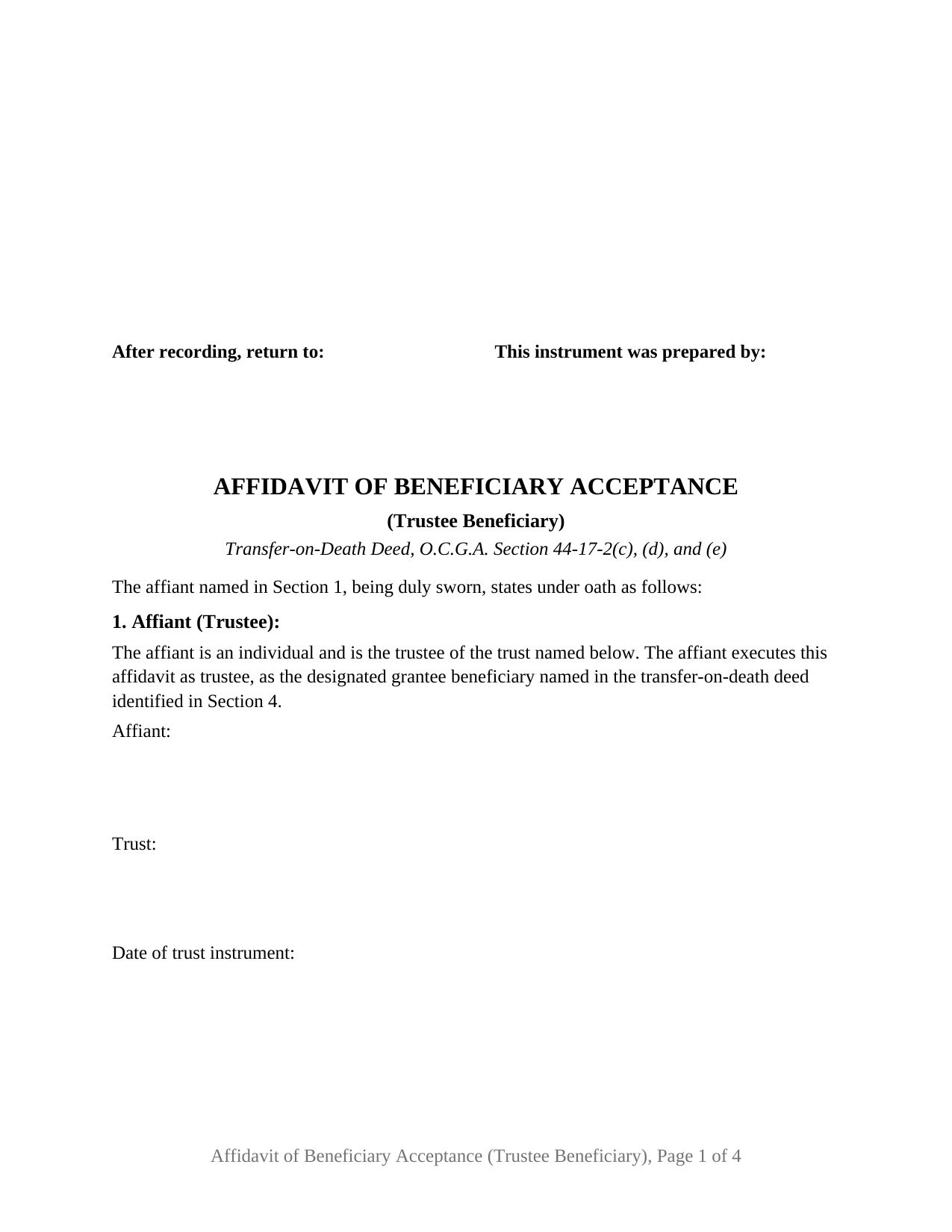
About the Georgia Affidavit of Beneficiary Acceptance (Trustee Beneficiary)
How to Use This Form
- Select your county from the list
- Download the county-specific form
- Fill in the required information
- Have the document notarized if required
- Record with your county recorder's office
What Others Like You Are Saying
"process was easy and simple to do"
"Deeds.com is a great way for people that are unfamiliar with legal documents to get things done. Tha…"
"Very Good!"
"ive been looking for this information thank you ."
"Excellent and easy to download and use. Love the example page and was so easy to fill out and use im…"
4.8/5 from 4,832 reviews. Read all
A Georgia transfer-on-death deed can name the trustee of a trust as its beneficiary, and at the record owner's death that trustee is the one who takes the property for the trust. This Georgia Affidavit of Beneficiary Acceptance (Trustee Beneficiary) is the sworn instrument by which one individual serving as trustee accepts the deceased record owner's real estate in that capacity, under O.C.G.A. Section 44-17-2, so the interest lands in the trustee for the trust.
A trust takes through its trustee
Georgia's transfer-on-death deed chapter, as rewritten effective April 22, 2026, authorizes a record owner to convey a beneficiary interest to an express trust by naming the trustee as a designated grantee beneficiary, O.C.G.A. Section 44-17-2(a)(5)(B). The deed itself may not create or declare a trust; the trust exists under its own instrument, and the deed points at its trustee. After the record owner's death, Section 44-17-2(c)(2) lists the trustee among those who may accept the interest, and Section 53-12-25 treats a transfer to a trust as a transfer to its trustee. The affidavit carries that chain in fixed text: the affiant is an individual and the trustee of the named trust, accepts as trustee, and takes the interest as trustee of that trust.
One trustee, one oath
The form recites exactly one affiant, a natural person holding the office of trustee. The affiant's name is an entry rather than fixed text, so the individual holding the office at acceptance signs, whether the trustee the deed named or a successor under the trust instrument. The trust is identified by name and instrument date, and the deed's own description of the grantee beneficiary is copied into the affidavit so the two instruments read together in the index. Two co-trustees acting jointly, a bank or trust company acting through an officer, and a deed naming several beneficiaries who each accept separately present different facts; the form is not set up as any of those.
The marriage question, asked of a trustee
Section 44-17-2(d) requires the affidavit to affirm whether the record owner and the designated grantee beneficiary were married at the time of death. On this form that statement is made about the record owner and the trustee, and it is presented as two boxes with one marked. A surviving spouse who serves as trustee of the couple's family trust marks the first; a child, sibling, or friend serving as trustee marks the second. The form records the fact and attaches no consequence to it; Section 44-17-5(a) is where the statute addresses the claims of a spouse who married the record owner before, or after, the deed was signed.
Deed book, page, and the trust's paperwork
The remaining affirmations identify the recorded deed by deed book and page and carry the legal description copied from the deed. A copy of the record owner's death certificate is attached; Section 44-17-2(h) gives a designated grantee beneficiary standing to obtain a certified copy. The trust agreement itself is not recorded with the affidavit. A trustee who later deals with a title company or lender may furnish a certification of trust under O.C.G.A. Section 53-12-280, which states the trust's existence, settlor, current trustee, and powers without its dispositive terms; it is prepared separately and is not included in this package.
Sworn before an officer, recorded through the portal
The trustee swears to the affidavit before a notary public or other officer authorized to administer oaths, who completes the jurat and applies the seal O.C.G.A. Section 45-17-6 requires; the form reserves a labeled area for the stamp, and the sworn name line carries the trustee capacity. For a record owner's death on or after July 1, 2026, the affidavit, a PT-61 transfer tax declaration, and the related documents are recorded with the clerk of superior court of the county where the real estate is located. A trustee filing without an attorney presents it electronically through the GSCCCA portal as a self-filer under Section 44-2-2; the amended statute sets no filing deadline. Under Section 44-17-2(c)(1), ownership passes only once the affidavit is both executed and recorded.
The package contains the fillable affidavit, a completed example filled in for a Gwinnett County fact pattern in which a son serving as trustee of a family trust accepts his late mother's home, and the guide that explains each section, the jurat, and the PT-61 and e-filing steps. This description and the guide explain the form and the Georgia statutes behind it in general terms and are not legal advice.
Important: County-Specific Forms
Our affidavit of beneficiary acceptance (trustee beneficiary) forms are specifically formatted for each of the 159 counties in Georgia.
After selecting your county, you'll receive forms that meet all local recording requirements, ensuring your documents will be accepted without delays or rejection fees.