Georgia Affidavit of Beneficiary Acceptance (Individual Beneficiary)
County Specific Legal Forms Validated as recently as October 21, 2026 by our Forms Development Team
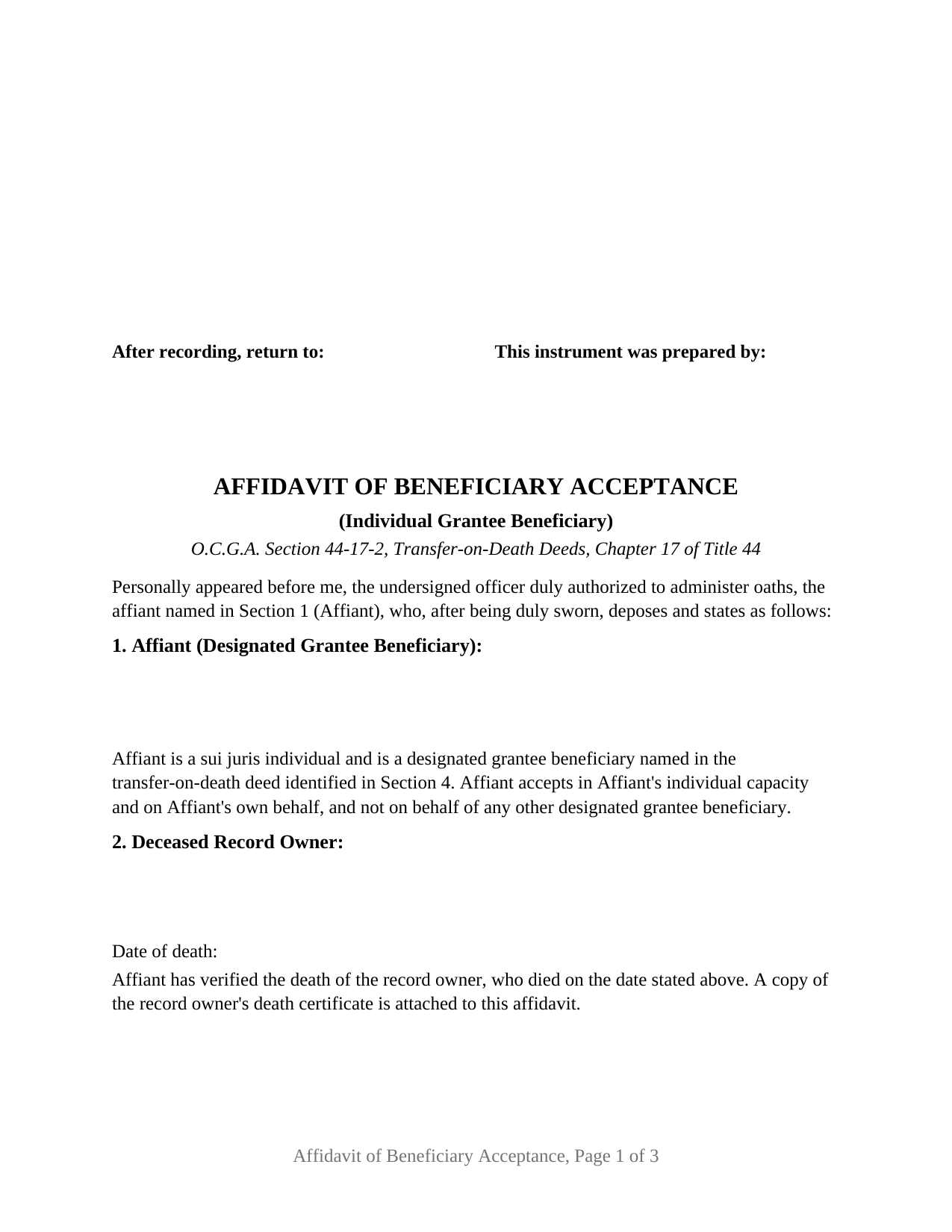
About the Georgia Affidavit of Beneficiary Acceptance (Individual Beneficiary)
How to Use This Form
- Select your county from the list
- Download the county-specific form
- Fill in the required information
- Have the document notarized if required
- Record with your county recorder's office
What Others Like You Are Saying
"It was easy to complete the deed but on the third page I only need one signature in stead of 3 I nee…"
"This site was awesome And received what I wanted the same day."
"Your service is a life saver! I'm a paralegal and new to lien releases especially in Platte Co., MO.…"
"Easy smooth process to get a legal Maine template - thanks for providing"
"Provided the template and guide I was looking for. Reasonable pricing,"
4.8/5 from 4,829 reviews. Read all
In Georgia, a recorded transfer-on-death deed does not finish the job at the owner's death. Since the 2026 amendments to O.C.G.A. Section 44-17-2, the interest passes to a named beneficiary only when that beneficiary executes an acceptance affidavit and records it in the county where the land lies. This Georgia Affidavit of Beneficiary Acceptance (Individual Beneficiary) is that affidavit, written for one beneficiary who is an adult with legal capacity and who accepts in an individual capacity, on that beneficiary's own behalf.
The affidavit is the transfer event
Georgia's transfer-on-death deed chapter, Chapter 17 of Title 44, took effect in July 2024 and was rewritten in April 2026. Under amended Section 44-17-2(c)(1), ownership of the record owner's interest transfers to each grantee beneficiary upon both execution of the affidavit the statute describes and recording of that affidavit after the record owner's death. Until both have happened, the interest remains in the deceased record owner's estate. The earlier nine month deadline and reversion to the estate were struck in 2026; the amended section states no filing deadline. A TOD deed beneficiary who never records the affidavit never takes title.
Four statutory affirmations, one affiant
Section 44-17-2(d) lists what the affidavit affirms: verification of the record owner's death, whether the record owner and the beneficiary were married at the time of death, the deed book and page of the recorded deed, and a legal description of the real estate. The form carries each as its own numbered section, with the marriage fact presented as two boxes and one marked. Section 44-17-2(e) adds a copy of the death certificate as an attachment and, for a death on or after July 1, 2026, directs recording with the clerk of superior court of the county where the real estate is located, together with a PT-61 transfer tax declaration. The operative section states the acceptance in plain words.
The form recites exactly one affiant, a sui juris individual accepting in an individual capacity, following the statute's rule on who may accept: Section 44-17-2(c)(2) lists a sui juris individual, a trustee, or a legal entity over which the individual has proper authority, with a guardian or conservator accepting for a ward or minor, and Section 44-17-2(c)(3) bars one beneficiary from accepting on behalf of another. An adult child named in a parent's TOD deed and a surviving spouse named in the deceased spouse's deed each present the single-individual pattern this affidavit recites. A trustee, an entity, or a guardian for a minor recites different facts, and a deed naming two beneficiaries calls for a separate affidavit from each who accepts; this form is not set up as any of those.
Sworn, not acknowledged
Because the statute calls for an affidavit, the form closes with a jurat rather than an acknowledgment certificate. The affiant signs in the presence of a notary public or other officer authorized to administer oaths, who completes the sworn statement with the date, the venue, a signature in ink exactly as the name appears on the commission under O.C.G.A. Section 45-17-8.1, and the seal that Section 45-17-6 makes part of every official notarial act; the form reserves a labeled area for the stamp. No witness line appears, since the officer-plus-witness rule in Section 44-5-30 governs deeds, and an acceptance affidavit is not a deed.
Recording in Georgia
The affidavit is formatted for the Georgia clerk's office: letter size paper with the three inch top margin O.C.G.A. Section 15-6-61 reserves for the clerk's notation, and the return name and mailing address Section 44-2-14(b) places at the top of the first page directly below that reserve. A beneficiary filing without an attorney is a self-filer under Section 44-2-2 and presents the affidavit through the GSCCCA electronic filing portal, where the PT-61 is also completed.
What the beneficiary takes
Under Section 44-17-5(a), on acceptance the beneficiary takes free and clear of claims of a person who became the record owner's spouse after the deed was executed, subject to the claims of a spouse whose marriage preceded execution, and subject to the liens and conveyances that bound the record owner during life.
The package includes the fillable affidavit, a completed example filled in for a realistic Cobb County fact pattern, and the guide that walks through each section, the jurat, and the PT-61 and recording steps. This description and the guide describe the form and the governing Georgia statutes in general terms; they are not legal advice.
Important: County-Specific Forms
Our affidavit of beneficiary acceptance (individual beneficiary) forms are specifically formatted for each of the 159 counties in Georgia.
After selecting your county, you'll receive forms that meet all local recording requirements, ensuring your documents will be accepted without delays or rejection fees.