Georgia Quitclaim Deed
County Specific Legal Forms Validated as recently as October 8, 2026 by our Forms Development Team
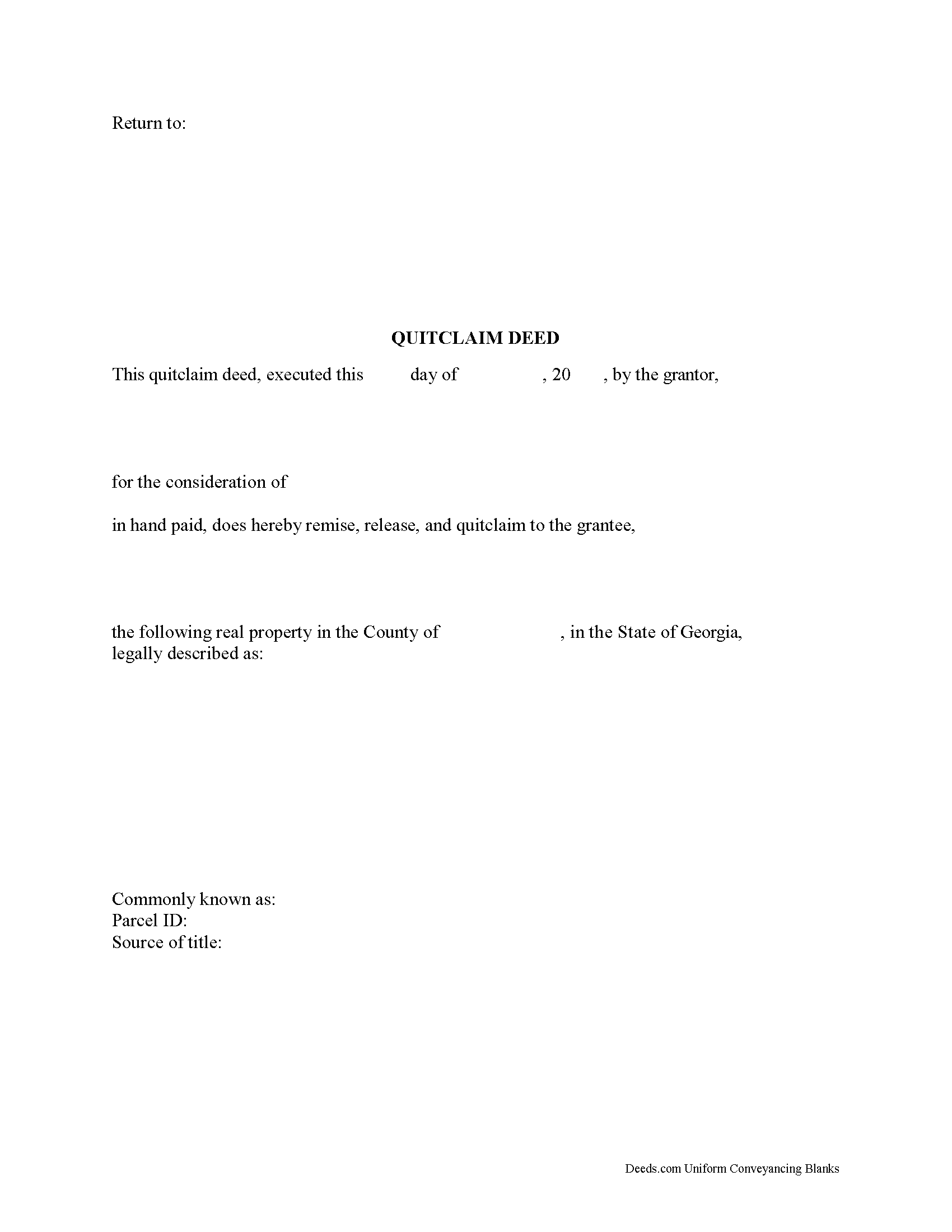
About the Georgia Quitclaim Deed
How to Use This Form
- Select your county from the list
- Download the county-specific form
- Fill in the required information
- Have the document notarized if required
- Record with your county recorder's office
What Others Like You Are Saying
"Excellent instructions to guide one through the warranty deed."
"I like the form except the title should be ENHANCED LIFE ESTATE DEED and not Quit Claim Deed"
"Great service"
"Wonderful service, very fast and great customer service will be using you guys from now on. Thanks a…"
"Quick and easy to use and with the provided instructions and example it took a lot of the guess work…"
4.8/5 from 4,836 reviews. Read all
Whatever the grantor owns on the day of delivery is what a Georgia quitclaim deed carries, and Georgia stops the instrument there. O.C.G.A. Section 44-5-44 binds the maker of a deed against a title acquired afterward, but the decisions construing that Code section place a conveyance limited to such right, title, and interest as the grantor holds outside the rule: Morrison v. Whiteside and Taylor v. Wainman in 1902, and Federal Land Bank v. Bank of Lenox in 1941. An interest the signer picks up next year stays with the signer.
A release measured at delivery
That boundary is the character of the instrument, not a technicality in it. The operative sentence remises, releases, and forever quitclaims all right, title, interest, claim, and demand of the grantor, and the habendum runs to the grantee and to the heirs, successors, and assigns of the grantee. Since O.C.G.A. Section 44-5-61 reads no warranty into any Georgia conveyance, the deed announces in capital letters that it carries none, and what stands of record stays of record: security deeds, judgment and tax liens, easements, and restrictive covenants all survive the transfer. No legislative template governs the drafting either, because O.C.G.A. Section 44-5-33 makes no prescribed form essential to a deed of lands, which is why the same instrument is indexed as a quit claim deed and described as a non-warranty deed.
Blanks that count to two on either side
This is the base configuration of the Georgia quitclaim line. Section 1 receives one or two natural persons signing in their own capacity and Section 3 receives one or two grantees, both as open blanks: no status wording, ownership form, or capacity language is preprinted anywhere on the instrument, so the entries carry the names as record title carries them. The execution page follows the same count, with a GRANTOR block and a SECOND GRANTOR (if applicable) block, an unofficial witness line under each, and a separate officer certificate for each signature; a deed from one grantor leaves the second set unused. Where two grantees take together, the words after their names decide the ownership form: O.C.G.A. Section 44-6-120 leaves two names holding as tenants in common when the deed says nothing more, while the express survivorship wording of O.C.G.A. Section 44-6-190 creates a survivorship estate instead. Four configurations sit outside this form: an entity grantor executing through an officer, a fiduciary conveying in a representative capacity, an agent signing the owner's name under a power of attorney, and three or more owners on one side.
Attested rather than acknowledged
Georgia signs deeds in a pattern that surprises anyone arriving from a plain notarial state. Under O.C.G.A. Section 44-5-30 the maker signs, an officer from the O.C.G.A. Section 44-2-15 list attests the signature, and one more person attests it too, the signer Georgia practice calls the unofficial witness. The certificate here is captioned ATTESTATION for that reason, and O.C.G.A. Section 44-14-33 states the principle: where the officer attests, a formal certificate of acknowledgment is not necessary. Each grantor block carries its own certificate, so one signature never waits on the other.
Twenty-five dollars, a PT-61, and a first page built for the clerk
Filing goes to the clerk of superior court of the county holding the land (O.C.G.A. Section 44-2-1) at a flat twenty-five dollar fee, whatever the page count (O.C.G.A. Section 15-6-77(f)). A PT-61 real estate transfer tax filing travels with the deed through the state clerks' authority system, and the clerk certifies the tax before recording (O.C.G.A. Section 48-6-4). Tax accrues above one hundred dollars of consideration or value (O.C.G.A. Section 48-6-1), which on the twenty-seven thousand dollars recited in the completed Clarke County example produces twenty-seven dollars. Anyone filing without a Georgia attorney, title agent, or other listed professional files electronically as a self-filer with verified government identification, the rule in force since January 1, 2025. The instrument opens below three clear inches for the recording notation, then the return-to name and address that O.C.G.A. Section 44-2-14(b) puts at the top of a Georgia deed, then a tax parcel line answering DeKalb County's local requirement.
Three files come with the purchase: the fillable deed, the Clarke County example filled at full capacity with two grantors releasing to two grantees, and a plain language guide that takes the sections in order and then treats the ownership forms Georgia recognizes, the attestation rules, and the trip to the counter. The materials explain Georgia law generally and are not legal advice.
Important: County-Specific Forms
Our quitclaim deed forms are specifically formatted for each of the 159 counties in Georgia.
After selecting your county, you'll receive forms that meet all local recording requirements, ensuring your documents will be accepted without delays or rejection fees.