Illinois Notice of Death Affidavit (Transfer on Death Instrument Beneficiary)
County Specific Legal Forms Validated as recently as October 23, 2026 by our Forms Development Team
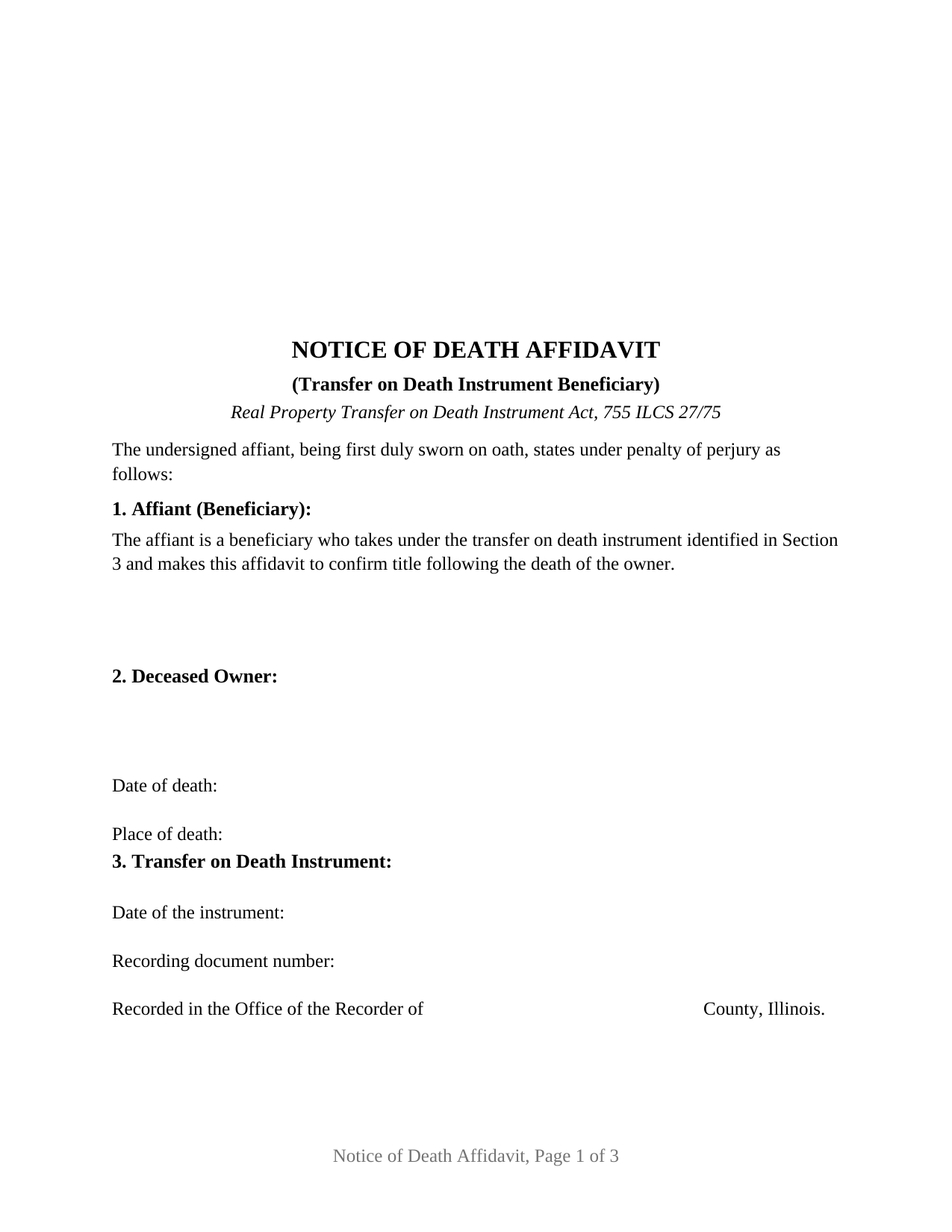
About the Illinois Notice of Death Affidavit (Transfer on Death Instrument Beneficiary)
How to Use This Form
- Select your county from the list
- Download the county-specific form
- Fill in the required information
- Have the document notarized if required
- Record with your county recorder's office
What Others Like You Are Saying
"Easy peazy to find the right forms and they come with instructions and a sample."
"Easy to use!!"
"Great service, easy way to get accurate documents"
"Great experience"
"Their customer service is impressive to say the least. I sent them an email and I received a respons…"
4.8/5 from 4,832 reviews. Read all
When the owner who recorded an Illinois transfer on death instrument dies, the property passes to the named beneficiary by force of the recorded instrument itself. What the Real Property Transfer on Death Instrument Act then offers the beneficiary is a sworn filing, the notice of death affidavit of 755 ILCS 27/75, and this form prepares that affidavit for a beneficiary who takes under a recorded Illinois TODI, also searched for as an Illinois transfer on death deed or beneficiary deed.
A filing that confirms, not one that transfers
Section 75 says what the affidavit is for in a single phrase: to confirm title following the death of the owner. The transfer itself happened at the moment of death under Section 65 of the Act, and the same section that creates the affidavit states that filing it is not a condition to the transfer of title. The affidavit therefore carries no conveyance language and no warranty; it carries sworn facts, placed where a title examiner, the county assessor, and the next purchaser will look for them.
What Section 75 puts in the affidavit
The statute lists the contents rather than prescribing a form, and the affidavit's numbered sections follow that list: the deceased owner's name with the date and place of death; the transfer on death instrument by its date and the document number the recorder assigned to it; the real property by legal description, street address, and parcel identification number; every beneficiary taking under the instrument, by name and, where known, address; and the name and address to which future tax bills are to be mailed. The affiant then swears, under penalty of perjury before a notary, to the statements that tie those facts together: that the owner died owning an interest in the property, that the instrument was recorded before the death, that no revocation was recorded, and, where the instrument was made by joint owners, that the deceased owner was the last of them to die.
Sworn before a notary, not merely acknowledged
Section 75 requires the affidavit to be acknowledged under penalty of perjury before a notary public or another person authorized to administer oaths. The form therefore ends in a verification upon oath or affirmation, the Illinois notary's jurat, rather than the acknowledgment certificate that appears on deeds. The certificate carries the short form sentence of the Illinois Notary Public Act, Signed and sworn (or affirmed) to before me, with a venue for the place of the act and the notary's signature, printed name, state, and commission expiration. The venue is wherever the beneficiary appears, which need not be Illinois.
The beneficiary configuration this form recites
The form recites exactly one affiant, a beneficiary who takes under the instrument and signs as an individual, with one signature block and one notarial certificate. The affiant's beneficiary status is fixed text in Section 1, in the words of Section 75, not a blank. All of the beneficiaries taking under the instrument, the affiant included, are listed in Section 5 without signing; a second beneficiary who swears a separate affidavit uses a second copy of the form. An adult child named as sole beneficiary of a parent's home, and two siblings named together who take equal undivided shares under Section 65 of the Act, present the pattern this form recites. A beneficiary that is a trust or a company, signing through a trustee or officer, presents a representative capacity configuration the form is not set up as.
Recording in the county where the property lies
The affidavit is filed with the recorder of the county or counties where the real property is located, the office that already holds the instrument. It is built to the Counties Code standard document format, with the three by five inch recorder's space on the first page and the preparer statement and return address the Code requires on the face of a recorded instrument. Whether the recorder asks for a transfer tax declaration or exemption notation with the affidavit is a county intake practice the guide describes, as is the attachment of a certified copy of the death certificate, which the Act does not require.
The package includes the fillable notice of death affidavit, a completed example filled in for a realistic Sangamon County fact pattern, and a guide that walks through each numbered section, the jurat, and the recording process; this description and the guide describe the form and the governing Illinois statutes in general terms and are not legal advice.
Important: County-Specific Forms
Our notice of death affidavit (transfer on death instrument beneficiary) forms are specifically formatted for each of the 102 counties in Illinois.
After selecting your county, you'll receive forms that meet all local recording requirements, ensuring your documents will be accepted without delays or rejection fees.