Illinois Renunciation of Transfer on Death Instrument (Surviving Spouse)
County Specific Legal Forms Validated as recently as October 24, 2026 by our Forms Development Team
About the Illinois Renunciation of Transfer on Death Instrument (Surviving Spouse)
How to Use This Form
- Select your county from the list
- Download the county-specific form
- Fill in the required information
- Have the document notarized if required
- Record with your county recorder's office
What Others Like You Are Saying
"Easy to follow forms, and the attached go-by and instructions made it easy to complete."
"Excellent service bc you create your own account and have immediate access to documents!"
"Easy to use. Good price. I like that it came with instructions and an example."
"Easy to use. Accomplished my goal"
"Deed.com was very user friendly, made recording convenient and fast responses. I do recommend."
4.8/5 from 4,833 reviews. Read all
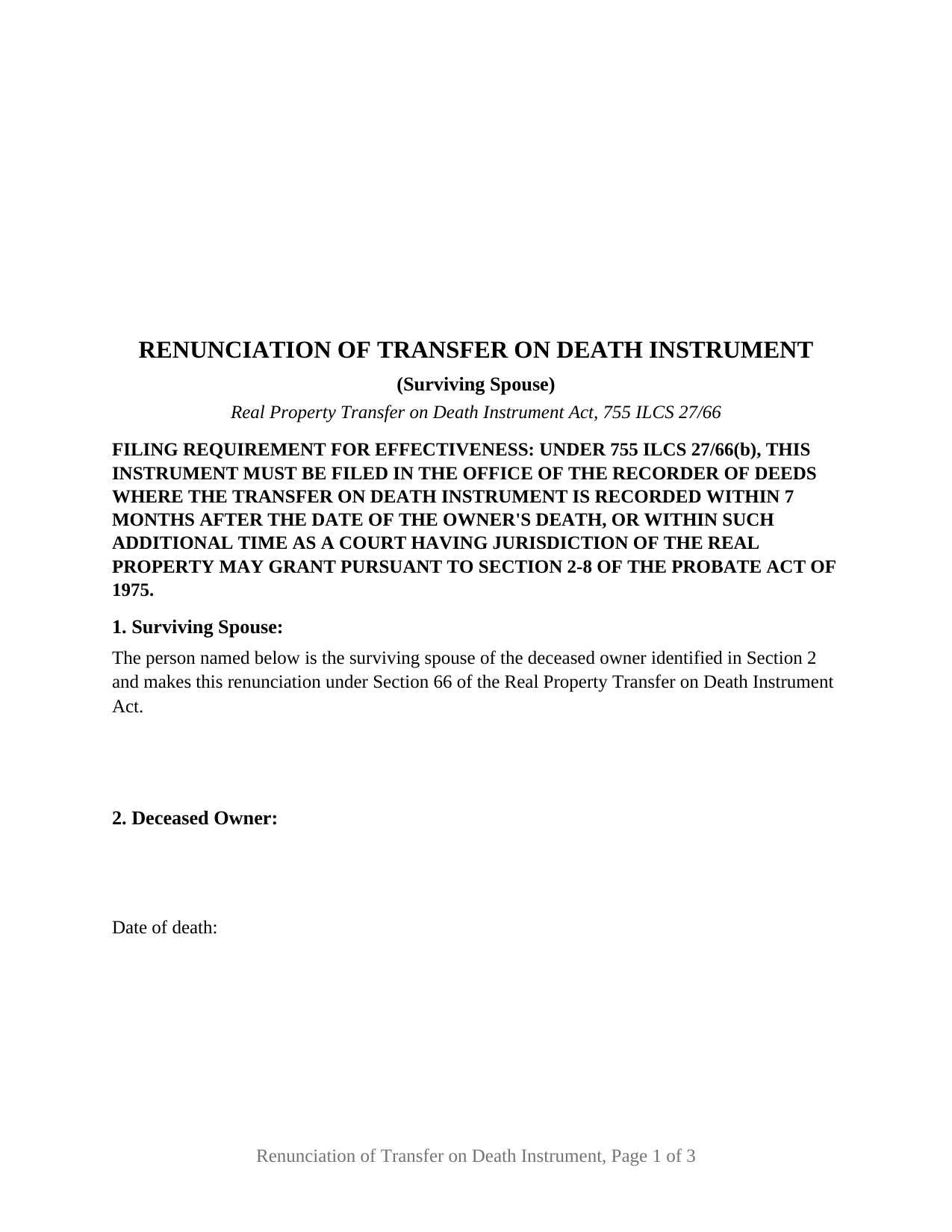
An Illinois transfer on death instrument moves real estate to a named beneficiary at the owner's death without probate, but it does not move it past the owner's surviving spouse. Section 66 of the Real Property Transfer on Death Instrument Act, 755 ILCS 27/66, lets the surviving spouse renounce the instrument and take a statutory share of the property instead. This form is that renunciation, signed by one person, the deceased owner's surviving spouse, and filed with the recorder of deeds where the transfer on death instrument was recorded.
A statutory share carved out of a TOD instrument
Under Section 66(a), unless the surviving spouse waived the right as part of the transfer on death instrument, the spouse may renounce it and is then entitled to a one-third interest in the real property the instrument transferred if the owner leaves a descendant, or a one-half interest if the owner leaves no descendant. One exception is built in: no right to renounce exists where the instrument transfers the property to a trustee of a trust for the sole benefit of the surviving spouse during the spouse's lifetime.
The right arrived with Public Act 102-68 in 2022, which also expanded transfer on death instruments, sometimes called TOD deeds or beneficiary deeds, from residential real estate to Illinois real property generally. A 2025 amendment to Section 90 ties purchaser and lender protection to the same filing.
Filed with the recorder, not the probate court
A will renunciation goes to the probate court; a transfer on death renunciation goes to the recorder. Section 66(b) requires a written instrument signed by the surviving spouse, setting forth a description of the real property and declaring the renunciation, filed in the recorder of deeds office where the transfer on death instrument is recorded. The filing is the act: once of record, it is a complete bar to any claim of the surviving spouse under the instrument, and the statutory share takes its place.
Because the document is recorded, it carries what Illinois recorders look for on an instrument affecting title: the preparer statement, the return address, the document number of the instrument it relates to, a legal description and permanent index number, a typed name beside the signature, and an acknowledgment certificate in the Illinois statutory short form, with the top of the first page left open for the recorder's stamp.
Seven months, measured from the date of death
The filing period runs 7 months from the date of the owner's death, or such additional time as a court having jurisdiction of the real property grants under Section 2-8 of the Probate Act of 1975. The form records the date of death on its own line, so the period the statute measures is stated on the face of the instrument. The guide covers the extension mechanism and the Section 66(c) and 66(d) rules on accelerated future interests and apportionment among the other beneficiaries.
What the surviving spouse form recites
The form recites exactly one signer: the surviving spouse of the deceased owner, identified by name and mailing address in Section 1 beneath fixed text stating that status. It carries one signature block and one acknowledgment certificate, completed by the notary where the spouse actually appears. Sections 2 through 4 name the deceased owner and the date of death, identify the transfer on death instrument by date, recording date, document number, and county, and set out the legal description, street address, and permanent index number of the real property. Section 5 is the operative renunciation in the words of Section 66, claiming the interest a renouncing spouse is entitled to under Section 66(a) and stating the complete-bar effect of Section 66(b). The form states no fraction, because Section 66(a) fixes one-third or one-half by whether the owner leaves a descendant, and that determination belongs to the statute rather than to a blank. A beneficiary's disclaimer, a notice of death affidavit, and a petition for additional filing time are different instruments, prepared separately and not included in this package. Where the transfer on death instrument carried a waiver of the right to renounce, or named a trust for the spouse's sole lifetime benefit, Section 66 supplies no right for this form to declare.
The package includes the fillable renunciation form, a completed example filled in for a DuPage County fact pattern, and the guide that walks through every numbered section, the signing formalities, and the recorder filing. The description and the guide describe the form and the governing Illinois statutes in general terms; they are not legal advice.
Important: County-Specific Forms
Our renunciation of transfer on death instrument (surviving spouse) forms are specifically formatted for each of the 102 counties in Illinois.
After selecting your county, you'll receive forms that meet all local recording requirements, ensuring your documents will be accepted without delays or rejection fees.