Indiana Transfer on Death Deed
County Specific Legal Forms Validated as recently as October 12, 2026 by our Forms Development Team
About the Indiana Transfer on Death Deed
How to Use This Form
- Select your county from the list
- Download the county-specific form
- Fill in the required information
- Have the document notarized if required
- Record with your county recorder's office
What Others Like You Are Saying
"Downloadable documents, instructions and a completed sample form were just what I needed. Very pleas…"
"Your website was very helpful & easy to use"
"The forms are easy to fill in but too restricted for editing."
"Great Experience"
"Very straight forward easy to use. No need to hunt for the information or forms you ate looking for,…"
4.8/5 from 4,828 reviews. Read all
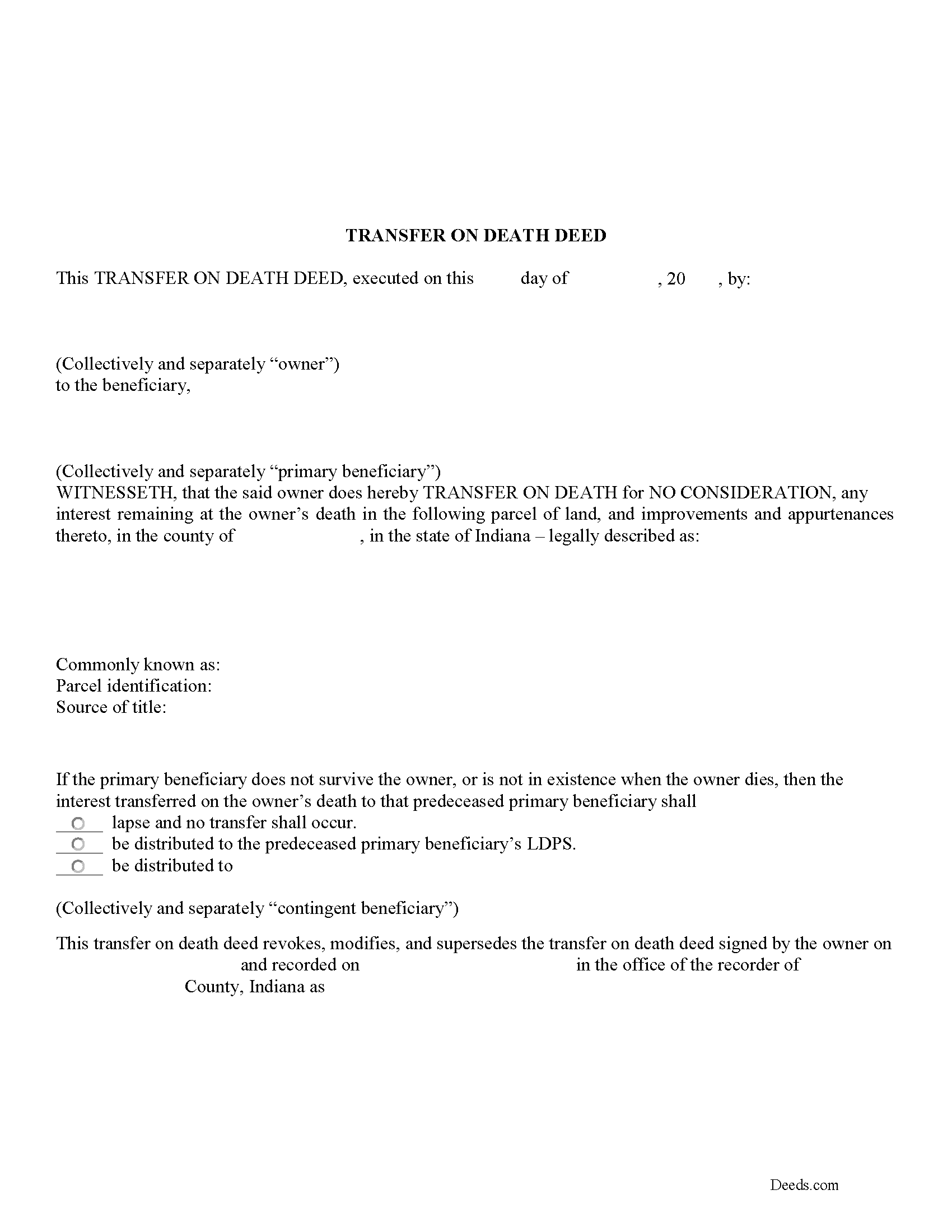
An Indiana transfer on death deed names who receives real estate at the owner's death and does nothing until then. Recorded during the owner's life, it keeps the property out of probate without giving up ownership, the right to sell or mortgage, or the right to change the designation later. This form prepares that deed, also searched as a TOD deed or beneficiary deed, under Indiana Code 32-17-14, the Transfer on Death Property Act, for one or two owners who are natural persons signing for themselves.
A deed that is void unless recorded in time
Indiana ties the deed's effect to the recorder's office. Under IC 32-17-14-11, a transfer on death deed transfers the owner's interest to the beneficiary only if the owner executed it and it was recorded in the county where the property is situated before the owner's death; a deed left unrecorded at death is void. The deed also takes a county detour most deed forms never mention: the county auditor's endorsement under IC 36-2-11-14 is necessary to record it, so the signed deed goes to the assessor and the auditor before the recorder. The form carries the parcel number and prior deed reference those offices look for, and a bold notice at the top states the before-death recording condition.
Conveys and warrants, or quitclaims
The chapter supplies its own wording: the owner conveys and warrants (or quitclaims) to the owner, TOD to the beneficiary. The form prints both operative words with a box beside each, neither one marked. The marked word is the warranty, or the absence of warranty, the owner gives on that conveyance: under IC 32-17-1-2 a deed that conveys and warrants carries the statutory title covenants, and under IC 32-21-1-15 a deed that quitclaims passes the owner's interest without them. Either way the beneficiary takes at death subject to every lien, easement, and contract the owner made during life under IC 32-17-14-19.
One or two owners, four title patterns
The form recites nothing about marital status, vesting, or capacity; the owner block is open text. A sole owner signs alone. Two joint tenants with right of survivorship sign together, and the designation operates at the death of the last surviving owner under IC 32-17-14-4(c). Two spouses holding by the entireties sign together, because IC 32-17-14-11(e)(1) makes a transfer on death conveyance of entireties property inoperable and void unless the other spouse joins, and the surviving spouse controls the designation after the first death under IC 32-17-14-16(b). Two tenants in common each designate the beneficiary of their own undivided interest on the one deed. The form carries two signature blocks and two acknowledgment certificates, one for each owner; a sole owner leaves the second block and its certificate blank. Entity owners, trustees, attorneys in fact, and groups of three or more owners present configurations this form is not set up as.
Beneficiaries the Indiana way
A beneficiary may be an individual, a trust named through its trustee, or an entity, and more than one may be named. The chapter's conventions are entered in the beneficiary block itself: equal shares unless a different share is stated (IC 32-17-14-26(b)(5)); the words contingent beneficiary for a backup taker (IC 32-17-14-26(b)(4)); and the lineal descendants per stirpes rule of IC 32-17-14-22, under which a child who dies first is replaced by that child's own descendants unless the notation No LDPS appears. After the owner's death, the affidavit under IC 32-17-14-26(b)(20), prepared and recorded separately and not included in this package, places the beneficiary of record.
Built for the Indiana recorder's counter
An Indiana recorder may receive an instrument that meets IC 36-2-11-16.5: two inch top and bottom margins on the first and last pages, black type of at least ten points, and names printed beneath every signature under IC 36-2-11-16. The form reserves those margins, carries the preparer statement and Social Security redaction affirmation of IC 36-2-11-15 and the address statement of IC 32-21-2-3 at its conclusion, and follows each signature with an acknowledgment certificate written to IC 33-42-9-12. The recorder's fee for a deed is $25 under IC 36-2-7-10, and Indiana imposes no deed transfer tax.
The package includes the fillable transfer on death deed, a completed example filled in for a Hamilton County fact pattern, and the guide that walks through every section, the signing rules, and the auditor to recorder path. This description and the guide describe the form and the governing statutes in general terms; they are not legal advice.
Important: County-Specific Forms
Our transfer on death deed forms are specifically formatted for each of the 92 counties in Indiana.
After selecting your county, you'll receive forms that meet all local recording requirements, ensuring your documents will be accepted without delays or rejection fees.