Iowa Gift Deed
County Specific Legal Forms Validated as recently as October 20, 2026 by our Forms Development Team
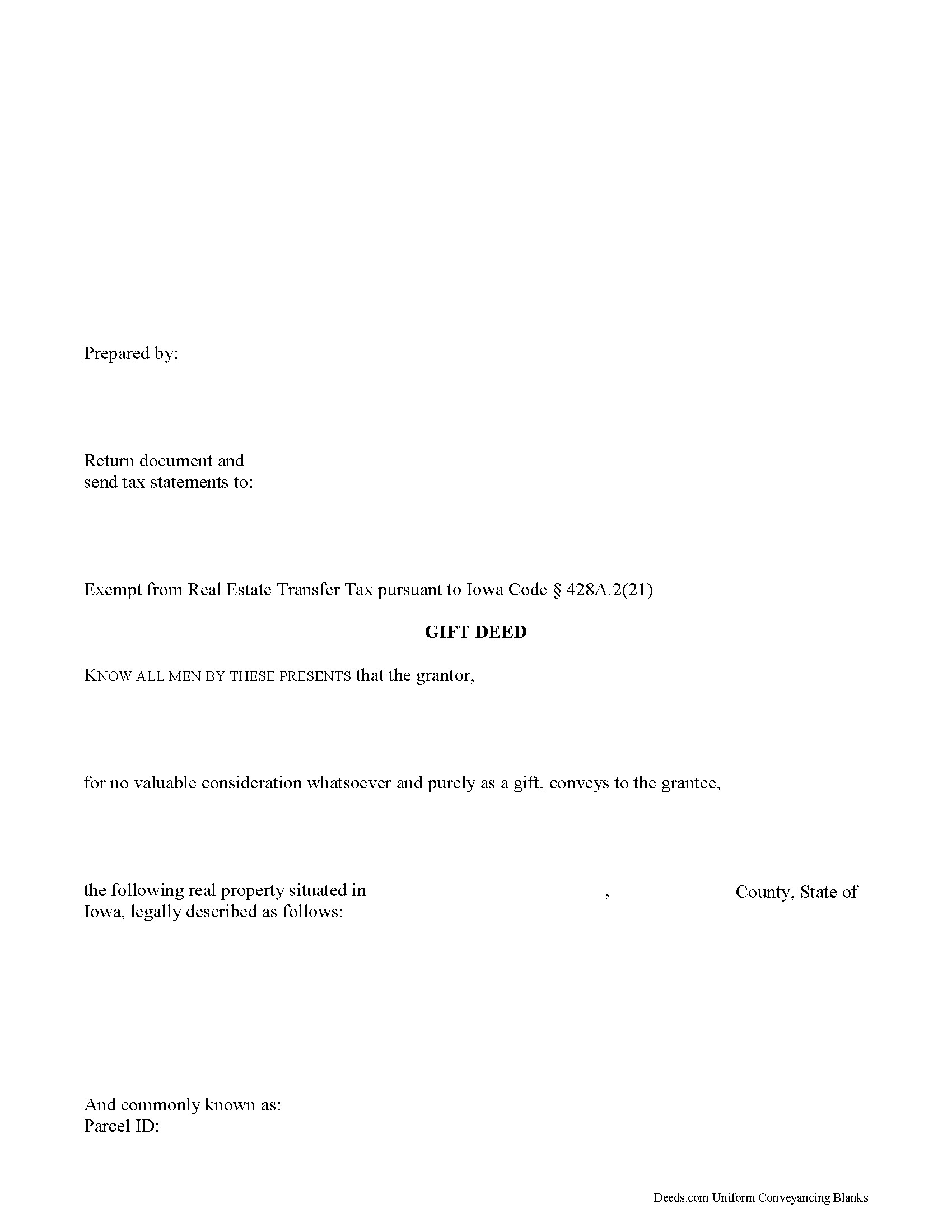
About the Iowa Gift Deed
How to Use This Form
- Select your county from the list
- Download the county-specific form
- Fill in the required information
- Have the document notarized if required
- Record with your county recorder's office
What Others Like You Are Saying
"Excellent system and serviced!"
"I had a wonderful experience and am looking forward to doing business with you again."
"excellent reference"
"This was a seamless process. It probably took one minute to fill out my information and upload the d…"
"Got access to the forms immediately after ordering. Lots of helpful information, forms were easy to …"
4.8/5 from 4,836 reviews. Read all
Gifts of Real Property in Iowa
Gift deeds convey title to real property from one party to another with no exchange of consideration, monetary or otherwise. Often used to transfer property between family members or to gift property as a charitable act or donation, these conveyances occur during the grantor's lifetime. Gift deeds must contain language that explicitly states that no consideration is expected or required. Ambiguous language, or references to any type of consideration, can make the gift deed contestable in court.
A lawful gift deed includes the grantor's full name and marital status, as well as the grantee's full name, marital status, vesting information, and mailing address. Vesting describes how the grantee holds title to the property. Generally, real property is owned in either sole ownership or co-ownership. For Iowa residential property, the primary methods for holding title are tenancy in common and joint tenancy. An estate conveyed to two or more people who are not married to each other is considered a tenancy in common unless otherwise specified. A conveyance to a married couple vests as joint tenancy with rights of survivorship unless otherwise stated (Iowa Code 557.15).
As with any conveyance of realty, a gift deed requires a complete legal description of the parcel. Recite the source of title to maintain a clear chain of title, and detail any restrictions associated with the property. The deed must be signed by the grantor and acknowledged by an individual authorized to take acknowledgements. All signatures must be original.
In Iowa, most conveyances of real property require a Declaration of Value. Because a gift deed transfers real property from one party to another with no exchange of consideration, however, it is exempt from this requirement (Iowa Code 428A.2(21)). Record the completed gift deed in the recorder's office of the county where the subject property is located. Contact the same office to confirm recording fees and accepted forms of payment.
With gifts of real property, the recipient of the gift (grantee or donee) is not required to declare the amount of the gift as income, but if the property accrues income after the transaction, the grantee is responsible for paying the requisite state and federal income tax [1].
In Iowa, there is no state gift tax, but gifts of real property are subject to the federal gift tax. The person or entity making the gift (grantor or donor) is responsible for paying the federal gift tax; however, if the donor does not pay the gift tax, the donee (grantee) will be held liable [1]. For questions regarding state and federal tax laws, consult a tax specialist.
In accordance with federal law, individuals are permitted an annual exclusion of $15,000 on gifts. This means that gifts valued below $15,000 do not require a federal gift tax return (Form 709). However, if the gift's value could possibly be disputed by the IRS, a donor may benefit from filing a Form 709 [2].
This article is provided for informational purposes only and is not a substitute for the advice of an attorney. Contact an Iowa lawyer with any questions about gift deeds or other issues related to the transfer of real property.
[1] http://msuextension.org/publications/FamilyFinancialManagement/MT199105HR.pdf
[2] https://www.irs.gov/businesses/small-businesses-self-employed/frequently-asked-questions-on-gift-taxes
(Iowa Gift Deed Package includes form, guidelines, and completed example)
Important: County-Specific Forms
Our gift deed forms are specifically formatted for each of the 99 counties in Iowa.
After selecting your county, you'll receive forms that meet all local recording requirements, ensuring your documents will be accepted without delays or rejection fees.