Iowa Warranty Deed (Two Grantors)
County Specific Legal Forms Validated as recently as October 6, 2026 by our Forms Development Team
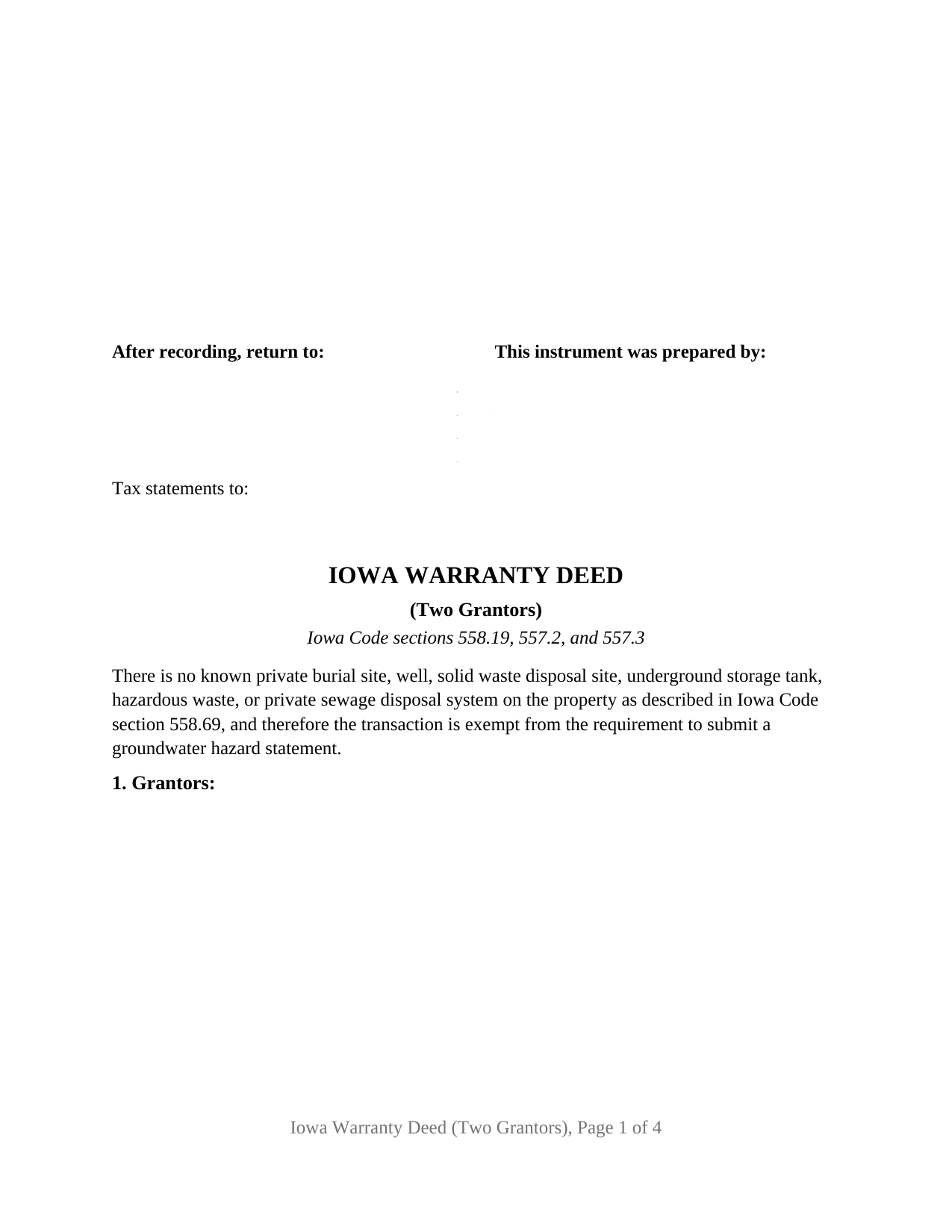
About the Iowa Warranty Deed (Two Grantors)
How to Use This Form
- Select your county from the list
- Download the county-specific form
- Fill in the required information
- Have the document notarized if required
- Record with your county recorder's office
What Others Like You Are Saying
"Worked out good can the forms be filled out on the computer and printed off."
"The forms were easy to download and use. I'm satisfied with it. The sample and the instructions were…"
"I was very pleased to be able to get all the legal forms, with instructions, I need to file a benefi…"
"Fantastic efiling service! The transaction went very smoothly. Thanks!"
"So far this looks like exactly what I need and at a reasonable price. Glad it was so easy to find on…"
4.8/5 from 4,828 reviews. Read all
Two owners of record, one instrument: this Iowa warranty deed is arranged for exactly two grantors conveying together. A married couple selling the home they hold jointly, and two co-owners such as heirs or co-investors passing a shared parcel, present the pattern the deed recites: both current owners named in the grantor section, a signature block for each grantor with a printed name line beneath it, and a separate notarial acknowledgment certificate for each signer in the short form wording of Iowa Code chapter 9B.
Two signatures, two certificates, one deed
The execution architecture is the point of this version of the general warranty deed. Each of the two grantors signs above a printed name, matching Iowa Code section 331.606B(1)(e), which requires the corresponding name typed, printed, or stamped beneath each original signature and makes a missing printed name a rejection ground for documents dated on or after July 1, 2009. Each grantor then acknowledges the deed, and the form closes with two certificates rather than one. Iowa Code section 9B.16 lets a single certificate name every person who acknowledges before the same notary in one act; the form carries one certificate per grantor instead, so the two owners may acknowledge on different days, before different officers, or in different counties while the deed itself stays one instrument.
The homestead rule that calls for both signatures
Iowa Code section 561.13 provides that a conveyance of a homestead, if the owner is married, is not valid unless and until the owner's spouse executes the same or a like instrument, subject to narrow statutory exceptions, and the Iowa Supreme Court in Martin v. Martin, 720 N.W.2d 732 (Iowa 2006), held a homestead deed lacking that execution invalid as to both spouses. When the two grantors on this form are married to each other, the statute's both-spouses execution pattern sits inside the deed itself: husband and wife, or either pair of spouses, sign the same instrument. The operative section adds a relinquishment of all rights of dower, homestead, and distributive share, the statutory label Iowa attaches to the spousal rights a joining signer gives up; the guide traces that language to its statutes.
A statutory warranty behind two names
The warranty keeps the words of Iowa Code section 558.19, adapted to plural grantors: the grantors convey the described real estate and warrant the title against all persons whomsoever, the general warranty that reaches the entire chain of title. Because Iowa Code section 557.3 passes the grantors' whole interest unless a contrary intent appears, the deed stays short, with a numbered section for matters the warranty is subject to. On the receiving side, the grantee section accepts a co-ownership designation; under Iowa Code section 557.15(2), grantees identified as married to each other, or described as joint tenants or with survivor language, are presumed joint tenants with right of survivorship unless a contrary intent is expressed, and the completed example shows that designation written after the grantee names.
Recording in the county where the land lies
The finished deed goes to the county recorder of the county where the real estate is located, on paper or through the statewide Iowa Land Records e-submission service, and its first page is laid out to the information list of Iowa Code section 331.606B(2): below the three-inch recording reserve sit the return address, the preparer statement, the taxpayer address block, the title, and both grantors' and all grantees' names, with the legal description opening page two under the page reference section 331.606B(3) calls for. A declaration of value and the groundwater hazard item under Iowa Code section 558.69 travel with a taxable sale, and after indexing the recorder routes the deed to the county auditor, whose transfer books carry a five dollar fee per transaction, capped at fifty dollars for one instrument. The guide covers each filing, the transfer tax computation, and the exemption statement path for transfers excepted from the tax.
The purchase downloads three items: the fillable two-grantor deed form, a completed example worked through a Linn County sale from grantor names to notary certificates, and a plain-language guide to filling in, signing, and recording the deed. The package holds nothing further, and its contents explain Iowa law generally rather than give legal advice.
Important: County-Specific Forms
Our warranty deed (two grantors) forms are specifically formatted for each of the 99 counties in Iowa.
After selecting your county, you'll receive forms that meet all local recording requirements, ensuring your documents will be accepted without delays or rejection fees.