Kansas Transfer on Death Deed (Married Owners, Joint Tenants with Right of Survivorship)
County Specific Legal Forms Validated as recently as October 25, 2026 by our Forms Development Team
About the Kansas Transfer on Death Deed (Married Owners, Joint Tenants with Right of Survivorship)
How to Use This Form
- Select your county from the list
- Download the county-specific form
- Fill in the required information
- Have the document notarized if required
- Record with your county recorder's office
What Others Like You Are Saying
"Fast efficient informative. Thank you."
"Form was easy to complete, price was reasonable and everything worked out just fine. Would absolutel…"
"great forms, nice that they are fillable pdfs, easy to use, no issues. thanks."
"So easy to use. Would recommend."
"Listen, I love your services. It's been such a convenience utilizing it."
4.8/5 from 4,837 reviews. Read all
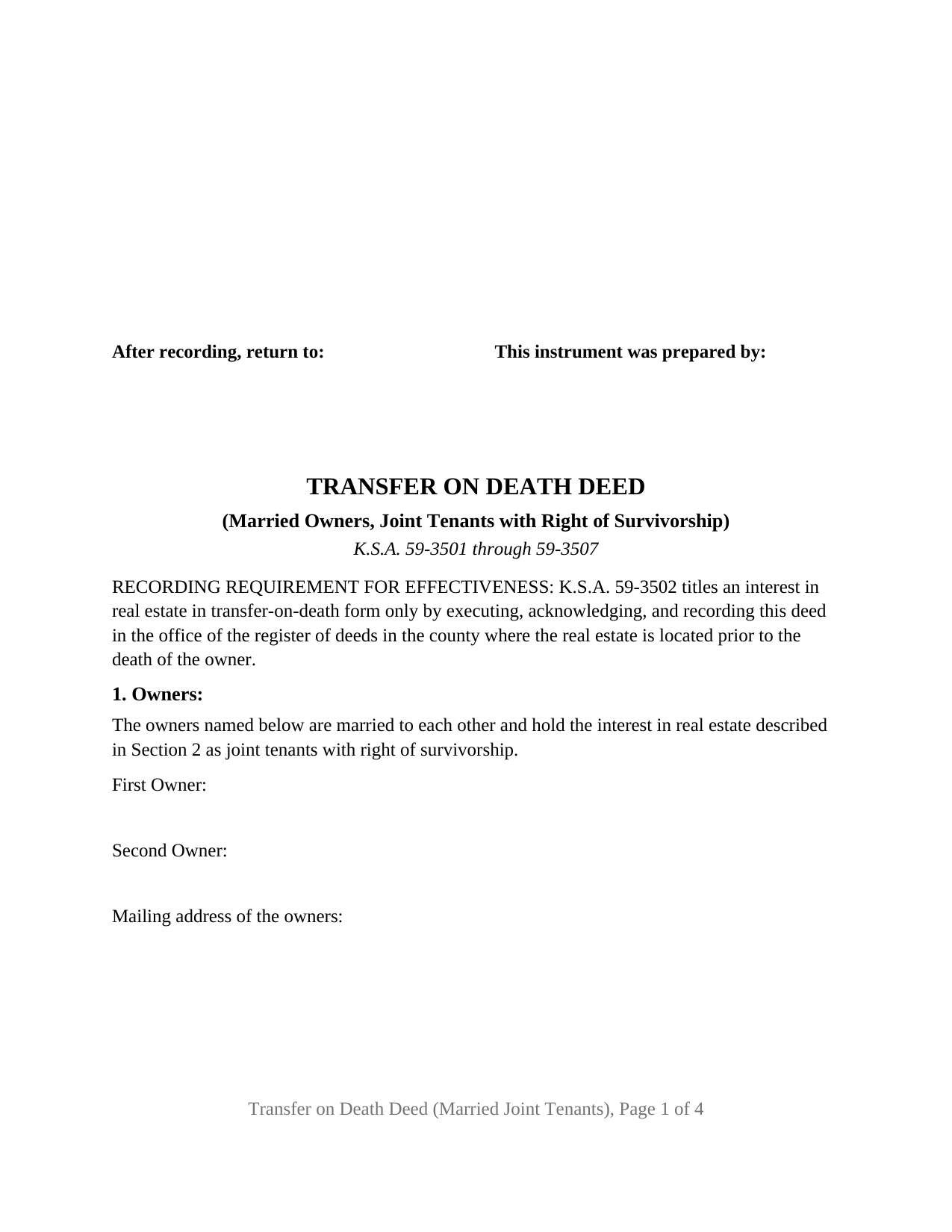
Kansas spouses who hold real estate as joint tenants with right of survivorship can fix the whole path of the title in one recorded instrument: to the survivor at the first death, by the survivorship already in their vesting deed, and then to the beneficiaries they name at the second death, outside probate. This form prepares that transfer on death deed under K.S.A. 59-3501 through 59-3507 for exactly two record owners who are married to each other and hold as joint tenants with right of survivorship; it is also searched for as a Kansas TOD deed or beneficiary deed for a married couple.
A deed that waits for the second death
K.S.A. 59-3505 is the section this deed is built around. A record joint owner may title that owner's interest in transfer-on-death form, but title vests in the grantee beneficiary only if that joint owner is the last to die of all of the record joint owners, and a deed in transfer-on-death form does not sever a joint tenancy. Both spouses sign this deed and name the same beneficiaries, so the first death changes nothing the deed does: the surviving spouse holds the entire interest by survivorship, and the beneficiaries take only when the survivor dies. Section 5 of the deed states that rule beside the K.S.A. 59-3502 legend.
Spousal consent carried by the signatures
The Kansas Constitution, article 15, section 9, and K.S.A. 60-2301 bar alienation of a homestead without the joint consent of husband and wife, and K.S.A. 59-505 preserves for a surviving spouse one half of real estate disposed of during the marriage without that spouse's written consent. A transfer on death deed signed by both spouses carries each spouse's written consent on its face. The deed carries a signature block and a separate acknowledgment certificate for each spouse in the short form of K.A.R. 7-43-17.
Joint tenancy is a question the vesting deed answers
Marriage alone creates no survivorship in Kansas. K.S.A. 58-501 makes a grant to two or more persons, husband and wife included, a tenancy in common unless the instrument makes clear that a joint tenancy was intended, and Kansas has no tenancy by the entirety. The recital in Section 1 states that the owners are married to each other and hold as joint tenants with right of survivorship; the words that created that joint tenancy sit in the couple's own vesting deed. Divorce rewrites the configuration: K.S.A. 59-105 severs a former couple's joint tenancy into equal tenancies in common, after which neither former spouse is a joint owner under K.S.A. 59-3505.
How this form is set up
The deed recites exactly two record owners, married to each other, holding as joint tenants with right of survivorship, each signing in that owner's own capacity; nothing about status or vesting is left to a blank or a checkbox. Section 3 takes one or more grantee beneficiaries by name and mailing address, and the optional Section 4 names an alternative grantee beneficiary to succeed a beneficiary who dies first, the designation K.S.A. 59-3504(c) contemplates; where no alternative is named and the deceased beneficiary leaves issue, that section vests the share in the issue per stirpes. A couple holding the house they bought together as joint tenants presents the pattern this deed recites. A sole owner, an unmarried pair of joint tenants, spouses who hold as tenants in common, a trustee, an owner signing through a power of attorney, and three or more owners are configurations this deed is not set up as.
Recording with the register of deeds
K.S.A. 59-3502 makes recording the act that titles the interest in transfer-on-death form: execution, acknowledgment, and recording in the office of the register of deeds for the county where the real estate is located, all before the owner's death. Kansas levies no deed transfer tax, the register collects the K.S.A. 28-115 page fees, and Department of Revenue Directive #19-041 tells registers that a transfer on death deed arrives without the sales validation questionnaire that accompanies a deed transferring title. The first page keeps its top three inches open for the stamp.
The package contains the fillable deed with a non-recorded instructions cover page, a completed example filled in for a Douglas County couple, and a guide that walks through each section, the joint tenancy and spousal rules, the lapse rule, and recording. This description, like the guide, describes the form and the Kansas statutes that govern it in general terms and is not legal advice.
Important: County-Specific Forms
Our transfer on death deed (married owners, joint tenants with right of survivorship) forms are specifically formatted for each of the 105 counties in Kansas.
After selecting your county, you'll receive forms that meet all local recording requirements, ensuring your documents will be accepted without delays or rejection fees.