Kansas Transfer on Death Deed (Unmarried Sole Owner)
County Specific Legal Forms Validated as recently as October 25, 2026 by our Forms Development Team
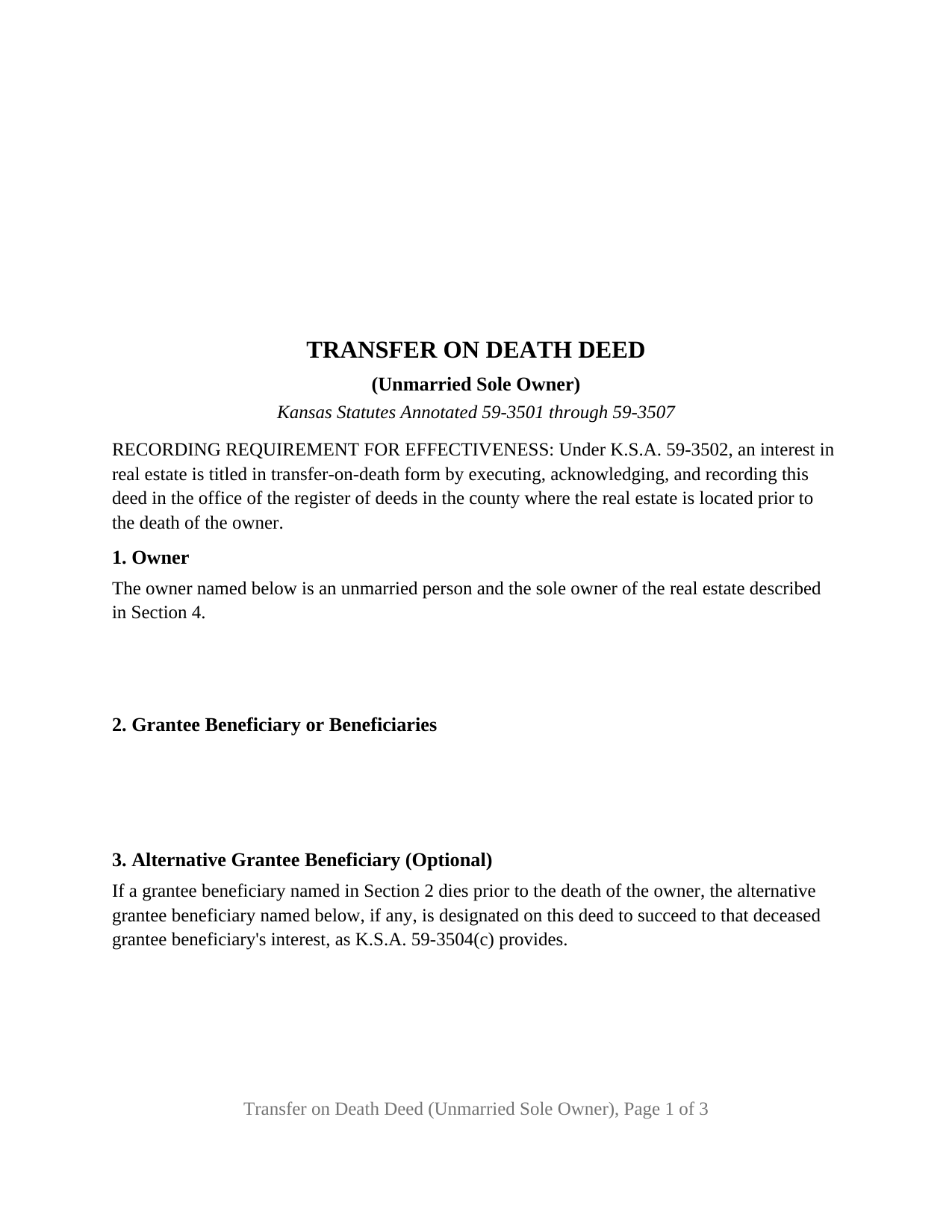
About the Kansas Transfer on Death Deed (Unmarried Sole Owner)
How to Use This Form
- Select your county from the list
- Download the county-specific form
- Fill in the required information
- Have the document notarized if required
- Record with your county recorder's office
What Others Like You Are Saying
"I found the form easy to file out. But everything else was confusing with very little direction and …"
"Thank you for your kind help. Great help. VR Roy F. Sutton"
"This is so convenient. Thank you."
"I was unable to finish what I started due to computer crash. I'll get back soon. I paid off my mortg…"
"I am pleased with this electronic service in making a time sensitive deed transfer since very few op…"
4.8/5 from 4,833 reviews. Read all
This Kansas transfer on death deed is drawn for a single record owner who is unmarried and holds the real estate alone. Section 1 recites that status and that sole ownership as fixed deed text, the deed carries exactly one signature line and one acknowledgment certificate, and the operative sentence is the one K.S.A. 59-3502 prescribes, so the person completing it fills in names, a legal description, and a county and nothing else. Owners search for it as a Kansas TOD deed or beneficiary deed.
One owner, one signature, one certificate
The deed recites exactly one owner, an unmarried person who is the sole owner of the real estate, and carries no blank, selector, or second signature block for anyone else. The signature section is headed OWNER, and the certificate below the notary line is the Kansas short form of K.A.R. 7-43-17, with a reserved area for the official stamp K.S.A. 53-5a16(b) places on a paper certificate. A widowed owner, a divorced owner, and an owner who has never married each present the pattern this deed recites; a married owner, two co-owners of any kind, a trustee, and an attorney in fact are configurations the form is not set up as.
The recital an unmarried owner signs
Two Kansas rules turn on marriage, and the recital addresses both. Article 15, section 9 of the Kansas Constitution and K.S.A. 60-2301 bar alienation of a homestead without the joint consent of husband and wife when that relation exists, and K.S.A. 59-505 reaches real estate a married owner disposes of without the spouse's written consent. The deed recites that no marriage exists, so it carries no spousal line. The recital states the status the owner asserts at signing; the vesting deed of record shows the interest the owner holds, and the deed reaches all of that interest and no more.
When a named beneficiary dies first
Kansas writes the answer into K.S.A. 59-3504(c), and Section 3 gives it a home: a complete provision with one blank, naming an alternative grantee beneficiary to succeed to the interest of a grantee beneficiary who dies before the owner. Under subsection (c)(1) the transfer to a beneficiary who dies first lapses when no alternative has been designated on the deed, except that under subsection (c)(2), where the deed was not made contingent on the beneficiary surviving the owner and the deceased beneficiary leaves issue surviving at the owner's death, the interest vests in that issue per stirpes as successor grantees. This deed prints no survival contingency, so a Section 3 left reading None leaves the per stirpes path in place, and a named alternative names the successor. These rules, amended in 2023, apply to deeds filed of record on or after July 1, 2023.
Titled only when recorded before death
Nothing passes while the owner lives; K.S.A. 59-3501 provides that the deed transfers ownership upon the owner's death and that no consideration is required. K.S.A. 59-3502 makes recording part of the titling act itself: the interest is titled in transfer-on-death form by executing, acknowledging, and recording the deed with the register of deeds of the county where the real estate is located prior to the death of the owner. The deed prints that condition above Section 1 as a one-sentence notice, because a deed left unrecorded at the owner's death titles nothing. At death, K.S.A. 59-3504 vests title subject to every mortgage, lien, contract, and Kansas medical assistance claim the owner was subject to in life, and K.S.A. 59-3503 keeps the designation revocable by recorded instrument, never by will, through a revocation or later deed prepared and recorded separately and not included in this package.
What the register of deeds sees
The register sees a letter-size deed with 12-point body text, the typed name beneath the owner's signature that K.S.A. 28-115(d) asks for on pain of a one dollar fee, and a certificate whose jurisdiction, date, officer title, and commission expiration are the content K.S.A. 53-5a16 requires. Kansas collects no deed transfer tax. The completed example is filled in for a Sedgwick County fact pattern: a Wichita owner naming two children as grantee beneficiaries and a third as the alternative.
The package contains the fillable transfer on death deed with a non-recorded instructions cover page, the completed example, and a guide covering each numbered section, the signing formalities, the lapse and successor rules, and recording; both describe the form and the Kansas statutes that govern it in general terms and are not legal advice.
Important: County-Specific Forms
Our transfer on death deed (unmarried sole owner) forms are specifically formatted for each of the 105 counties in Kansas.
After selecting your county, you'll receive forms that meet all local recording requirements, ensuring your documents will be accepted without delays or rejection fees.