Kansas Transfer on Death Deed (Trust Beneficiary)
County Specific Legal Forms Validated as recently as October 25, 2026 by our Forms Development Team
About the Kansas Transfer on Death Deed (Trust Beneficiary)
How to Use This Form
- Select your county from the list
- Download the county-specific form
- Fill in the required information
- Have the document notarized if required
- Record with your county recorder's office
What Others Like You Are Saying
"Awesome service! 4 services wouldn't handle a 1-time filing, but Deeds.com got the job done in less …"
"I appreciate being able to find the forms needed for my Gift Deed. It was simple to understand and c…"
"They didn't have what I was looking for so they refunded my money immediately. Very easy to work wit…"
"Fast, efficient, and helpful. I don't often have documents that need recording but I found Deeds.com…"
"I have used the quit claim form and seem is very easy."
4.8/5 from 4,833 reviews. Read all
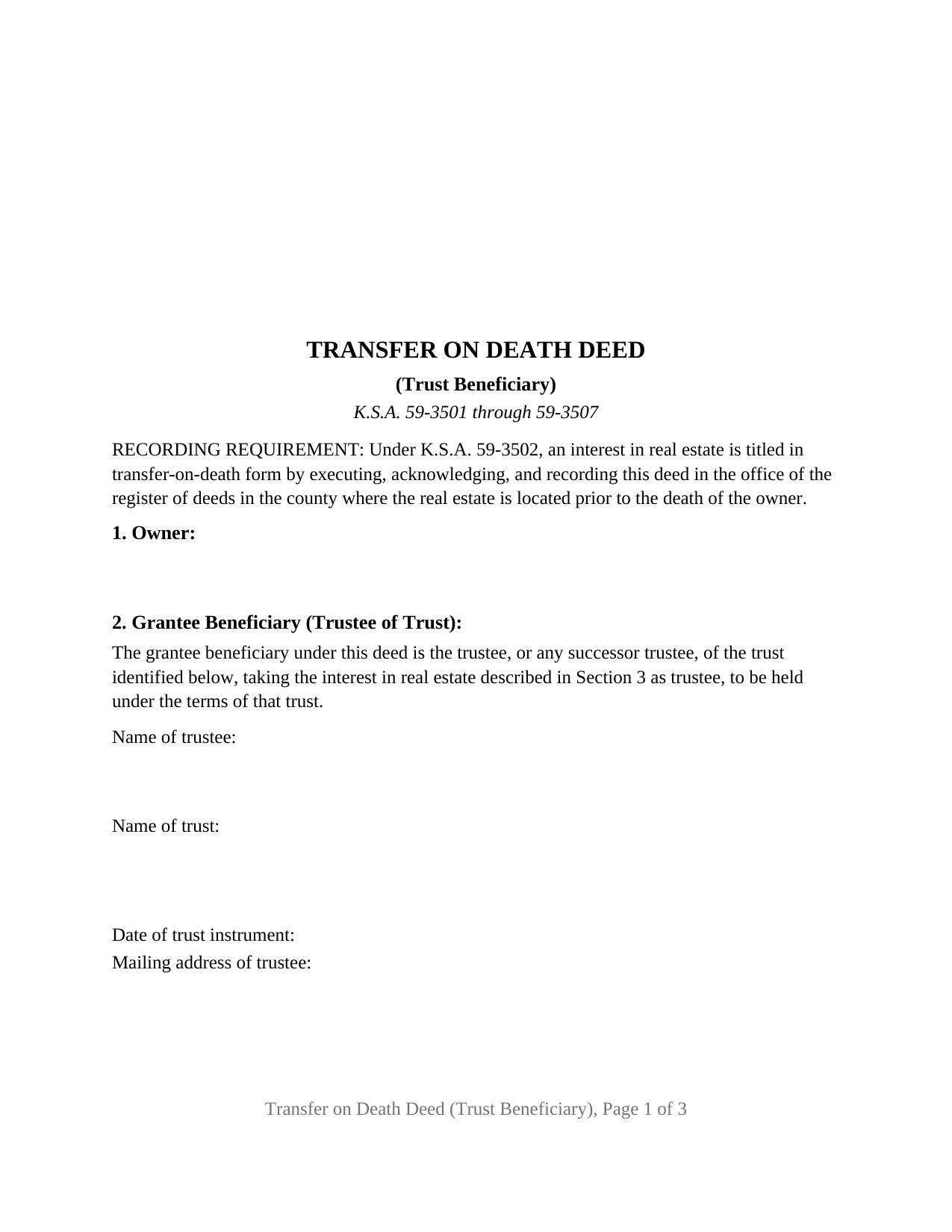
A Kansas transfer on death deed that names a trust reaches, for one parcel of real estate, the result a pour-over will aims at, with no probate in between: at the owner's death the described interest vests in the trustee under the trust the owner already signed. This form prepares that deed for one record owner under K.S.A. 59-3501 through 59-3507, with the grantee beneficiary fixed as the trustee of a trust; it is also searched for as a Kansas TOD deed to a trust or a beneficiary deed naming a trustee.
The trustee is the beneficiary, and the office outlives the person
K.S.A. 59-3501 lets the record owner designate a grantee beneficiary and leaves the term undefined; the uniform trust code supplies the rest. K.S.A. 58a-401 counts a disposition taking effect at the settlor's death among the ways property comes into a trust, and K.S.A. 58a-103(19) reads the word trustee to include a successor trustee and a cotrustee. Section 2 of the deed fixes the designation on that footing: its printed text names the trustee, or any successor trustee, of the trust identified below, taking the interest as trustee to be held under the terms of that trust, and the blanks beneath take the trustee's name, the trust's name, the date of the trust instrument, and the trustee's mailing address. Because the designation runs to the office, a trustee who dies or resigns while the owner lives does not defeat it.
A trust funded at death, not during life
A deed into a trust signed today is a present conveyance, and the trustee becomes the record owner. This deed leaves the owner on the record as owner: K.S.A. 59-3501(b) requires nothing from the trustee while the owner lives, and the owner remains free to sell, mortgage, lease, or revoke the designation under K.S.A. 59-3503. The statute fixes one timing rule: the deed is executed, acknowledged, and recorded with the register of deeds of the county where the real estate lies before the owner dies, and an unrecorded deed at death titles nothing.
One owner, one trust, one signature
The deed recites exactly one record owner, signing in that owner's own capacity, and exactly one grantee beneficiary, the trustee of the named trust. The owner block accepts the marital status words Kansas deeds customarily carry and fixes none of its own; one owner signature block is followed by one acknowledgment certificate in the Kansas short form of K.A.R. 7-43-17. An owner who serves as initial trustee of her own revocable living trust and names herself in that capacity, and a parent who holds a rental house in her own name and names the trustee of a trust created for a child, each present the pattern this deed recites. The form carries no second owner block, no alternative grantee beneficiary block, and no natural person or entity beneficiary line; a trustee who already holds record title, an owner signing through an attorney-in-fact, and two record owners on one instrument are patterns this deed is not set up as.
What the trustee holds afterward
Title vests in the trustee at the owner's death under K.S.A. 59-3504(a), subject under K.S.A. 59-3504(b) to every mortgage, lien, and contract the owner made and to claims of the State of Kansas for medical assistance. The trustee then administers the real estate under the trust instrument, dealing with a buyer or lender through the certification of trust K.S.A. 58a-1013 describes, and completes the county record with evidence of the owner's death, an affidavit of death prepared and recorded separately and not included in this package.
Recording in the county where the land lies
Kansas imposes no transfer tax, and the Kansas Department of Revenue's directive to registers of deeds treats a transfer on death deed as outside the sales validation questionnaire requirement. K.S.A. 58-2221 has the person recording a deed furnish the register the name and last-known post-office address of the person to whom the property is conveyed, and the trustee's mailing address line in Section 2 carries it.
The package contains the fillable deed with a non-recorded instructions cover page, a completed example for a Sedgwick County owner who names herself as trustee of her own revocable living trust, and a guide that walks through every section, the trust code provisions behind the designation, the lapse and spousal rules, and the recording steps. This description and the guide describe the form and the governing Kansas statutes in general terms; they are not legal advice.
Important: County-Specific Forms
Our transfer on death deed (trust beneficiary) forms are specifically formatted for each of the 105 counties in Kansas.
After selecting your county, you'll receive forms that meet all local recording requirements, ensuring your documents will be accepted without delays or rejection fees.