Louisiana Quitclaim Deed (Corrective)
Parish Specific Legal Forms Validated as recently as October 14, 2026 by our Forms Development Team
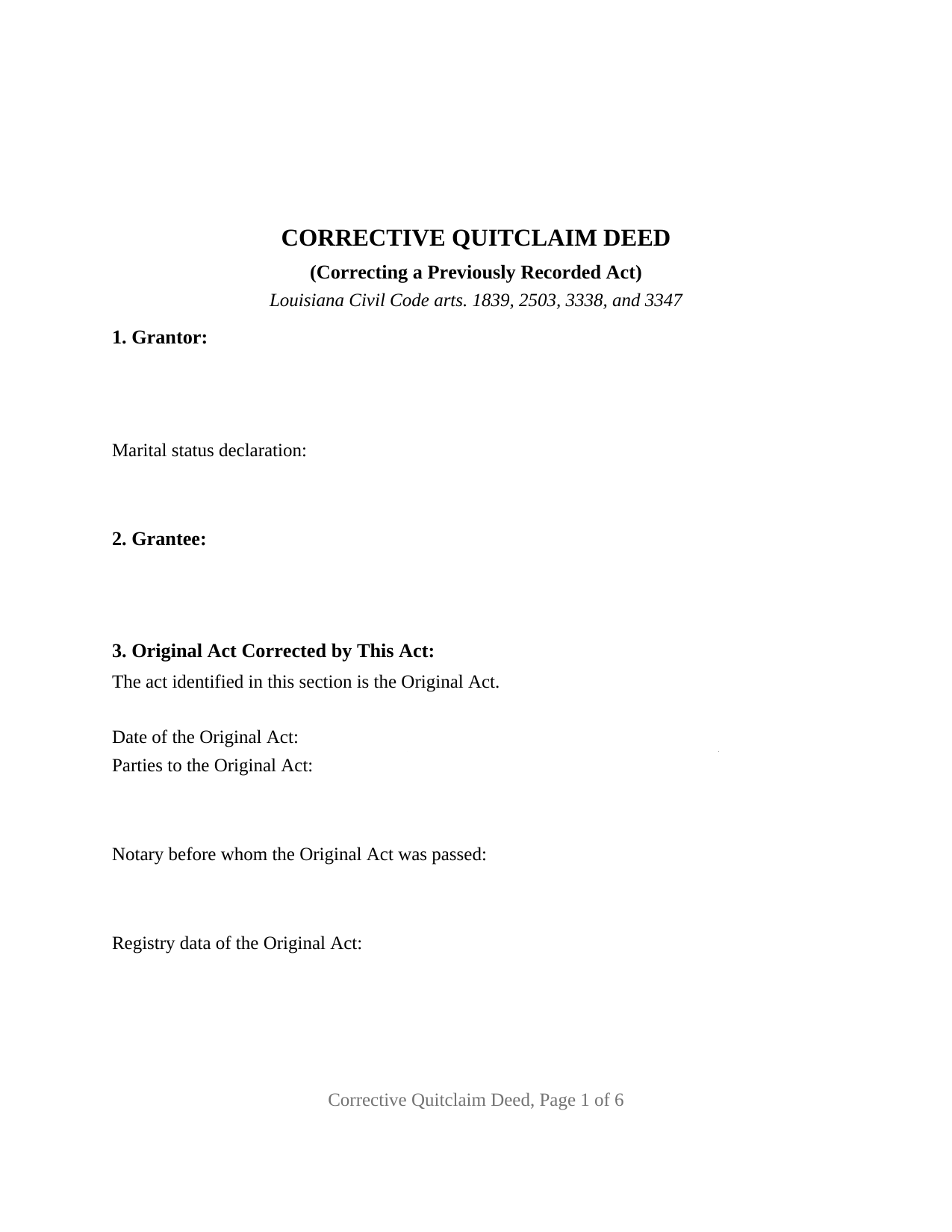
About the Louisiana Quitclaim Deed (Corrective)
How to Use This Form
- Select your parish from the list
- Download the parish-specific form
- Fill in the required information
- Have the document notarized if required
- Record with your parish recorder's office
What Others Like You Are Saying
"Fonts for all fields are not the same. Collin County has a specified size it wants in all fields. Ot…"
"Outstanding site in every way and reasonably priced."
"The deed form served my purpose and saved the expense of using an attorney. Easy to use. It would ha…"
"This service is an amazing time saver. No more trips to the recorder's office. Well worth the servic…"
"Great source easy to use."
4.8/5 from 4,829 reviews. Read all
Louisiana already has a correction instrument, and it does not belong to the parties. Revised Statutes 35:2.1 lets the notary who passed or prepared an act fix a clerical error in it, signing before two witnesses and another notary, and gives that filing retroactive effect back to the recordation date of the original. This Louisiana corrective quitclaim deed is the other half of the picture: the grantor and the grantee of a recorded quitclaim deed sign again themselves, set out what the earlier act says and what it is corrected to say, and quitclaim the same interest a second time with no warranty of title.
Whose statement carries the error decides which instrument answers
The dividing line in Louisiana is not how serious the mistake is but whose words hold it. A clerical slip in the notarial act is what Revised Statutes 35:2.1 hands to the notary, in an instrument prepared and recorded on its own that is not part of this package. A misdescription in what the parties themselves declared is answered by the parties themselves. Where the two sides do not agree that the writing misstates their bargain, no recorded form reaches it at all: Agurs v. Holt treats reformation as an equitable action, personal even as to land, on clear and convincing proof of mutual error.
A second filing date, not a rewritten first one
The retroactivity Revised Statutes 35:2.1 attaches to a notarial act of correction has no counterpart in an act the parties sign. Civil Code article 3338 leaves an instrument without effect as to third persons unless it is registered, and article 3347 dates that effect from filing, so a party-signed correction reaches third persons from its own filing in the parish where the immovable lies. Article 3341 adds that recordation raises no presumption that an act is valid or genuine. Anything filed between the two dates stands to be read on its own terms.
Correcting without unwinding
Section 10 is where an act of this construction earns its name. It states that the correction reaches the respect named in Sections 5 and 6 and no other, that the earlier act otherwise stands according to its terms, and that this one does not novate, rescind, or extinguish it. Sections 5 and 6 carry the two halves side by side, the statement as the record now reads and the statement as corrected, while Section 4 prints the full corrected description. Section 9 then performs both acts in one sentence.
No warranty, and the declarations that belong to the grantee
Article 2503 puts the warranty against eviction into every Louisiana sale and lets an act limit or exclude it, yet an exclusion standing alone still leaves the price recoverable after an eviction. Section 11 carries the exclusion as far as the article reaches and passes no after-acquired title. Section 12 supplies the other half from the grantee's side, awareness of the danger, acceptance at the grantee's sole peril and risk, and an express release of the return of the price, printed above the accepting signature. Capitals hold the one liability no agreement touches, an eviction occasioned by the grantor's own act.
What this configuration recites
The act names one grantor and one grantee, the same two parties the earlier instrument named, with a marital status declaration on the grantor side and a numbered section collecting the earlier act's date, parties, notary, and registry data, so the two instruments point at each other in the conveyance index. A transposed lot or square number, a plat reference pointing at the wrong book and folio, and a party name initialed differently from the vesting act present the pattern this deed recites. Patterns it does not recite: a change in the interest transferred or in who receives it, which is a fresh conveyance rather than a correction, and a community immovable, whose alienation Civil Code article 2347 conditions on both spouses concurring.
Searched as a correction deed, a deed of correction, or a scrivener's error deed, this Louisiana corrective quitclaim deed answers in the state's own civil law vocabulary, and six recorded pages price it in the two hundred dollar tier of Revised Statutes 13:844 before parish charges. The purchase delivers the blank deed as a fillable PDF, a completed example built on a Tangipahoa Parish pattern correcting a transposed lot number, and a plain language guide covering the numbered sections, execution, and parish recording. The materials are informational and are not legal advice.
Important: Parish-Specific Forms
Our quitclaim deed (corrective) forms are specifically formatted for each of the 64 parishes in Louisiana.
After selecting your parish, you'll receive forms that meet all local recording requirements, ensuring your documents will be accepted without delays or rejection fees.