Louisiana Quitclaim Deed (Married Couple as Grantors)
Parish Specific Legal Forms Validated as recently as October 15, 2026 by our Forms Development Team
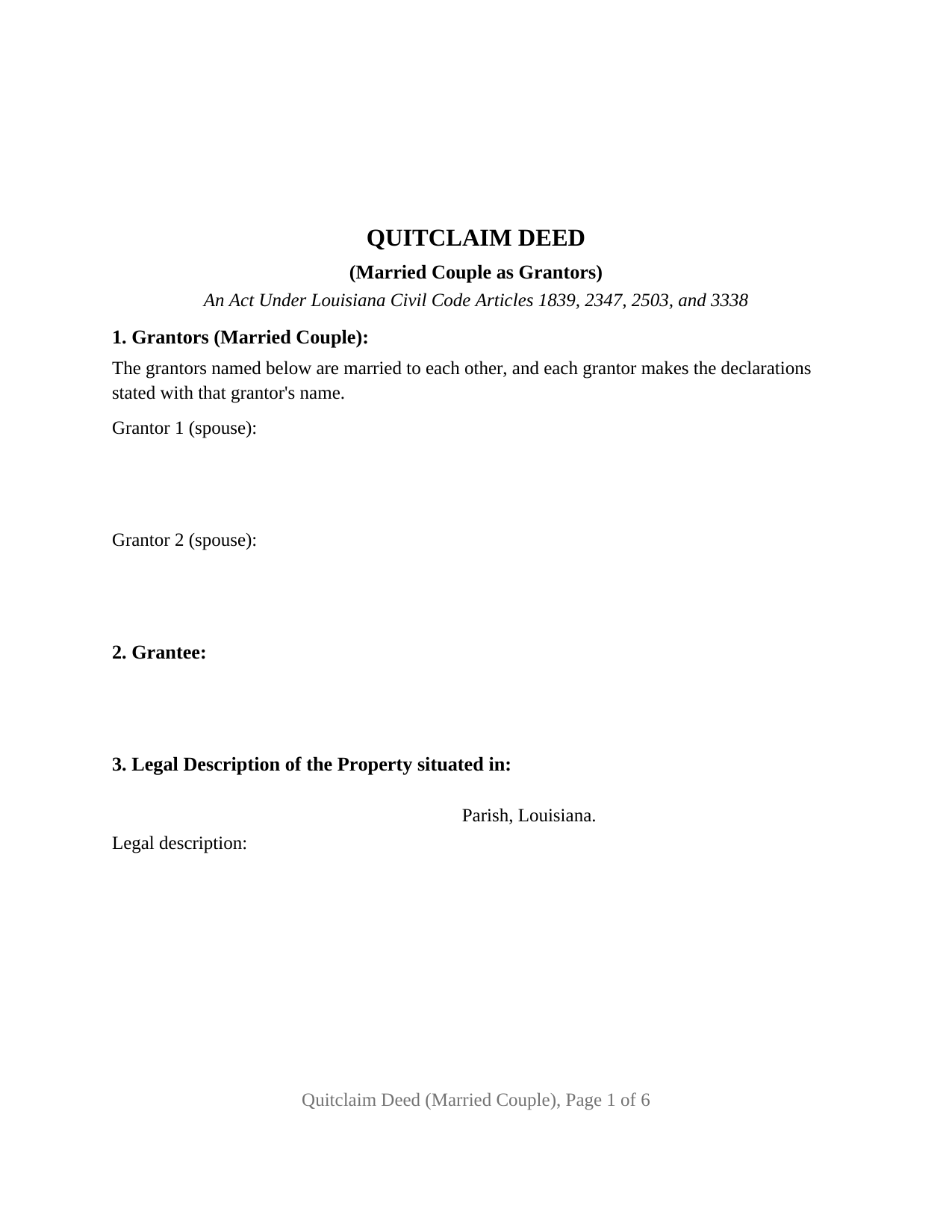
About the Louisiana Quitclaim Deed (Married Couple as Grantors)
How to Use This Form
- Select your parish from the list
- Download the parish-specific form
- Fill in the required information
- Have the document notarized if required
- Record with your parish recorder's office
What Others Like You Are Saying
"Great service"
"Awesome and quick service again, just like always from KvH. Thanks!"
"Very good, very expensive. I hope that this is what my lawyer needed for us to finish our wills. Geo…"
"descriptions for some areas were longer than what would print out on document - it showed and was vi…"
"Very responsive and helpful. Made a big task quite easy and effecient. I would highly recommend. Rea…"
4.8/5 from 4,828 reviews. Read all
Louisiana writes marriage into its property law, and this quitclaim deed writes it into the act itself. The form prepares a conveyance by two grantors who are married to each other: both spouses named with declared marital status, both spouses signing, and each spouse concurring on the face of the act in the conveyance made by the other. Whatever right, title, and interest the couple holds in the described immovable, community or separate, passes to the grantee with no warranty of title.
A deed built around article 2347
Each spouse owns a present undivided one half interest in community property under Civil Code article 2336, article 2347 makes the concurrence of both spouses the condition for alienating a community immovable, and a one-spouse transfer where concurrence is needed is relatively null under article 2353. This form treats those articles as architecture. The printed party section states that the grantors are married to each other, a marital status declaration rides with each grantor's name, and a dedicated concurrence section states that each spouse joins in and concurs in the conveyance made by the other, so the concurrence the code calls for is executed inside the act rather than left to inference from two signatures.
Community, separate, or standing in one name
Property acquired during a Louisiana marriage under the legal regime is presumed community under article 2340, and the presumption does not turn on whose name the act of acquisition carried. That is the quiet pattern this configuration reaches: a lot bought during the marriage and titled in one spouse's name alone still moves as community property, and a deed executed by both spouses places both conveyances and both concurrences of record in a single instrument. Married parents passing a camp or homeplace to an adult child present the same two-spouse pattern. Because each grantor conveys that grantor's own right, title, and interest, the act also reaches any separate interest either spouse holds in the property, so the conveyance does not wait on classifying the property first.
No warranty, in the code's own words
The operative section quitclaims, transfers, assigns, and delivers, then closes every door article 2503 leaves open: the act excludes the warranty against eviction, states that no after-acquired title passes, and pairs the exclusion with the grantee's own declarations, acceptance at the grantee's peril and risk, awareness of the danger of eviction, and an express release of the return of the price, placed above the grantee's accepting signature. The one statutory constant stays printed in the act: a grantor remains liable for an eviction that grantor's own act brings about.
Three certificates, two witnesses, one parish filing
The signature page carries a block for each spouse, an accepting block for the grantee, and two witness lines, serving execution as an authentic act before a notary and two witnesses under Civil Code article 1833, or execution under private signature with acknowledgment to follow under article 1836. A separate acknowledgment certificate appears for each signing party, captioned with the state and parish venue and carrying a line for the notary identification or bar roll number. Recording goes to the clerk of court of the parish where the property sits, and filing is what gives the act effect as to third persons under the registry articles. The deed runs six recorded pages, within the $200 six to twenty five page tier of the statewide fee statute, R.S. 13:844, before parish add-ons.
Searched for as a husband and wife quitclaim deed, a spousal quit claim deed, or a married couple deed without warranty, the instrument answers to Louisiana's civil law vocabulary, and this form speaks it. The purchase delivers the blank two-spouse deed as a fillable PDF, a completed example filled in for a married couple conveying a St. Tammany Parish lot to their adult son, and a plain language guide that walks through each numbered section, the spousal concurrence articles, both execution paths, and parish recording. The materials are informational and are not legal advice.
Important: Parish-Specific Forms
Our quitclaim deed (married couple as grantors) forms are specifically formatted for each of the 64 parishes in Louisiana.
After selecting your parish, you'll receive forms that meet all local recording requirements, ensuring your documents will be accepted without delays or rejection fees.