Louisiana Quitclaim Deed (Trustee Grantor)
Parish Specific Legal Forms Validated as recently as September 4, 2026 by our Forms Development Team
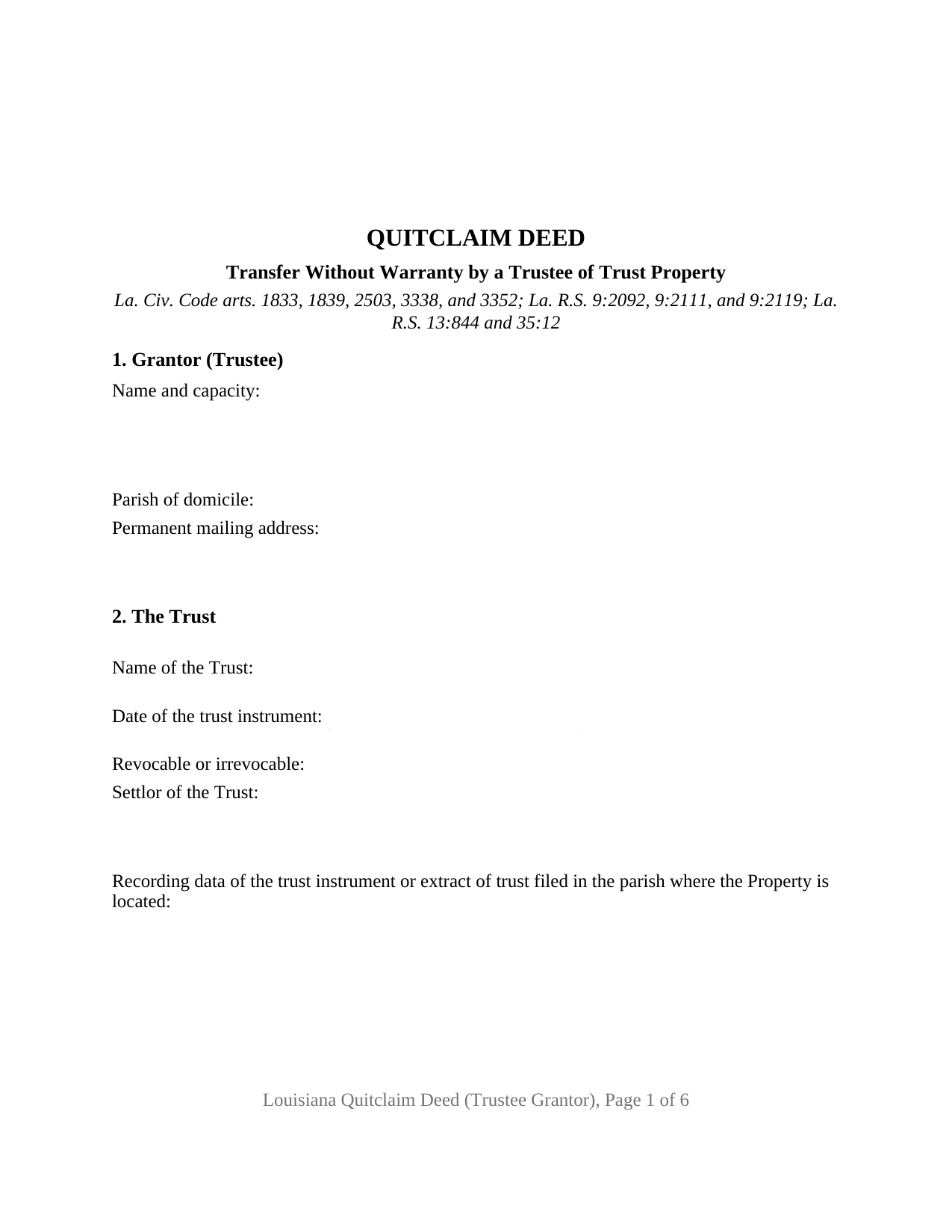
About the Louisiana Quitclaim Deed (Trustee Grantor)
How to Use This Form
- Select your parish from the list
- Download the parish-specific form
- Fill in the required information
- Have the document notarized if required
- Record with your parish recorder's office
What Others Like You Are Saying
"This is the go to place for quick work. They are awesome."
"Excellent service and site. Easy to use. Finding the required forms was easy."
"Price is fair and system is so user friendly. Highly recommend"
"Very fast and efficient. Easy to fill out but was upset the latest tax exemptions ruled in 2014 did …"
"The service provided was exactly what I needed. The downloadable deed and supporting documents allow…"
4.8/5 from 4,828 reviews. Read all
On this Louisiana quitclaim deed the grantor is a trustee, and the act says so in its own words: the trustee moves whatever right, title, and interest the trust holds in a described immovable, with no warranty of title, signing in a fiduciary capacity and taking on nothing personally. A numbered section names the trust, dates its instrument, marks it revocable or irrevocable, and locates the trust filing already in the record.
Two conditions the Trust Code puts on a trustee's sale
Title stands in the trustee, not in the trust, so the signer is a person holding a capacity. R.S. 9:2111 confines a trustee to the powers the trust instrument confers or that are necessary or appropriate to the trust's purposes and not forbidden by it. R.S. 9:2119 speaks to sales directly: a trustee may sell trust property unless the sale is forbidden in specific words by the trust instrument, or unless it appears from the instrument that the property is to be retained in kind. Section 9 turns those two conditions into printed declarations of the trustee.
The restriction that has to be recited to reach third persons
R.S. 9:2092 sends a trustee holding Louisiana trust immovables to the records of each parish where they lie, with the trust instrument, an extract of trust, or a clerk-certified copy. Subsection B carries the consequence this configuration is built around: a restriction in the trust instrument on the power to alienate, lease, or encumber immovable property reaches third persons only if the recorded extract recites it. Section 2 collects that filing's registry data and any restriction it carries, so the two read against each other in one index; the filing is a separate instrument, recorded on its own and not included here.
A signature in a capacity, and one trustee only
The trustee's name line and the certificate by-line are both sized for the words of capacity, and R.S. 35:12 lets a clerk refuse a notarized filing lacking typed or printed names and the notary identification or bar roll number. Printed text states that the trustee signs solely as trustee and takes on no personal obligation. The act recites one trustee: R.S. 9:2113 has two trustees exercising their powers only together, and R.S. 9:2114 lets a majority act where three or more hold the office, each signing and acknowledging in a block of that trustee's own. The capacity line takes an original, alternate, or successor trustee alike, per R.S. 9:1785. A trustee closing a sale of trust land, one handing an immovable to a beneficiary in kind, and one returning property to the settlor of a revocable trust present this single-trustee act.
How far the exclusion of warranty reaches
Civil Code article 2503 implies the warranty against eviction in every Louisiana sale and lets the parties limit or exclude it. Exclusion alone leaves the price obligation standing unless the party taking knew of the danger, took at its own peril and risk, or released it. Section 8 excludes the warranty as far as article 2503 allows; Section 12 puts the grantee's peril-and-risk declaration and an express release of the price above the accepting signature, running to the trustee and the trust property alike. Capitals print the one liability the article holds open against any contrary agreement, an eviction brought about by the transferor's own act.
Execution, and what filing accomplishes
Two signature blocks and two witness lines serve either Civil Code path, an authentic act under article 1833 or an act under private signature acknowledged later under article 1836, each signing party taking a certificate captioned with the state and the parish. Filing with the clerk of court where the immovable lies carries the transfer to third persons under articles 3338 and 3347, while article 3341 keeps recordation from creating any presumption that an act is valid or genuine. Six recorded pages sit in the two hundred dollar tier of R.S. 13:844 before parish charges, and page one holds two inches for the clerk's stamp.
Searched as a trustee deed, a quit claim deed from a trust, or a deed out of a living trust, it speaks the Civil Code and the Trust Code at once. The purchase delivers the blank as a fillable PDF, a completed example built on a Calcasieu Parish fact pattern where a family trust's trustee moves a Lake Charles lot to a buyer, and a plain language guide covering every numbered section, execution, and parish recording. The materials are informational and are not legal advice.
Important: Parish-Specific Forms
Our quitclaim deed (trustee grantor) forms are specifically formatted for each of the 64 parishes in Louisiana.
After selecting your parish, you'll receive forms that meet all local recording requirements, ensuring your documents will be accepted without delays or rejection fees.