Louisiana Quitclaim Deed
Parish Specific Legal Forms Validated as recently as September 30, 2026 by our Forms Development Team
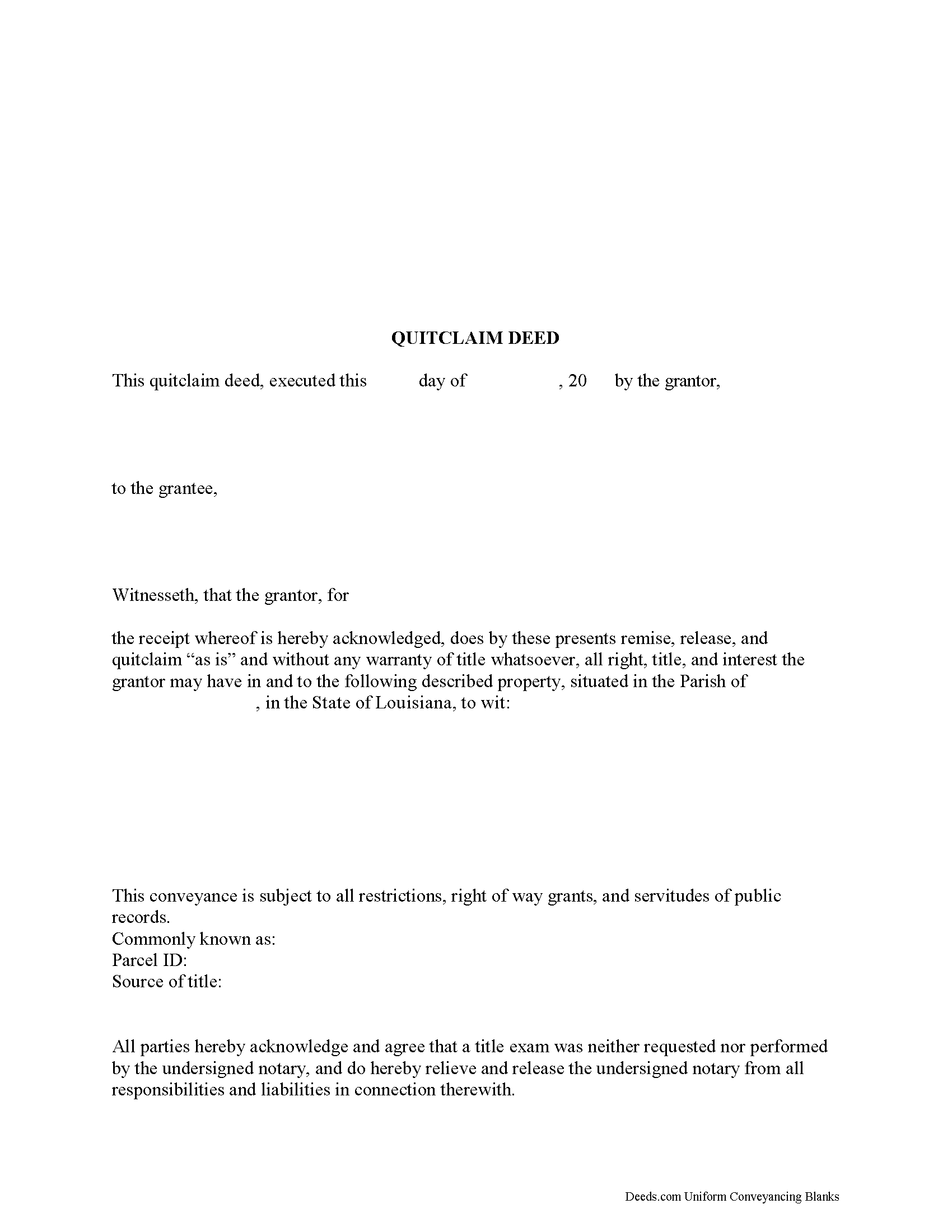
About the Louisiana Quitclaim Deed
How to Use This Form
- Select your parish from the list
- Download the parish-specific form
- Fill in the required information
- Have the document notarized if required
- Record with your parish recorder's office
What Others Like You Are Saying
"First Time User here. Simple and easy. Delivered Deed in excellent time. Sure beats going to the rec…"
"Easy to use,thanks"
"The download of forms, etc. was easy and the guides that were provided were good, but more informati…"
"So easy to use!"
"Wow! That was easy! I was expecting a more difficult process. Upload your docs and wait for a respon…"
4.8/5 from 4,828 reviews. Read all
Ask a Louisiana deed how its new owners will hold title and the Civil Code answers with silence, because that question belongs to classification rather than to drafting. This Louisiana quitclaim deed is built on that silence: one or two people on the transferring side, one or two on the receiving side, all of them signing in their own right, and party blanks that carry the status and title words the parties themselves supply rather than a printed menu of tenancies.
An interest, not a parcel
The instrument moves what the transferor happens to hold. Louisiana appellate law describes an act of this construction as one purporting to transfer nothing more than the interest the grantor may have at the time of the transaction, drawing on the Louisiana Supreme Court's treatment in Waterman v. Tidewater Associated Oil Co., and that limit is printed in the transfer section itself: the act reaches the right, title, and interest held when the parties sign, and no title reaching the grantor afterward travels with it. Section 5 is the practical companion, collecting the act the interest came from with its parish entry number, so a later reader can see which record interest the deed was aimed at.
No tenancy menu, and the default article 797 supplies
Louisiana recognizes no joint tenancy and no tenancy by the entirety in land. Two grantees who take without saying more own the thing in indivision under Civil Code article 797, in shares the article presumes equal, with each share passing through its owner's succession at death rather than to the survivor. Spouses domiciled in Louisiana meet a different rule again, since article 2334 places acquisitions during the legal regime in the community of acquets and gains by classification, whatever the deed calls the parties. So the grantee blank stays open: it takes two names and whatever share or capacity words go with them, and the guide sets out each form the taxonomy recognizes, the default when the act names none, and the ones borrowed vocabulary cannot import.
A warranty the Code inserts, and the words that take it back out
Article 2503 implies the warranty against eviction in every sale and permits the parties to exclude it, yet an exclusion standing by itself still leaves the price recoverable when eviction comes, unless the party taking knew of the danger, took at peril and risk, or released that obligation in terms. The exclusion section closes the warranty and the price obligation together; the section after it collects the awareness, the peril and risk, and the release from the grantee, above the accepting signature, because those are the taker's words to give. Capitals carry what no drafting reaches, the transferor's liability for an eviction his own act occasions.
What this configuration recites
The act prints four signature blocks in fixed order, a grantor, a second grantor, a grantee, and a second grantee, with two witness lines and a certificate for each block, so a single filing accommodates one or two natural persons on either side and leaves unused blocks empty. Nothing about marriage, capacity, or vesting is preprinted anywhere on the deed, which is what lets one instrument carry any of those four count patterns: a sole owner naming a sole taker, one transferor to a pair, or a pair on each side. Configurations it does not print are equally definite, and each belongs to its own act: a transferor that is a company, a corporation, or a partnership, whose signer's authority comes from entity law; a signature given by a mandatary under a power of attorney; a taker who receives in a fiduciary capacity; and three or more owners on either side, which outruns the blocks and certificates printed here.
Searched as a quit claim deed, a no warranty deed, or simply a quitclaim, the Louisiana version answers in civil law vocabulary, and this one is written in it. Filing with the clerk of court in the parish of the immovable is what carries the transfer to third persons under articles 3338 and 3347, and its eight recorded pages price in the second tier of Revised Statutes 13:844 before parish charges. The purchase brings the blank deed as a fillable PDF, a completed example built on a Lafayette Parish fact pattern, and a plain language guide covering the numbered sections, both execution paths, and parish recording. These materials describe the form and the statutes behind it; they are informational, and they are not legal advice.
Important: Parish-Specific Forms
Our quitclaim deed forms are specifically formatted for each of the 64 parishes in Louisiana.
After selecting your parish, you'll receive forms that meet all local recording requirements, ensuring your documents will be accepted without delays or rejection fees.