Michigan Correction Deed
County Specific Legal Forms Validated as recently as May 18, 2026 by our Forms Development Team
About the Michigan Correction Deed
How to Use This Form
- Select your county from the list on the left
- Download the county-specific form
- Fill in the required information
- Have the document notarized if required
- Record with your county recorder's office
What Others Like You Are Saying
"You have made this process so simple - I can see it would have been complicated and frustrating with…"
"Love the names on the example! thanks for the smiles!"
"Very fast Process to get this to ROD"
"Very easy to use. Had my Transfer of Death Designation Affidavit done in no time and filed with the …"
"Beware, you cannot save the information you typed and change it later. It will be a PDF upon saving.…"
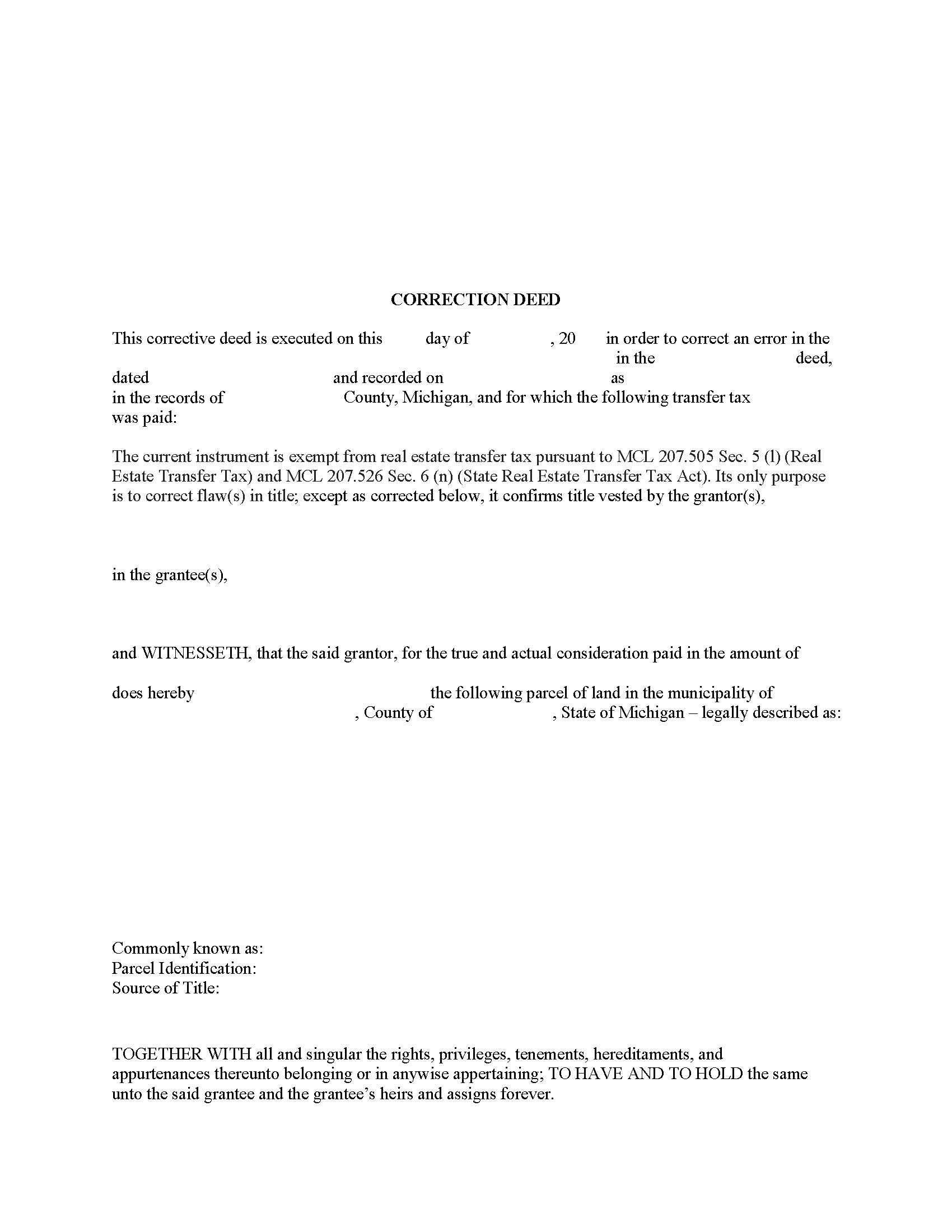
Use this correction deed to correct an error in a previously executed and recorded deed.
Correction deeds are used to adjust the earlier deed when that document contains minor errors of omission or typographical errors, sometimes called scrivener's mistakes. For example, a misspelled name, an omitted or wrong middle initial, a minor error in the property description, or an omitted execution date. Do not us the correction deed for more substantial changes, such as the removal of a name from a deed. Such alterations are better handled through a quit claim deed.
The correction deed, also called corrective deed, must state that its sole purpose is to correct a specific error, which is usually identified by type. For example: an error in the grantor's name, or an error in the grantor's marital status. It also must clearly reference the type of document it is correcting and state the execution and recording date of that prior document, as well as the number under which it was recorded, either referred to as instrument number or liber (book) and page number.
In subsequent sections, the correction deed repeats the information that was in the prior deed with the exception of the false, ambiguous or omitted information that needs to be corrected. By restating all the information from the earlier deed, this new deed of correction will confirm the previously recorded deed, which remains on record as is.
Warranty deeds require a tax stamp from the treasurer's office before recording. If the prior deed is a warranty deed and the legal description is being corrected, be sure to get a new tax stamp for the current instrument as well. In some counties, any deed that contains the word "warrant" must be checked by the treasurer's office first regardless of the type of correction.
(Michigan CD Package includes form, guidelines, and completed example)
How to Use This Form
- Select your county from the list above
- Download the county-specific form
- Fill in the required information
- Have the document notarized if required
- Record with your county recorder's office
What Others Like You Are Saying
"You have made this process so simple - I can see it would have been complicated and frustrating with…"
"Love the names on the example! thanks for the smiles!"
"Very fast Process to get this to ROD"
"Very easy to use. Had my Transfer of Death Designation Affidavit done in no time and filed with the …"
"Beware, you cannot save the information you typed and change it later. It will be a PDF upon saving.…"
Common Uses for Correction Deed
- Amend an error in the grantee or grantor information
- Correct a legal description error in a recorded document
- Correct the marital status listed on a deed
- Correct a recorded deed that omitted required language
- Fix a transposition error in a property's legal description
- Correct a deed that listed the wrong county or jurisdiction
- Correct a missing or incorrect notary acknowledgment
Compare other Michigan deed forms and documents
Important: County-Specific Forms
Our correction deed forms are specifically formatted for each county in Michigan.
After selecting your county, you'll receive forms that meet all local recording requirements, ensuring your documents will be accepted without delays or rejection fees.