Mississippi Warranty Deed
County Specific Legal Forms Validated as recently as October 4, 2026 by our Forms Development Team
About the Mississippi Warranty Deed
How to Use This Form
- Select your county from the list
- Download the county-specific form
- Fill in the required information
- Have the document notarized if required
- Record with your county recorder's office
What Others Like You Are Saying
"All in all an easy, cost-effective approach to simple legal work."
"I am not done yet but so far this has worked very slick"
"Excellent service with rapid turn around time!"
"Thank you for always providing great service!"
"Quick and easy. Had what I was searching for. Simple to pay and download."
4.8/5 from 4,832 reviews. Read all
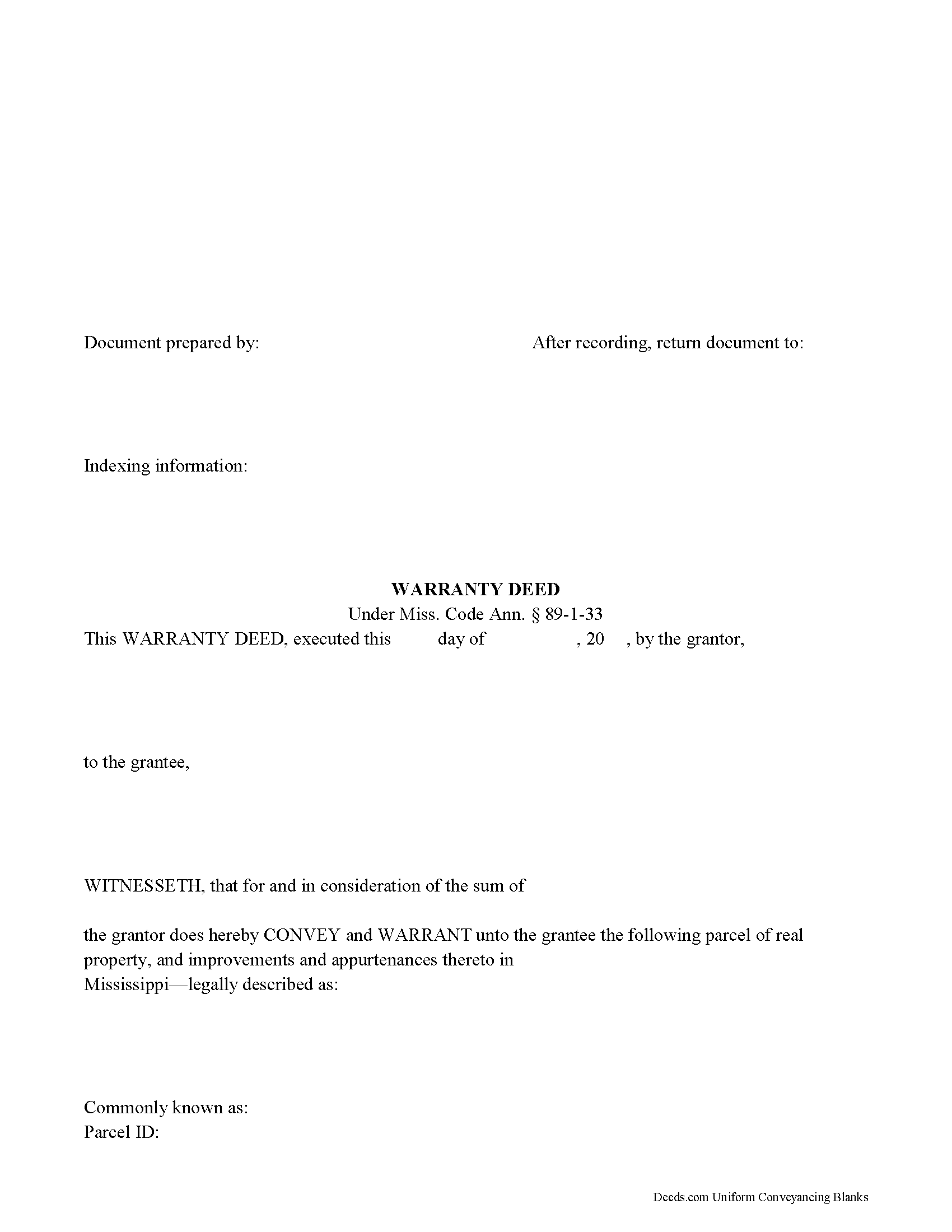
A Mississippi deed takes its character from the words inside it rather than from the caption at the top of the page. Section 89-1-33 of the Mississippi Code loads five common law covenants onto the single unrestricted word warrant; Section 89-1-35 cuts the promise back to claims by, through, or under the grantor once the word specially is inserted; Section 89-1-37 leaves a conveyance without warranty operating as a quitclaim. This Mississippi warranty deed prints the unrestricted phrase drawn from the state's statutory short form, conveys and warrants, and leaves the party lines open for the names, marital status recitals, and vesting words the filler supplies.
Two words, five covenants
Section 89-1-61's short form of conveyance is spare: consideration, the phrase convey and warrant, the grantee, the land. Section 89-1-33 does the work behind it: warrant without restrictive words embraces all five common law covenants, seizin, power to sell, freedom from incumbrance, quiet enjoyment, and warranty of title. The Supreme Court of Mississippi quoted that provision in Ferrara v. Walters when it held sellers to a contract calling for a warranty deed. Those covenants reach the whole chain of title rather than the grantor's own years of ownership. The exceptions block on the form is where the promise stops: current year taxes, recorded easements and restrictions, mineral reservations, and any surviving lien are listed there, because an encumbrance left off the list is one the covenant reaches.
One deed, one or two owners on each side
The form is the general configuration of this deed type. Its grantor block is an open field that receives one or two natural persons signing in their own capacity, its grantee block receives one or two names along with any co-ownership designation, and nothing about status, capacity, or vesting is preprinted anywhere on the instrument. Two signature blocks and two acknowledgment certificates follow the operative section; a deed signed by one grantor leaves the second block and certificate blank. That second block also answers a hard Mississippi rule: under Section 89-1-29 a conveyance of a homestead by an owner who is married and living with a spouse is not valid or binding without the spouse's signature, a defect the state's courts treat as fatal rather than curable. The form is not set up as an entity or trustee conveyance, a deed executed under a power of attorney, or an instrument for three or more owners on a side; each of those recites a different capacity and signature architecture.
Survivorship is drafted, never assumed
Section 89-1-7 reverses the expectation many buyers carry into a closing. A conveyance to two or more people, including a conveyance to a married couple, creates a tenancy in common unless joint tenancy or tenancy by the entirety with right of survivorship manifestly appears in the instrument. Survivorship here is a drafting act, so the grantee line is where it lives or fails to, and the guide sets out each form Mississippi recognizes and the words that create it.
A first page written by statute
Deeds are recorded with the chancery clerk of the county containing the land; under Sections 89-5-1 through 89-5-5 the deed is good between the parties from delivery, while filing time controls against later purchasers and creditors. Section 89-5-24 reserves the top three inches of page one for the clerk and then names what sits below that margin on the same page: the preparer's name, address, and telephone number, the name, mailing address, and telephone numbers of every grantor and grantee, the return address, the title, and the indexing instruction or legal description. The form lays out its first page to that list, with the sectional indexing instruction Section 89-5-33(3) wants distinctly set apart placed on page one and the legal description following. Section 27-3-51 lets the clerk refuse a deed missing either side's address and telephone data. Section 25-7-9 sets recording at twenty five dollars for five pages and a dollar per added page, and no transfer tax or transfer declaration attaches to an ordinary Mississippi deed.
Three files arrive with the purchase: the blank deed as a fillable PDF, a completed example worked through a DeSoto County conveyance, and a plain language guide taking up the statutory framework, every numbered blank, the co-ownership choices open to grantees, the signing rules, and the recording counter. All of it describes Mississippi law at a general level and none of it is legal advice; a Mississippi attorney can apply these statutes to a particular title or transaction.
Important: County-Specific Forms
Our warranty deed forms are specifically formatted for each of the 82 counties in Mississippi.
After selecting your county, you'll receive forms that meet all local recording requirements, ensuring your documents will be accepted without delays or rejection fees.