Missouri Beneficiary Deed (Sole Owner, Primary and Contingent Beneficiary)
County or Independent City Specific Legal Forms Validated as recently as November 10, 2026 by our Forms Development Team
About the Missouri Beneficiary Deed (Sole Owner, Primary and Contingent Beneficiary)
How to Use This Form
- Select your county or independent city from the list
- Download the county or independent city-specific form
- Fill in the required information
- Have the document notarized if required
- Record with your county or independent city recorder's office
What Others Like You Are Saying
"Easy Peasy. Great experience."
"Still in process, but it is well explained. I would recommend it to anyone in Texas."
"Very helpful information and great forms."
"5 stars...thanks for your fast and professional assistance. Charles"
"Was insecure about being able to access the information but pleasantly found that the site was easy …"
4.8/5 from 4,848 reviews. Read all
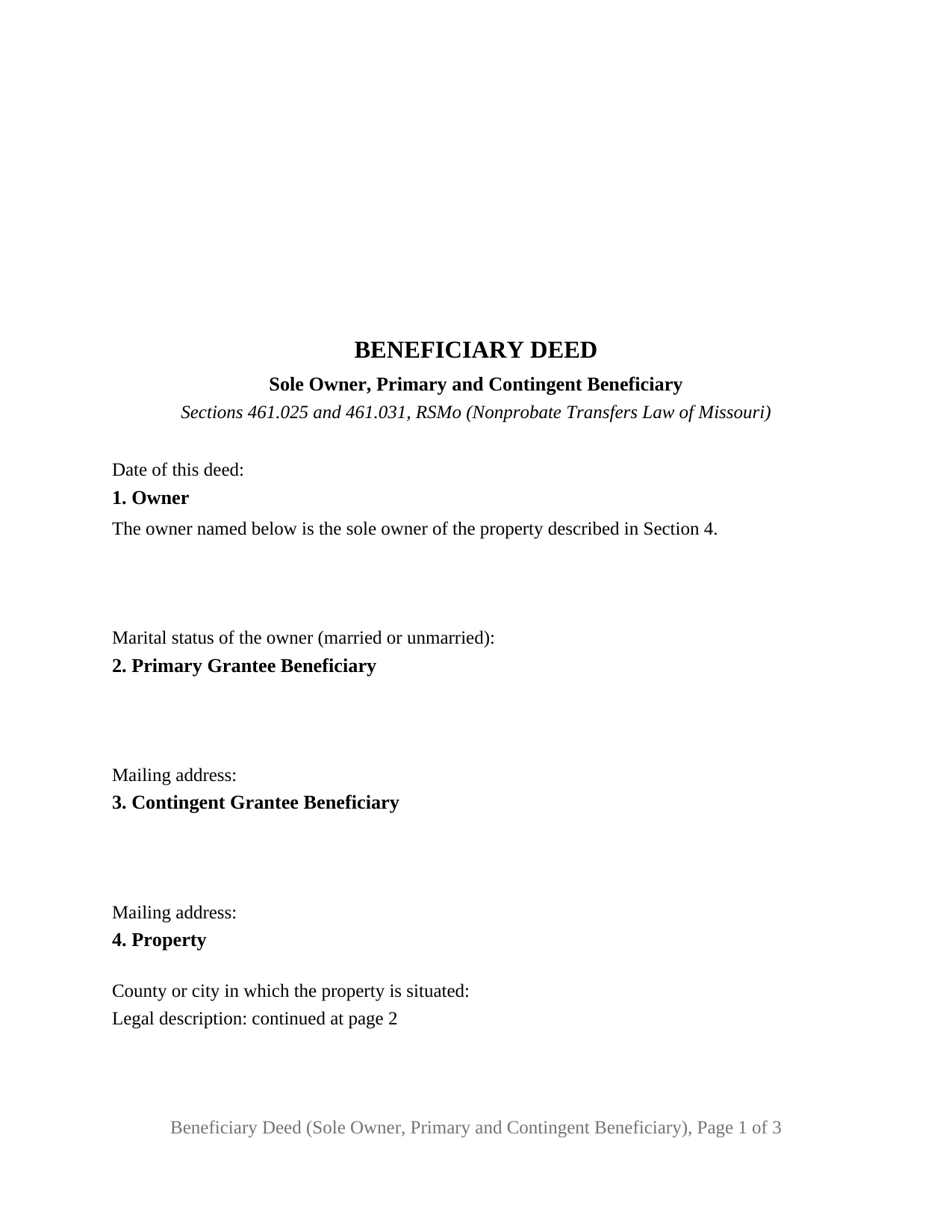
A Missouri beneficiary deed lets one owner of real estate name who takes the property at death, outside probate, while giving up nothing during life. This form prepares that deed for one owner who holds title alone and who names two people in sequence: a primary grantee beneficiary, and a contingent grantee beneficiary who takes only if the primary does not survive. The deed states, in the words Section 461.025 of the Missouri Revised Statutes requires, that it is not to take effect until the death of the owner.
A deed that waits, with a named backup
The Nonprobate Transfers Law of Missouri, Chapter 461, RSMo, has recognized the beneficiary deed since 1989. The owner signs and records the deed now; the grantee beneficiary has no rights in the property until the owner dies, and the owner's signature alone is enough for any sale, mortgage, or lease in the meantime (Section 461.031). At death the property passes by operation of law to the grantee beneficiary who takes under the deed. What distinguishes this configuration is the second name. Section 461.062.3 provides that a beneficiary designation may name one or more primary beneficiaries and one or more contingent beneficiaries, and that if no primary beneficiary or lineal descendant substitute survives, the property belongs to the surviving contingent beneficiaries. The deed recites exactly one of each, and its operative section states the order in which they take, so a primary beneficiary's death before the owner does not send the property back into the owner's estate by default.
One owner, one signature, one marital status line
The form identifies one owner as the sole owner of the described property and carries one signature block and one acknowledgment certificate. The marital status line on the first page, completed with the word married or unmarried, is the statement Section 442.130.2, RSMo, draws from every natural person who signs a Missouri conveyance, and Missouri recorders look for it on page one. The acknowledgment certificate is the statutory short form of Section 442.210, with the appearance designation that Section 442.145.2 has every acknowledging officer make, whether the owner appeared in person or by communication technology. The guide walks through the Missouri statutes that bear on a married owner's deed, including the homestead rule of Section 513.475 and the marital rights rule of Section 474.150, as statutory text, described and not applied.
What the contingent grantee beneficiary does
Missouri writes the substitution rules into the statute rather than the deed. Under Section 461.045, a beneficiary who is a lineal descendant of the owner and who does not survive is replaced by that beneficiary's own lineal descendants per stirpes unless the deed carries the notation no LDPS after the name; a beneficiary who is not a lineal descendant gets the same substitution only when the deed adds LDPS or the words and lineal descendants per stirpes. The contingent grantee beneficiary named in Section 3 of this deed takes when neither the primary grantee beneficiary nor any lineal descendant substitute survives the owner, and if no grantee beneficiary survives at all, the property belongs to the owner's estate under Section 461.031.5. A beneficiary survives only by living one hundred twenty hours past the owner (Section 461.042). The guide describes each of these rules against the completed example, in which a Columbia homeowner names her son as primary grantee beneficiary and her niece as contingent grantee beneficiary.
Recorded before death, or nothing
A Missouri beneficiary deed works only if it is executed and filed of record with the recorder of deeds in the city or county where the property is situated before the owner's death; the statute says so, and the deed carries that condition in capital letters above the signature. The first page is laid out to the recorder's statute, Section 59.310.2, RSMo: title, date, the owner's name and marital status, both grantee beneficiaries' names and mailing addresses, and the county appear below the three inch recording margin, and the first page states that the legal description continues at page 2, which is the overflow rule the statute itself supplies. The page size, type size, and margins follow the Chapter 59 standards, so the document arrives at the counter as a standard document rather than one that draws the nonstandard fee.
What this configuration is, and is not, set up as
The deed recites a single record owner conveying the whole of that owner's interest, with one primary and one contingent grantee beneficiary, each of whom may be a person, a trust, or an entity. A widow planning for an adult child with a niece as the fallback, or an unmarried owner naming a partner and then a sibling, present the sequence this deed recites. The form is not set up as a deed of two owners, whom Chapter 461 treats as joint owners with their own revocation and survivorship rules, nor for an owner signing through an attorney in fact, nor for a designation of several primary or several contingent beneficiaries sharing by percentage. It carries no warranty of title, conveying with the word conveys rather than the statutory covenant words of Section 442.420, and the beneficiary takes subject to every lien and encumbrance of record under Section 461.039.
Missouri has no statewide transfer tax and no official beneficiary deed form; some recorders collect a county certificate of value with a deed, and the guide describes which ones publish that requirement. After the owner's death the property passes by operation of law, and Missouri practice places evidence of the death in the land records through an affidavit with a certified death certificate, a document prepared and recorded separately and not included in this package. The package includes the fillable beneficiary deed, a completed example filled in for a Boone County fact pattern, and the guide that walks through every section, the signing and acknowledgment rules, and the recording process. This description and the guide describe the form and the governing Missouri statutes in general terms; they are not legal advice.
Important: County or Independent City-Specific Forms
Our beneficiary deed (sole owner, primary and contingent beneficiary) forms are specifically formatted for each of the 115 county or independent cities in Missouri.
After selecting your county or independent city, you'll receive forms that meet all local recording requirements, ensuring your documents will be accepted without delays or rejection fees.