Missouri Beneficiary Deed (Married Owners, Tenancy by the Entirety, Last Survivor)
County or Independent City Specific Legal Forms Validated as recently as November 10, 2026 by our Forms Development Team
About the Missouri Beneficiary Deed (Married Owners, Tenancy by the Entirety, Last Survivor)
How to Use This Form
- Select your county or independent city from the list
- Download the county or independent city-specific form
- Fill in the required information
- Have the document notarized if required
- Record with your county or independent city recorder's office
What Others Like You Are Saying
"I have yet to have my Certification of Trust notarized nor have I gone to my bank to see if it's acc…"
"Forms were not to hard to fill out, Will go to Douglas County Oregon Recorders office in a few weeks…"
"7 stars!"
"Downloading the forms I needed was quick and helpful."
"Quick, easy, well-priced, and I have the forms that I need. PDFS download easily and are fillable! T…"
4.8/5 from 4,850 reviews. Read all
A Missouri beneficiary deed signed by both spouses does something a deed by one owner cannot: it names who takes the family home after both of them are gone, in one recorded instrument, and it leaves the surviving spouse's title untouched at the first death. This form prepares that deed for exactly two owners who are married to each other and hold Missouri real property as tenants by the entirety, under Sections 461.003 to 461.081, RSMo, the Nonprobate Transfers Law of Missouri.
A deed that waits for the second death
Missouri's chapter builds the two-death timing into its definitions rather than leaving it to the drafter. Section 461.005(5) defines joint owners to include a husband and wife who hold property as tenants by the entirety, and Section 461.005(3) provides that for joint owners the death of the owner means the death of the last surviving owner. The deed carries the statute's own required statement, that it is not to take effect until the death of the owner, and recites that the owners are joint owners within the meaning of Section 461.005, so the one sentence the chapter requires resolves to the second death. While either spouse lives, the tenancy by the entirety controls: Section 461.031.2 provides that on the death of one joint owner the property belongs to the surviving joint owner. The beneficiaries take nothing at the first death and, under Section 461.031.3, take by operation of law at the second.
Two spouses, one estate, two signatures
Tenancy by the entirety is the estate Missouri presumes when a deed conveys to spouses together, and each spouse is seized of the whole. The deed therefore recites both spouses as the owners, married to each other and holding as tenants by the entirety, and both sign. The recital also serves Section 442.130.2, RSMo, which has every natural person who executes a conveyance state whether married or unmarried; here the statement is fixed deed text rather than a blank. The form carries a separate acknowledgment certificate for each spouse, so the two acknowledgments may be taken on different dates or before different notaries. Each certificate uses the short form of Section 442.210.1(1), RSMo, and carries the appearance-mode designation Section 442.145.2 has the officer make on every Missouri acknowledgment, stating whether the signer appeared in person or by communication technology.
Revocation takes both spouses while both live
Under Section 461.033.1, a revocation or change of a beneficiary designation involving property of joint owners may only be made with the agreement of all owners then living. One spouse acting alone cannot quietly undo a recorded designation while the other lives; after one spouse's death, the survivor may revoke or change it alone. A will does not revoke a beneficiary deed under Section 461.033.4, and a lifetime transfer of the property terminates the designation under Section 461.033.5. The deed states its revocability on its face, in capital letters, beside the condition that matters most: it is effective only if it is executed and filed of record with the recorder of deeds where the property is situated before the death of the last surviving owner. The condition is measured against the death of the owner, which for these joint owners is the death of the last surviving owner; a deed recorded only after both spouses have died transfers nothing under Section 461.025.1.
What the beneficiary block carries
The grantee beneficiary block names who takes at the second death, with a mailing address for each, and it accepts the designations Chapter 461 recognizes: a natural person by full name, a trust through its trust estate or trustee, which Section 461.025.1 permits whatever the trust's revocability, or an entity capable of owning property. The abbreviation LDPS after a name invokes the lineal descendants per stirpes substitution of Section 461.045 for a beneficiary who is not the owners' descendant, and the words no LDPS negate it for one who is. Contingent beneficiaries follow the words contingent beneficiaries, and shares may be stated as percentages or fractions; without stated shares, multiple beneficiaries share equally under Section 461.062.3(5), and surviving beneficiaries hold as tenants in common unless the designation expressly provides for survivorship among them. An individual beneficiary takes only on surviving the last owner by one hundred twenty hours under Section 461.042. The guide describes each of these conventions with the statutory default that applies when the block says nothing.
Built for the Missouri first page
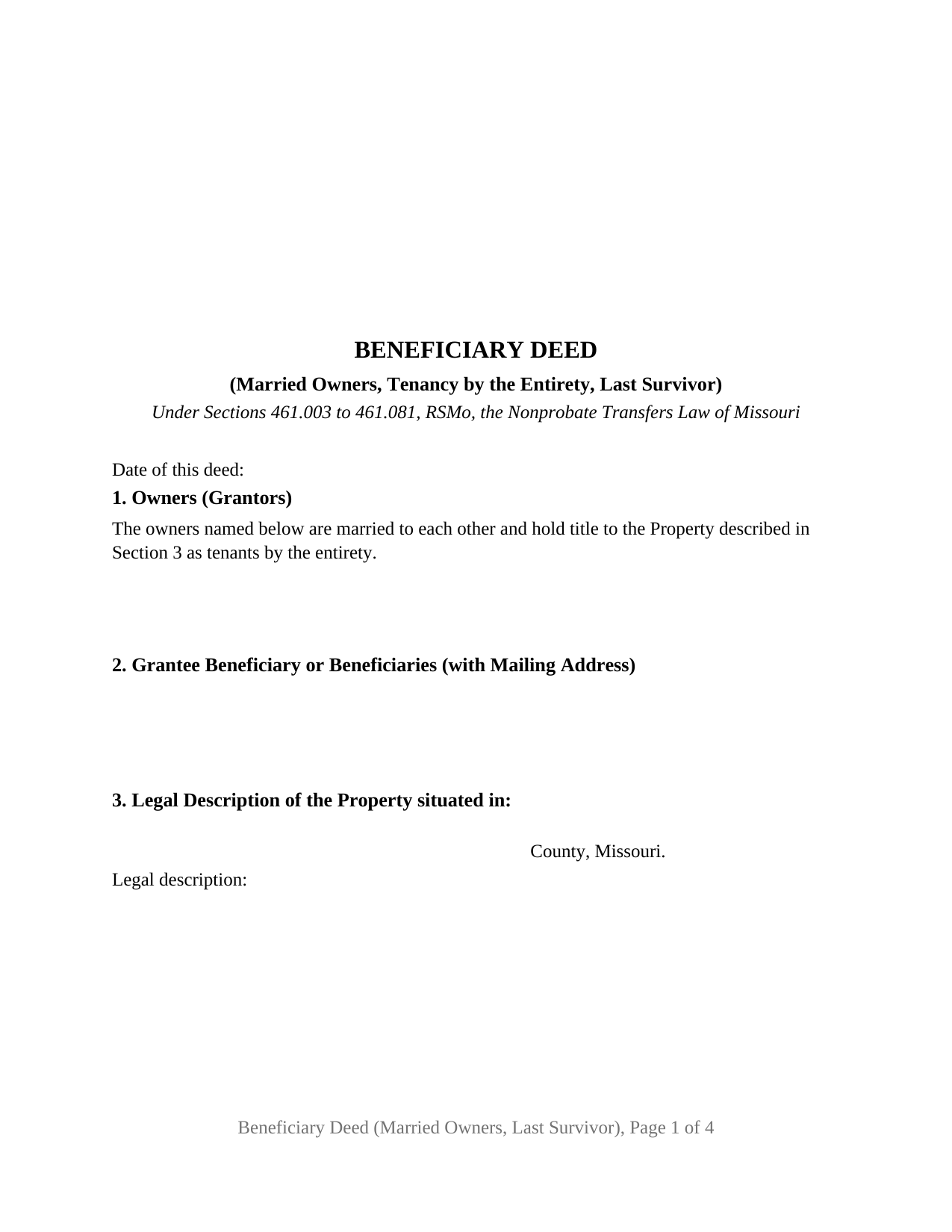
Section 59.310.2, RSMo, requires a recorded document to carry the title, the date, the grantors' names and marital status, the grantees' names, any statutory addresses, and the legal description on its first page below the three inch recording margin. The first three sections of this deed place every one of those items on page one, with the owners' fixed marital-status recital, the grantee beneficiaries' names and mailing address, and the legal description all above the page break. The street address, parcel number, operative transfer language, and both signature blocks follow on page two, and the two acknowledgment certificates and the return and preparer blocks complete a four-page instrument.
The configuration this deed recites
The form recites exactly two record owners, married to each other, holding the whole property as tenants by the entirety, each signing in an individual capacity. A couple who took title together by a deed naming them both as husband and wife, and who want the property to pass to their children or to a trust after both have died without a probate administration, present the pattern this deed recites. The form is not set up as a deed by one owner, married or unmarried; as a deed by co-owners who are not married to each other, even where their title carries a right of survivorship; as a deed by tenants in common, whose title the chapter's last-survivor rule does not reach; or as a deed by a trustee, an entity, an attorney in fact, or three or more owners. Divorce changes the pattern after recording: a dissolution converts the former spouses' entirety into a tenancy in common under Missouri case law, and Section 461.051 revokes a designation in favor of a former spouse or the former spouse's relatives, subject to the exceptions it states. The deed conveys without covenant or warranty of title, and the beneficiaries take subject to every lien and matter of record at the last owner's death; Section 461.300 keeps the transferred property within reach of statutory allowances and unpaid claims through an action for accounting brought within eighteen months after death.
The package includes the fillable beneficiary deed, a completed example filled in for a Greene County fact pattern, and the guide that walks through every numbered section, the signing and acknowledgment rules, the recording condition, and the post-death steps. The guide and this description explain the form and the Missouri statutes in general terms and are not legal advice.
Important: County or Independent City-Specific Forms
Our beneficiary deed (married owners, tenancy by the entirety, last survivor) forms are specifically formatted for each of the 115 county or independent cities in Missouri.
After selecting your county or independent city, you'll receive forms that meet all local recording requirements, ensuring your documents will be accepted without delays or rejection fees.