Missouri Beneficiary Deed (Sole Owner, Multiple Beneficiaries (Equal Shares))
County or Independent City Specific Legal Forms Validated as recently as November 10, 2026 by our Forms Development Team
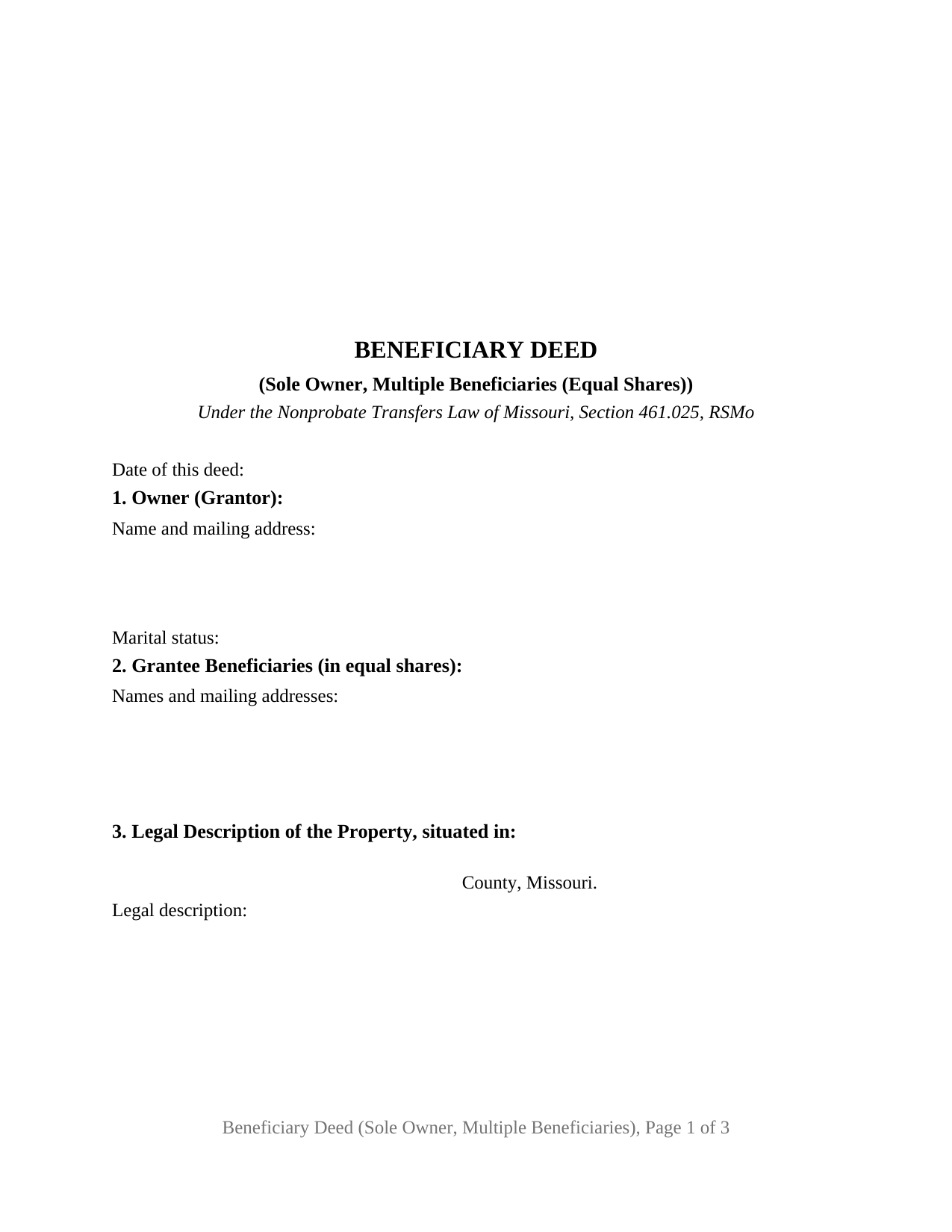
About the Missouri Beneficiary Deed (Sole Owner, Multiple Beneficiaries (Equal Shares))
How to Use This Form
- Select your county or independent city from the list
- Download the county or independent city-specific form
- Fill in the required information
- Have the document notarized if required
- Record with your county or independent city recorder's office
What Others Like You Are Saying
"It provided the forms I could not find elsewhere. Thank you."
"Very clear and complete. Good value."
"I wish all the forms had been in a downloadable package so that it wasn't so difficult to make sure …"
"Easy, quick and very proficient. I am glad I used Deeds."
"So far, this is working well. However, I don't see a form to change name due to marriage."
4.8/5 from 4,850 reviews. Read all
One Missouri owner, several people to take the home, and an equal division among them: that is the pattern this beneficiary deed recites. The owner signs alone as the sole owner of the property, names two or more grantee beneficiaries, and the deed itself states that they take in equal shares. Nothing changes hands while the owner lives. At the owner's death the property passes to the named beneficiaries by operation of law, outside probate, under Section 461.025 of the Revised Statutes of Missouri, the beneficiary deed section of the Nonprobate Transfers Law.
A deed that waits, in the words the statute asks for
Section 461.025 defines the instrument by one sentence it must contain: the deed expressly states that it is not to take effect until the death of the owner. This form carries that statement verbatim, together with the companion statement from Section 461.031 that on the owner's death the interest passes by operation of law to the grantee beneficiaries. Missouri adds two features that distinguish its beneficiary deed, sometimes searched as a transfer on death deed or TOD deed, from an ordinary gift. The deed need not be supported by consideration, and it need not be delivered to the beneficiaries; what it needs instead is a recording stamp. Section 461.025.1 transfers the property at death only if the deed was executed and filed of record with the recorder of deeds of the county or city where the property lies before the owner died. A beneficiary deed found in a desk drawer after the funeral transfers nothing, which is why the form prints the recording requirement in capital letters directly above the signature.
Equal shares, and what Missouri does when a beneficiary dies first
The equal division the deed recites is also the division Section 461.062.3(5) supplies on its own when no percentage or fractional share is stated, so the deed and the chapter agree. What the chapter adds, and the guide walks through, is the sequence of defaults that follow. Each beneficiary takes only by surviving the owner by one hundred twenty hours under Section 461.042. After the owner's death the surviving beneficiaries hold their separate interests as tenants in common, with no survivorship among them, because Section 461.031.4 provides that result unless the designation expressly says otherwise, and this deed does not. Where a beneficiary who is a lineal descendant of the owner, such as a child, dies before the owner, Section 461.045.1 passes that beneficiary's share to the beneficiary's own descendants per stirpes unless the deed carries the notation no LDPS after the name; for a beneficiary who is not a descendant, the same substitution happens only where the deed adds LDPS after the name. Where no substitute takes, the share belongs to the surviving named beneficiaries in proportion to their shares, and where no beneficiary survives at all, the property belongs to the owner's estate. The beneficiaries take subject to any mortgage, lien, or easement the owner left in place, under Section 461.039.
Revocable for life, and not by will
Section 461.033 keeps the designation revocable during the owner's lifetime. A later recorded beneficiary deed revokes the earlier one unless it says otherwise, and a sale or other lifetime transfer of the property ends the designation as to the property transferred. A will does not revoke a beneficiary deed unless the deed itself reserves that right, and this form reserves none, so a later will that says something different does not displace a recorded beneficiary deed. An agent under a power of attorney may make, revoke, or change the designation only where the power or a court order expressly authorizes it, under Section 461.035.
The configuration this form recites
The form fixes one owner, identified by name and mailing address, with the married-or-unmarried statement Section 442.130.2 requires of every natural person who executes a Missouri conveyance entered as a fact on its own line. Section 6 recites that the owner is the sole owner of the property and conveys as the sole owner, and Section 2 names the grantee beneficiaries with the words in equal shares printed in its heading. One signature block and one acknowledgment certificate follow. The certificate is the Missouri statutory short form of Section 442.210, and it ends with the designation line Section 442.145.2 places on every Missouri acknowledgment, where the officer states whether the owner appeared by physical presence or by communication technology. A widowed parent passing the family home to three adult children, as the completed example shows, and a single owner dividing a rental property equally among siblings, present the pattern this deed recites. The form is not set up as a deed by two owners, a deed by a trustee or an attorney in fact, a deed to a single beneficiary, a deed stating unequal percentage shares, or a deed naming contingent beneficiaries; each of those changes what the recordable page says.
Built for the Missouri recorder's first page
Missouri's recording statute, Section 59.310.2, places specific information on the first page of a recorded document below a three-inch top margin reserved for the recorder: the title, the date of the document, the grantor's name and marital status, the grantees' names, any statutory address, and the legal description. This form is laid out so each of those items sits on page one, with the grantee beneficiaries' mailing addresses satisfying the grantee-address rule of Section 59.330.2, and the return and preparer blocks placed at the end where they belong to no statutory inventory. The document uses a 12-point body, well above the 8-point minimum, with three-quarter-inch margins on every other side, and it carries no Social Security or account numbers, which Section 59.331 excludes from recorded documents. Three recording offices, St. Charles County, St. Louis County, and the City of St. Louis, publish a certificate of value presented with a deed at recording, and the guide describes those county filings and the City's additional first-page and signature expectations.
The package includes the fillable beneficiary deed, a completed example filled in for a realistic Boone County fact pattern, and the guide that walks through every numbered section, the signing and acknowledgment rules, and the recording process. This description and the guide describe the form and the governing Missouri statutes in general terms; they are not legal advice.
Important: County or Independent City-Specific Forms
Our beneficiary deed (sole owner, multiple beneficiaries (equal shares)) forms are specifically formatted for each of the 115 county or independent cities in Missouri.
After selecting your county or independent city, you'll receive forms that meet all local recording requirements, ensuring your documents will be accepted without delays or rejection fees.