Montana Quitclaim Deed (Corrective)
County Specific Legal Forms Validated as recently as August 28, 2026 by our Forms Development Team
About the Montana Quitclaim Deed (Corrective)
How to Use This Form
- Select your county from the list
- Download the county-specific form
- Fill in the required information
- Have the document notarized if required
- Record with your county recorder's office
What Others Like You Are Saying
"Saves a trip to the Recorders Office!"
"Thanks so much for all your help! That was painless."
"Great service ! Hawaii is not a "forms state" so unfortunately the public has no way to ge…"
"Easy to use & got my one question answered in less than 5 minutes! Excellence."
"Easy to find the form I needed. And the instructions helpful on how to fill out the form."
4.8/5 from 4,815 reviews. Read all
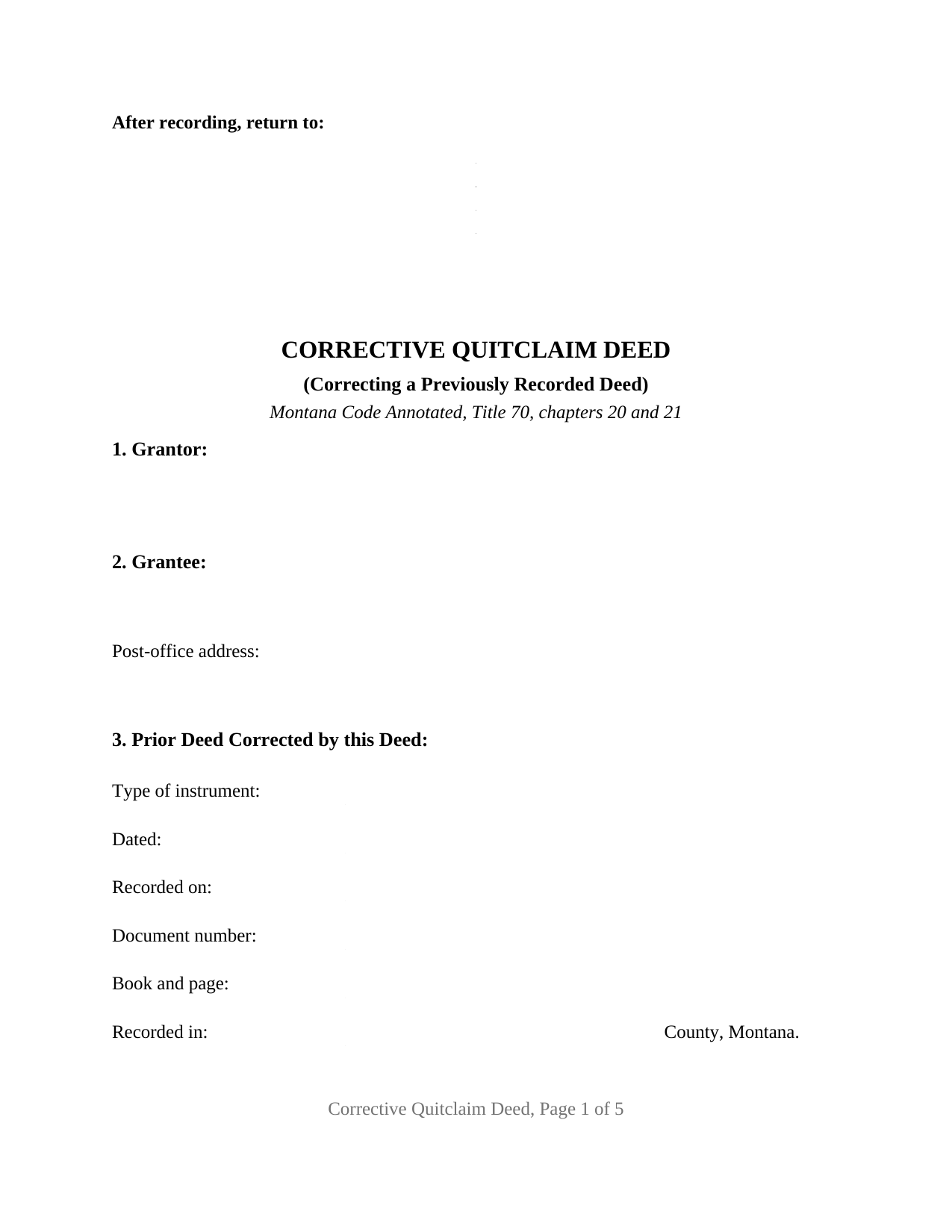
Montana closes the shortest route to fixing a recorded deed. Under Montana Code Annotated Section 70-20-110, redelivering a grant of real property to the grantor or canceling it does not operate to retransfer the title. The deed with the mistake in it stays where it is; what changes is that a second instrument goes in behind it. This Montana corrective quitclaim deed, also searched as a correction deed, is that second instrument: it identifies the recorded deed being corrected, sets the matter that deed states beside the matter as corrected, and quitclaims to the same grantee whatever right, title, and interest the grantor holds.
Two versions of the same line, in one place
Three sections do the corrective work. Section 3 pins the earlier deed down by six entries: instrument type, date signed, date recorded, document number, book and page, and county. Section 6 states the matter as the recorded deed states it, Section 7 states that matter as corrected, and Section 4 carries the legal description in corrected form. Nothing is quietly swapped; both versions sit in the record. Section 7-4-2613(2) is what lets one recorded instrument point at another, allowing an instrument that qualifies for recording to incorporate by reference language contained in another properly recorded instrument in the same county.
The grantor signs, and the grantee gets a line too
The form is configured for the two people the earlier deed named: one grantor and one grantee, repeated as that deed wrote them, which keeps both instruments in one chain. Section 10 carries a signature block for the grantor and a second, labeled joinder block for the grantee, each followed by its own acknowledgment certificate on the Montana short form at Section 1-5-610. The joinder conveys nothing, and the deed says so; it puts the grantee's agreement with the stated correction into the record beside the grantor's. Corrections appearing on Montana instruments of this kind include a grantee surname misspelled by a letter, a missing suffix or middle initial, and a plat or certificate of survey reference typed wrongly. The form is not set up for a correction to a deed signed by two co-owners, by an entity through an officer or manager, by a trustee, or by an attorney-in-fact.
Nothing promised about the title
Montana loads its implied deed covenants onto one verb. Section 70-20-304 attaches two of them to a fee conveyance made with the word grant unless express terms restrain them, and the operative section here never uses that verb: the grantor remises, releases, and forever quitclaims, the implied covenants are restrained in terms, and the after-acquired title provision at Section 70-20-302 is closed off. Montana enacted no quitclaim form of its own.
Where a correction stops and a court starts
A corrective deed states what the parties agree about; it adjudicates nothing, because no Montana statute gives one a curative effect by operation of law. That boundary shows in what the form leaves alone. Land cannot be taken back out of the description, since an interest that reached the grantee returns only by a conveyance from the grantee. Parties cannot be added or dropped, and the manner in which grantees hold title cannot be switched. Where the parties do not agree that the earlier deed misstates their intention, Section 28-2-1611 sends the question to a court, which may revise a written instrument so far as that can be done without prejudice to rights acquired by third persons in good faith and for value.
The certificate that need not name a price
Section 15-7-305 keeps the clerk and recorder from accepting an instrument evidencing a transfer until the Realty Transfer Certificate has been received. Corrective instruments have their own line in that statute: Section 15-7-307(5) covers an instrument that, without added consideration, confirms, corrects, modifies, or supplements a previously recorded instrument, and the certificate filed for it need not disclose consideration. A deed recorded on or after October 1, 2025 costs twenty dollars for its first page and ten for every page behind it. One body entry is an acceptance condition rather than a formality: under Section 7-4-2618, an instrument that omits the grantee's post-office address is not received for recording at all.
The package delivers this corrective quitclaim deed as a fillable PDF, a completed example worked through on a Silver Bow County misspelling, and a plain language guide that takes the numbered sections one at a time. The materials are informational and are not legal advice.
Important: County-Specific Forms
Our quitclaim deed (corrective) forms are specifically formatted for each of the 56 counties in Montana.
After selecting your county, you'll receive forms that meet all local recording requirements, ensuring your documents will be accepted without delays or rejection fees.