Montana Quitclaim Deed
County Specific Legal Forms Validated as recently as October 8, 2026 by our Forms Development Team
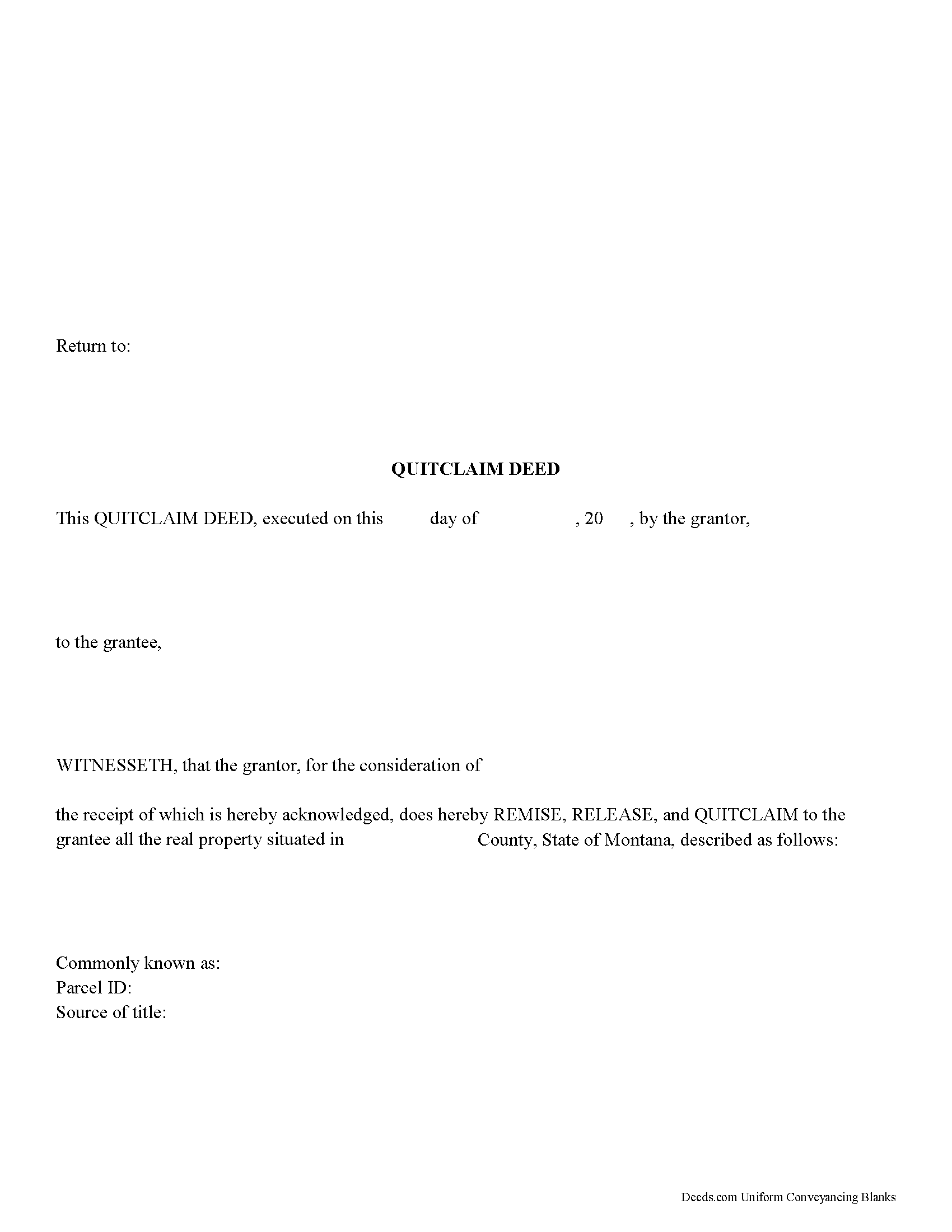
About the Montana Quitclaim Deed
How to Use This Form
- Select your county from the list
- Download the county-specific form
- Fill in the required information
- Have the document notarized if required
- Record with your county recorder's office
What Others Like You Are Saying
"Thanks for the service which was excellent and timely. Instructions were easy to follow and results …"
"This Guys are accurate and FAST, Thanks Staff- KVH.!!!! you were awesome!!"
"very user friendly"
"The service was VERY quick, simple and, easy. I would definetly use this service again."
"This service is fast and easy to use. We will definitely use this service again. Thank you."
4.8/5 from 4,829 reviews. Read all
Montana keeps a rule about names that deed forms rarely mention. Under Montana Code Annotated Section 70-20-109, an owner whose name has changed since taking title sets forth, in the later conveyance, the name in which title was derived, and the section attaches a fifty dollar penalty collected for the county's common schools. This Montana quitclaim deed answers that with open party blocks: the names are written by the parties rather than preprinted by the form, so a former name, a status, or a second owner goes onto the page as the record calls for it.
Names the way the index wants them
The grantor block runs four lines and carries whatever the vesting deed and the intervening years require: two owners, or a formerly known as recital. The grantee block does the same work on the receiving side, with room for the words that fix how two grantees take title. One entry there is an acceptance condition rather than a nicety, because Section 7-4-2618 keeps a deed off the record altogether unless the grantee's post-office address is contained in the instrument.
The covenant word this deed leaves out
Montana ties its implied deed covenants to a single word. Section 70-20-304 provides that a conveyance passing a fee or possessory title with the word grant implies two covenants and no others, unless the instrument restrains them in express terms: one against the grantor's own earlier conveyance of the same estate, and one against encumbrances the grantor made or suffered. The operative sentence of this quit claim deed never reaches for that word. Each grantor remises, releases, and forever quitclaims; the implied covenants are restrained on the face of the deed; and the instrument states that it does not purport to grant the property in fee simple within the meaning of Section 70-20-302, so a title the grantor picks up afterward stays with the grantor. No statutory quitclaim form exists in Montana, and the state's Supreme Court reads a deed's character from the document as a whole.
How two grantees take title
The grantee designation matters more here than the phrase suggests. Section 70-1-314 makes an interest created in favor of several persons an interest in common unless it is acquired in partnership or declared a joint interest under Section 70-1-307, so a deed naming two grantees and saying nothing else leaves them holding as tenants in common. Survivorship takes two statutes: Section 70-1-307 asks for the joint tenancy to be expressly declared, and Section 70-20-310 gives the right of survivorship effect by virtue of the grant that contains it.
The configuration: one or two names on each side
The form recites natural persons signing in their own right, in any of four counts: one grantor to one grantee, one to two, two to one, and two to two. Section 9 carries two signature blocks, and an acknowledgment certificate on the Montana short form at Section 1-5-610 follows each of them, so signers may appear on different days or before different officers; on a single-grantor conveyance the second block and its certificate are left blank. Nothing about marital status, ownership status, or the form of co-ownership is preprinted anywhere on the instrument, which is what lets one document carry a sole owner and a pair of co-owners without a checkbox. The form is not set up for a signer executing in an entity office, for a trustee or personal representative conveying in a fiduciary capacity, for an agent signing under a power of attorney, or for three or more owners on either side.
What the recording counter looks for
Page one reserves its top three inches for the stamp and prints the return name and address in the upper left corner, where Section 7-4-2636 assigns them. Recording costs 20 dollars for a first page and 10 dollars for each page after it, for documents recorded on or after October 1, 2025, with an added 10 dollars where a document departs from the state standards. The Realty Transfer Certificate that Montana asks for with an instrument evidencing a transfer keeps the price information on a confidential filing; it is a Department of Revenue form, prepared separately and not included here.
The download carries this quitclaim deed as a fillable PDF, a completed example worked out for a Lewis and Clark County conveyance in Helena, and a plain language guide covering each numbered section, the statutes behind them, the signing formality, and recording. The materials are informational and are not legal advice.
Important: County-Specific Forms
Our quitclaim deed forms are specifically formatted for each of the 56 counties in Montana.
After selecting your county, you'll receive forms that meet all local recording requirements, ensuring your documents will be accepted without delays or rejection fees.