Montana Quitclaim Deed (Interspousal)
County Specific Legal Forms Validated as recently as September 16, 2026 by our Forms Development Team
About the Montana Quitclaim Deed (Interspousal)
How to Use This Form
- Select your county from the list
- Download the county-specific form
- Fill in the required information
- Have the document notarized if required
- Record with your county recorder's office
What Others Like You Are Saying
"Would be great if you would just put all of these documents into ONE .pdf."
"Easily find and print forms necessary for peace of mind."
"The guide I needed was very easy to understand and the template was easy to complete. I had a proper…"
"Instructions were easy to follow and it was reasonable"
"Sofar very good. Especially an example helps."
4.8/5 from 4,833 reviews. Read all
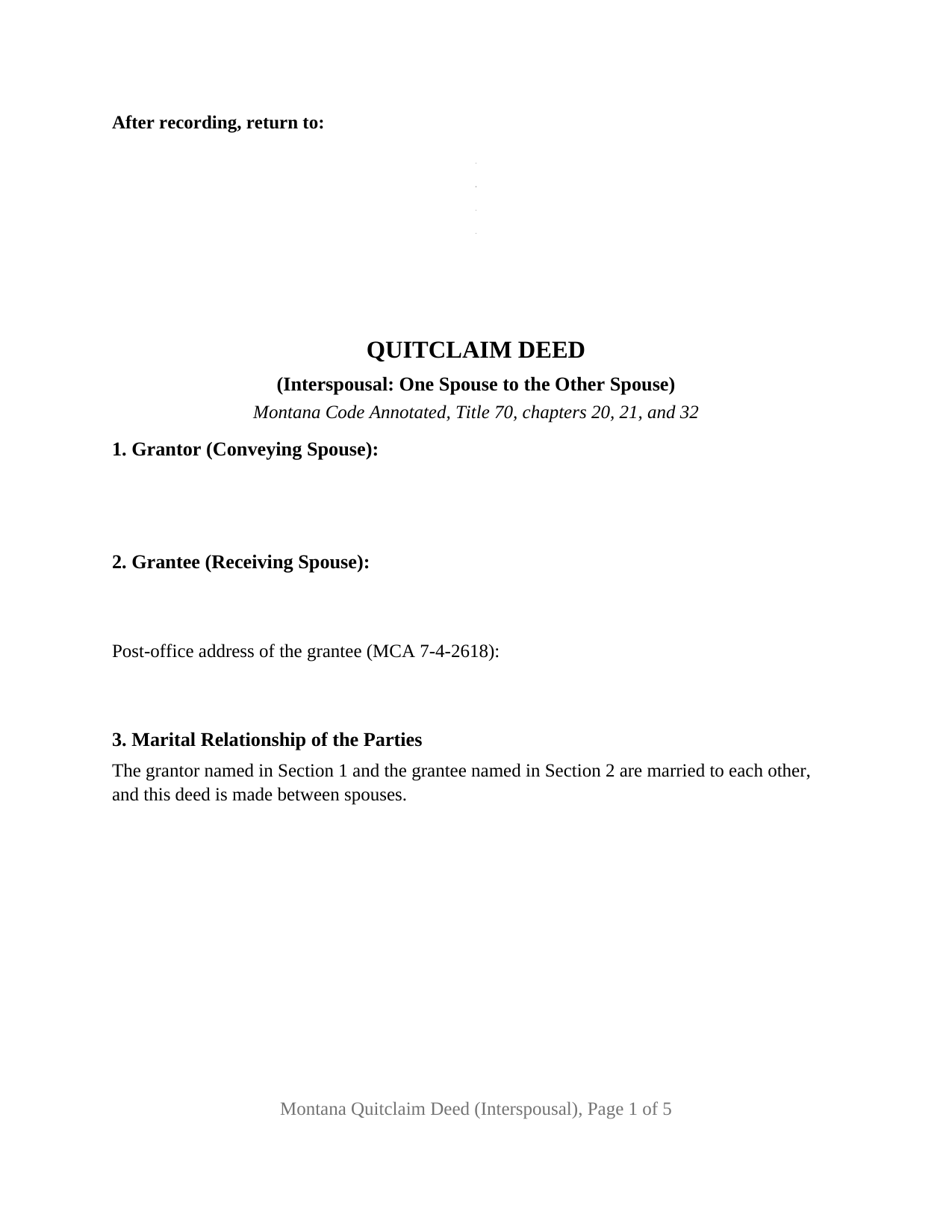
On this Montana quitclaim deed, the spouse who receives the property signs it as well. One spouse is named as grantor and releases whatever right, title, and interest that spouse holds in the described Montana real property. The other spouse is named as grantee, takes that release, and then executes and acknowledges the very same instrument. That second signature hands over nothing. It is on the page because Montana asks for it.
Why the receiving spouse signs
Section 70-32-301 of the Montana Code Annotated will not let a married person's homestead be conveyed or encumbered unless both husband and wife execute and acknowledge the instrument. A Montana homestead is claimed rather than assumed: a declaration is executed, acknowledged, and recorded under Sections 70-32-105 through 70-32-107, and Section 70-32-103 permits a married claimant to pick the homestead out of either spouse's property. A homestead can therefore attach to land whose record title stands in one spouse's name, and the statute's both-spouses formula reaches even a deed running from one spouse to the other. This form settles it the same way every time: each spouse signs and acknowledges on a labeled block of that spouse's own, and the deed says in terms that the grantee spouse parts with no interest by signing.
A release with nothing promised behind it
Montana pins its implied deed covenants to a single word. Under Section 70-20-304, the word grant carries two implied covenants in a fee conveyance: that the grantor has passed the same estate to no one else, and that the estate bears no encumbrance the grantor made or suffered. This deed keeps that word out of its operative sentence. The grantor remises, releases, and forever quitclaims; the instrument disclaims covenant and warranty of title in express terms; and an interest reaching the grantor after delivery stays with the grantor. Montana enacted no quitclaim form to copy, and such a deed's character is read from the document as a whole, the approach the Montana Supreme Court took in Henningsen v. Stromberg. The grantee spouse takes that interest as it stands, deed of trust, tax lien, easement, and plat restriction included.
Two spouses, two certificates, one recorded instrument
The form recites one grantor spouse and one grantee spouse married to each other, a labeled signature block for each, and an acknowledgment certificate after each block, drawn on the Montana short form at Section 1-5-610. Section 3 recites the marriage, Section 8 takes the recording reference for a declaration of homestead standing against the parcel, and Section 11 spells out what the grantee spouse's signature accomplishes and what it does not. Because every signer carries a certificate of its own, the spouses may appear on different days or before different officers; the statutory short form itself accepts one or several named individuals, so the per-signer arrangement is this form's own architecture. Arrangements presenting the pattern in Montana records include a spouse added to title at a closing for financing reasons releasing that interest once the loan is refinanced, a buyout under a marital property agreement that leaves the parcel in one name, and a release that puts a single spouse in a position to convey or encumber the land alone. The form is not set up as a conveyance by two owners to an outside grantee, and a deed signed by a trustee, a personal representative, or an officer of a business entity carries capacity and authority recitals absent from this one.
What the recording counter expects
The deed is recorded with the clerk and recorder of the county holding the land, at the statewide fee of twenty dollars for the first page and ten for every page after it, for documents recorded on or after October 1, 2025. It never arrives alone. Form RTC, the Montana Realty Transfer Certificate, is filed alongside, and Section 15-7-305 keeps the clerk from accepting the deed until that certificate is in hand. Subsection (11) of Section 15-7-307 relieves a transfer between husband and wife made for only nominal actual consideration from stating consideration there, which is why an interspousal deed so often recites love and affection and leaves the dollars to a confidential filing.
The package delivers the interspousal quitclaim deed as a fillable PDF, a completed example prepared on a Cascade County fact pattern with both certificates filled in, and a plain language guide covering every numbered section, the homestead execution rule, notarization, and recording step by step. The materials are informational and are not legal advice.
Important: County-Specific Forms
Our quitclaim deed (interspousal) forms are specifically formatted for each of the 56 counties in Montana.
After selecting your county, you'll receive forms that meet all local recording requirements, ensuring your documents will be accepted without delays or rejection fees.