Nebraska Transfer on Death Deed (Individual Grantor)
County Specific Legal Forms Validated as recently as October 9, 2026 by our Forms Development Team
About the Nebraska Transfer on Death Deed (Individual Grantor)
How to Use This Form
- Select your county from the list
- Download the county-specific form
- Fill in the required information
- Have the document notarized if required
- Record with your county recorder's office
What Others Like You Are Saying
"Extremely convenient for a moderate fee. Will definitely use Deeds.com for my recording needs going …"
"Quick and easy ordering and download. Appreciated that I could get the form that is used in my count…"
"Purchasing the real estate deed form from your platform was a breeze. The form was easy to fill out …"
"Response was timely, even though unsuccessful in locating a requested deed. Deeds very courteously a…"
"The site was quick and easy to find information I needed. It also provided extra paperwork that woul…"
4.8/5 from 4,823 reviews. Read all
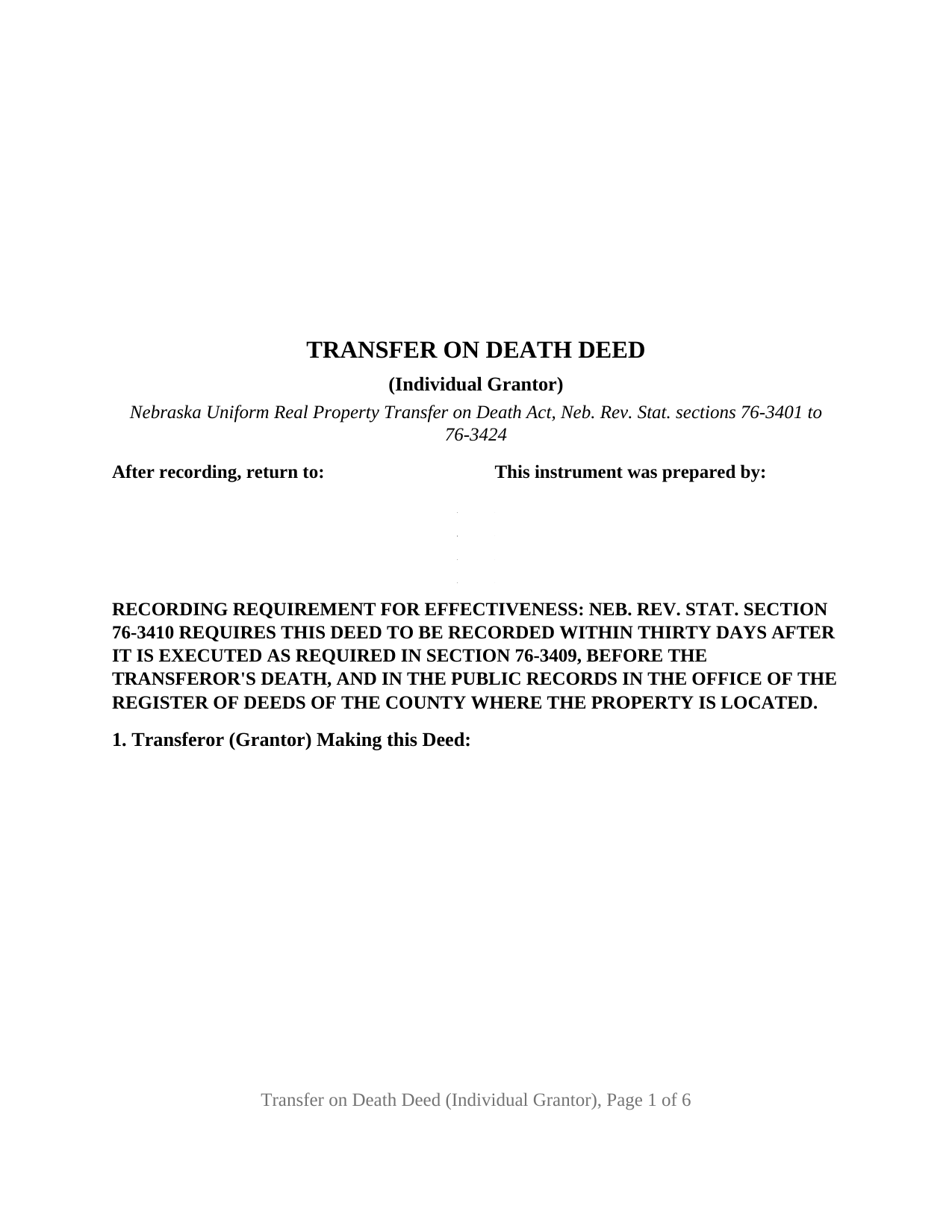
A Nebraska transfer on death deed made by one owner still ends with three sworn signatures on the page. The owner signs as transferor, two disinterested witnesses attest in writing, and a single officer certificate covers all three, in the form Neb. Rev. Stat. section 76-3409 prints. This version of the form recites one individual grantor, one property, and one signature block for the owner, with the two witness blocks and the shared certificate that Nebraska execution law builds around it.
One owner, three signers, one certificate
The single grantor configuration is the pattern behind most Nebraska TOD deeds: a sole record owner naming who receives the land at death. The form carries one transferor block with a printed name line, satisfying the rule in section 23-1503.01(3) that each party's name appear beneath the original signature, and it carries two blocks for the attesting witnesses. Section 76-3402(3) defines a disinterested witness as an individual who is not a designated beneficiary or an heir, a child, or a spouse of a designated beneficiary, so the beneficiary named in the deed cannot hold the pen. One certificate follows the three signature blocks, because the certificate the statute prints recites the instrument as subscribed, sworn to, and acknowledged before the officer by the transferor and subscribed and sworn to before the officer by the witnesses. Its practical effect is that owner and witnesses appear before the same officer on the same occasion. Property held with a joint owner follows a different rule inside the same act, under which the deed of the last surviving joint owner transferor operates; this form recites the single transferor pattern.
A thirty day window that decides whether the deed works
Recording a Nebraska beneficiary deed is not a matter of notice. Section 76-3410 makes recording an element: within thirty days after execution, before the transferor's death, and in the office of the register of deeds of the county where the property lies. A deed signed, witnessed, and sworn but recorded on the thirty-first day has missed a statutory element. The form reserves the top three inches of the first page for the register of deeds and prints the title and return address below it, following sections 23-1510 and 23-1503.01. Two filings that ride with an ordinary Nebraska deed are absent here: a transfer on death deed is exempt from documentary stamp tax under section 76-902, and section 76-214 does not call for a Form 521 when the deed itself is recorded.
The blank for growing crops
Nebraska wrote an agricultural provision into the authorizing section. Under section 76-3405, an owner of agricultural land may designate the disposition of an interest in growing crops, either to the estate or to one or more of the designated beneficiaries, and silence sends that interest to the estate. The form gives that designation its own numbered section, printed with the statutory default, next to the optional blanks for alternate beneficiaries and for special survivorship, share, or beneficiary provisions.
Four warnings the statute writes into the deed
Section 76-3410(b) supplies warning language that appears in the deed itself, and the form prints all four in the statute's own words: Nebraska inheritance taxation of the transferred property, the designated beneficiary's personal liability for medicaid reimbursement and for estate claims, allowances, and administration expenses where the estate falls short, the Department of Health and Human Services revocation point, and the insurance warning LB422 (2025) added for deeds created after September 3, 2025, describing how coverage can end within thirty days after the owner's death.
What the designated beneficiary receives
Under section 76-3415, the interest passes at death to a beneficiary who survives the transferor by one hundred twenty hours unless the deed sets a different period, and it passes subject to the mortgages, easements, contracts, liens, and other interests affecting title at that moment. The same section transfers the property without covenant or warranty of title even where a deed says otherwise, and points divorce or annulment after recording to section 30-2333. During the owner's life, section 76-3414 leaves ownership, the power to sell or mortgage, and creditors' rights untouched.
The package delivers the blank fillable deed, a completed example built on a Lancaster County fact pattern, and a guide covering the eleven numbered sections, the section 76-3409 execution language, and Nebraska recording format and fees. It is a self-preparation product and is not legal advice.
Important: County-Specific Forms
Our transfer on death deed (individual grantor) forms are specifically formatted for each of the 93 counties in Nebraska.
After selecting your county, you'll receive forms that meet all local recording requirements, ensuring your documents will be accepted without delays or rejection fees.